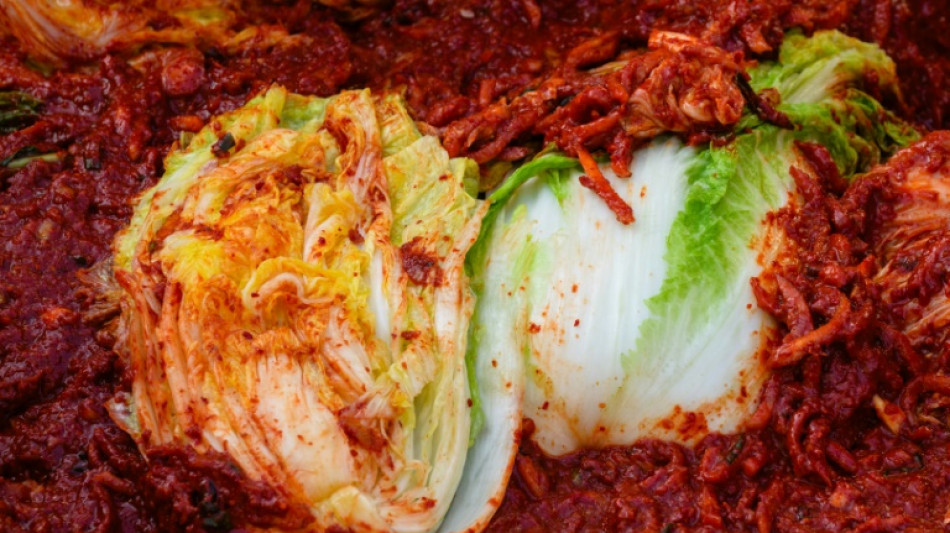
Kimchi threat as heatwave drives up South Korea cabbage prices / Photo: ANTHONY WALLACE - AFP/File

 Kenya's economy faces climate change risks: World Bank

 Tech rebound fuels record-breaking rally in South Korean stocks
 Cables and cooling bring AI windfall to Indian suppliers

 Anthropic's models gained unauthorized 'real-world' access during testing

 Apple tops estimates in CEO Cook's final quarter, but shares fall

 Milei demands expulsion of foreigners expressing 'hate' against Argentina

 Italy's Po River valley on drought alert

 Prada profits pinched as growth hard to chase

 Stocks climb on earnings and rates, oil retreats

 US economic growth slows in second quarter, missing expectations

 Russia adds Telegram founder Durov to 'terrorist' blacklist

 Stocks diverge on earnings, as oil steadies

 Eurozone economy grows despite Middle East war

 Singapore group will develop 'most promising' Ebola vaccine

 Shell profit surges as Mideast war fuels oil prices

 Car maker Stellantis says back in profit in second quarter

 Samsung quarterly operating profit up 1,800% on AI boom

 South Korean stocks bounce after rout, oil holds gains on Mideast woes

 South Korea's women web sleuths fight AI deepfake porn
 Anything but programmable: New cost-efficient EC-power-supply-series for the DIN rail by CAMTEC PS
 Meta misses profit expectations, sticks to massive AI spending

 Campari - king of the spritz - hopes to conquer American heartland

 Air France-KLM and Lufthansa bid for Portugal's TAP airline

 Profits soar at Airbus as it delivers more planes

 Rheinmetall shares surge after armsmaker reports record profit

An unprecedented heat wave across South Korea has driven up the price of cabbages, data revealed Friday, with the vegetable used in the famed national dish kimchi surging by nearly 70 percent year-on-year.
The price of a single cabbage hit 9,337 won (US$ 7.02) on Thursday -- up 69.1 percent from the same day a year ago, according to data released by the state-run Korea Agro-Fisheries & Food Trade Corporation.
Cabbage is a key ingredient of kimchi, the country's famed fiery fermented dish which many Koreans eat every day.
Experts say rising summer temperatures are leading to supply instability -- especially for highland cabbage, which thrives in cooler climates.
"Additionally, climate change has changed the patterns of soil disease outbreaks," said Lee Young-gyu, a virologist at the National Institute of Crop Science.
"For instance, soil-borne fungal diseases like root rot, which causes wilting in cabbage, are spreading," he told AFP.
Lee said there have also been reports of seedlings perishing from the extreme heat, or being scorched by the intense sunlight.
This month, South Korea's Rural Development Administration established a dedicated research institute to address the supply instability of highland cabbage.
The body has warned that if no measures are taken to address climate change, suitable areas for summer cabbage cultivation could vanish by 2090.
This year South Korea experienced its highest average summertime temperature since such records began half a century ago -- nearly two degrees higher than the historic average, the weather agency said earlier this month.
P.Kolisnyk--CPN