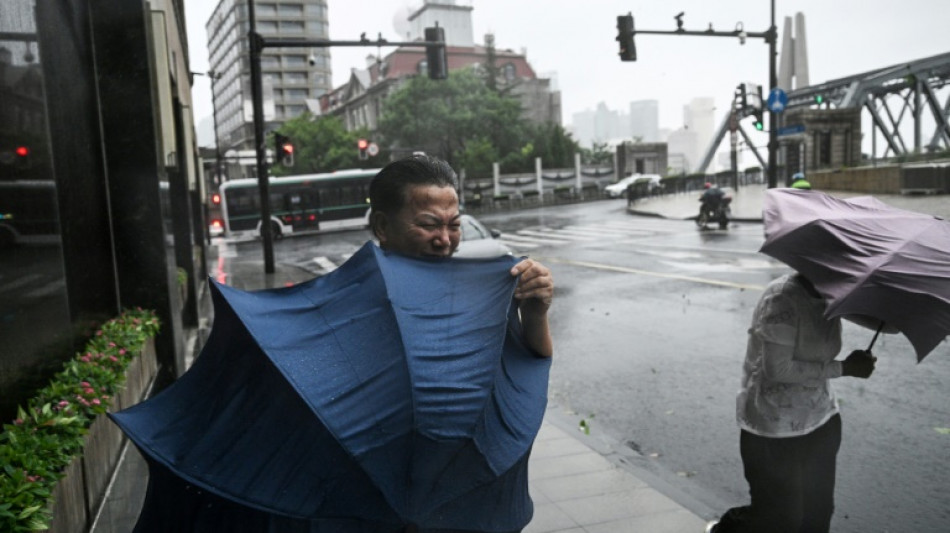
Shanghai cleans up after strongest storm in decades hits Chinese megacity / Photo: Hector RETAMAL - AFP

 Kenya's economy faces climate change risks: World Bank

 Tech rebound fuels record-breaking rally in South Korean stocks

 Cables and cooling bring AI windfall to Indian suppliers

 Anthropic's models gained unauthorized 'real-world' access during testing

 Apple tops estimates in CEO Cook's final quarter, but shares fall

 Milei demands expulsion of foreigners expressing 'hate' against Argentina

 Italy's Po River valley on drought alert

 Prada profits pinched as growth hard to chase

 Stocks climb on earnings and rates, oil retreats

 US economic growth slows in second quarter, missing expectations

 Russia adds Telegram founder Durov to 'terrorist' blacklist

 Stocks diverge on earnings, as oil steadies

 Eurozone economy grows despite Middle East war

 Singapore group will develop 'most promising' Ebola vaccine

 Shell profit surges as Mideast war fuels oil prices

 Car maker Stellantis says back in profit in second quarter

 Samsung quarterly operating profit up 1,800% on AI boom

 South Korean stocks bounce after rout, oil holds gains on Mideast woes

 South Korea's women web sleuths fight AI deepfake porn

 Anything but programmable: New cost-efficient EC-power-supply-series for the DIN rail by CAMTEC PS
 Meta misses profit expectations, sticks to massive AI spending

 Campari - king of the spritz - hopes to conquer American heartland

 Air France-KLM and Lufthansa bid for Portugal's TAP airline

 Profits soar at Airbus as it delivers more planes

 Rheinmetall shares surge after armsmaker reports record profit

Emergency workers cleared fallen trees and other debris from Shanghai's streets after the strongest storm to hit the Chinese megacity since 1949 disrupted transport and left tens of thousands of people without power.
Typhoon Bebinca landed in Shanghai's eastern coastal area early on Monday morning with wind speeds of around 150 kilometres (95 miles) per hour, state media said.
The municipal news service said the typhoon had caused "significant damage across the city", felling more than 1,800 trees and leaving 30,000 households without electricity.
Many businesses were already closed for the Mid-Autumn Festival public holiday and the city's 25 million residents were advised to avoid leaving their homes.
Only one injury had been reported so far, the municipal news service said.
Workers in orange jumpsuits cleared a big pile of corrugated iron and other metal that appeared to have fallen from a nearby building onto a major road in the city centre.
Shanghai resident Tracy Huang, who had ventured outside to buy supplies, watched them as the rain continued to pour.
"I didn't plan to go out today but there was a power outage in our house," she said.
"I don't know (when the electricity will come back on) but it might be tonight... the community staff said it was being repaired," she told AFP.
- Uprooted trees -
Authorities said 414,000 people across Shanghai had been evacuated to safer locations and tens of thousands of emergency personnel were on hand to be deployed.
Uprooted trees blocked off several roads in the city centre, AFP reporters saw, and the municipal news service said cars had been smashed by flying debris.
Many streets in the city's former French Concession turned a vivid green, carpeted with the felled boughs and leaves of the quarter's famous plane trees.
Bicycles and rubbish bags littered the road as clean-up crews and some delivery drivers persevered against the driving rain.
Navy veteran Tang Yongkui told AFP his years at sea had made him unafraid of storms, so he had gone outside to watch.
"The wind was really strong... You couldn't see the leaves on the trees, there was rain everywhere," the 84-year-old said.
"But it seems in the end that Shanghai's drainage is pretty good because by now there is no water left."
Xiong Zhuowu, a doctor and resident of the northern Baoshan district, posted a video of a real estate agent's sign being ripped away onto a roof in his compound.
"I feel quite nervous today, I'm constantly checking what the situation is out the window," Xiong told AFP.
"The property management found some trees with loose roots downstairs and immediately called me to move my car."
A government livefeed from Baoshan just after the typhoon hit showed ferocious winds ripping through a line of trees on the riverbank.
- Flights restarting -
The typhoon brought the normally heaving city to a standstill as it made landfall.
Live video feeds during the morning rush hour showed Shanghai's usually jammed roads almost empty of traffic and its famed skyline obscured by thick fog.
All flights from Shanghai's airports were grounded earlier but started up again slowly as the storm moved on through the afternoon.
Highways were opened after being closed at 1 am local time and some ferries, metro services and trains resumed service.
State broadcaster CCTV said Bebinca was expected to move northwest, causing heavy rain and high winds in Jiangsu, Zhejiang and Anhui provinces.
Some residents still braved the weather even at the storm's peak to go about their errands.
"I saw a lot of typhoons in the south, so I think Shanghai is OK," resident Wu Yun told AFP as she struggled to open her umbrella against the wind.
Another typhoon, Yagi, killed at least four people on China's southern Hainan island this month.
Bebinca also passed through Japan and the Philippines, where falling trees killed six people.
China is the world's biggest emitter of the greenhouse gases that scientists say are driving climate change that makes extreme weather more frequent and intense.
"We can't fight against nature. But we should protect it..."
L.Peeters--CPN