Strongest typhoon to hit Shanghai since 1949 shuts down megacity / Photo: Hector RETAMAL - AFP

 Kenya's economy faces climate change risks: World Bank

 Tech rebound fuels record-breaking rally in South Korean stocks

 Cables and cooling bring AI windfall to Indian suppliers

 Anthropic's models gained unauthorized 'real-world' access during testing

 Apple tops estimates in CEO Cook's final quarter, but shares fall

 Milei demands expulsion of foreigners expressing 'hate' against Argentina

 Italy's Po River valley on drought alert

 Prada profits pinched as growth hard to chase

 Stocks climb on earnings and rates, oil retreats

 US economic growth slows in second quarter, missing expectations

 Russia adds Telegram founder Durov to 'terrorist' blacklist

 Stocks diverge on earnings, as oil steadies

 Eurozone economy grows despite Middle East war

 Singapore group will develop 'most promising' Ebola vaccine

 Shell profit surges as Mideast war fuels oil prices

 Car maker Stellantis says back in profit in second quarter

 Samsung quarterly operating profit up 1,800% on AI boom

 South Korean stocks bounce after rout, oil holds gains on Mideast woes

 South Korea's women web sleuths fight AI deepfake porn

 Anything but programmable: New cost-efficient EC-power-supply-series for the DIN rail by CAMTEC PS

 Meta misses profit expectations, sticks to massive AI spending

 Campari - king of the spritz - hopes to conquer American heartland

 Air France-KLM and Lufthansa bid for Portugal's TAP airline

 Profits soar at Airbus as it delivers more planes

 Rheinmetall shares surge after armsmaker reports record profit

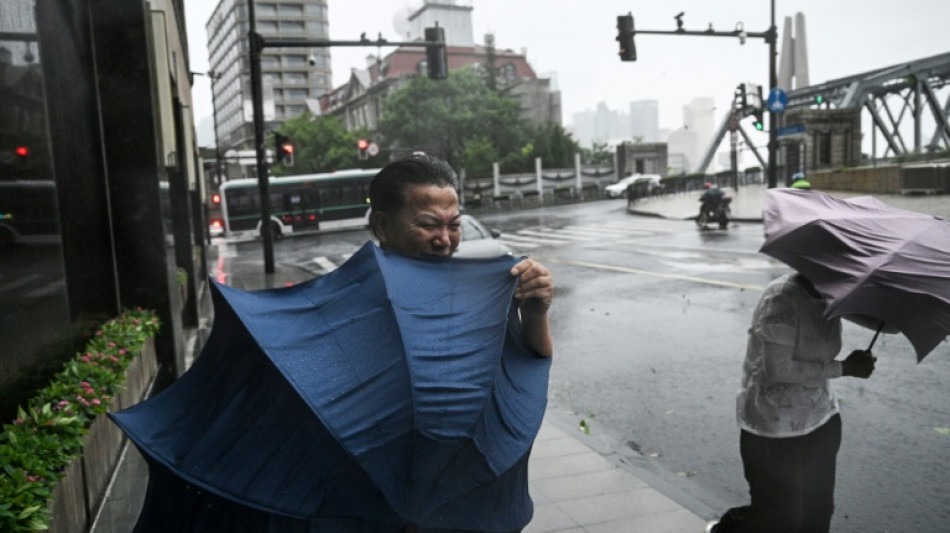
Tens of millions of people in Shanghai and across China's densely populated east coast hunkered indoors Monday as the strongest storm to hit since 1949 swept in, downing trees and disrupting transport across the region.
Typhoon Bebinca landed early Monday morning in the city's eastern coastal area, with wind speeds of up to 151 kilometres per hour (94 miles per hour), state media said.
It is the strongest storm to hit Shanghai since Typhoon Gloria in 1949, state broadcaster CCTV said shortly after Bebinca made landfall.
Many businesses were already closed for the Mid-Autumn Festival public holiday, and the city's 25 million residents have been advised to avoid leaving their homes.
Shanghai's flood control headquarters told CCTV they had already received dozens of reports of incidents related to the typhoon -- mostly fallen trees and billboards.
An uprooted tree completely blocked one road in the city centre, an AFP reporter saw.
- Ferocious winds -
Xiong Zhuowu, a doctor and resident of the northern Baoshan district, posted a video of a real estate agent's sign being ripped away onto a roof in his compound.
"I feel quite nervous today, I'm constantly checking what the situation is out the window," Xiong told AFP.
"The property management found some trees with loose roots downstairs and immediately called me to move my car to prevent the tree hitting it if it fell."
A government livefeed from Baoshan showed ferocious winds ripping through a line of trees on the riverbank.
Despite the violent downpours and sudden gusts of wind, some were still braving the weather to go about errands.
Resident Wu Yun said she had ventured outside because she had to sort something out at her sales job.
"I think it's okay, because I also saw a lot of typhoons in the south, so I think Shanghai is okay (compared to them)," she told AFP as she struggled to open her umbrella against the wind.
Branches and fallen bikes littered the road in the city's former French Concession, as delivery workers and clean-up crews persevered against the driving rain.
- Flights grounded -
All flights at Shanghai's two main airports are grounded, and ferry services and some trains have been suspended.
Highways were closed at 1 am local time, and a 40 kilometre (25 mile) per hour speed limit is in place on roads inside the city.
At rush hour, live video feeds showed Shanghai's normally jammed roads almost empty of traffic, and its famed skyline obscured by thick fog.
Nine thousand residents have been evacuated from Chongming District, an island at the mouth of the Yangtze River, authorities said.
CCTV broadcast footage of a reporter by the coast in neighbouring Zhejiang province, where waves pounded the craggy coastline under leaden skies.
"If I step out into (the storm), I can barely speak," the reporter said.
"You can see that the surface of the sea is just wave after wave, each higher than the last."
Another typhoon, Yagi, killed at least four people and injured 95 when it passed through China's southern Hainan island this month, according to national weather authorities.
Bebinca has also passed through Japan and the central and southern Philippines, where falling trees killed six people.
China is the world's biggest emitter of the greenhouse gases that scientists say are driving climate change and making extreme weather more frequent and intense.
Y.Jeong--CPN