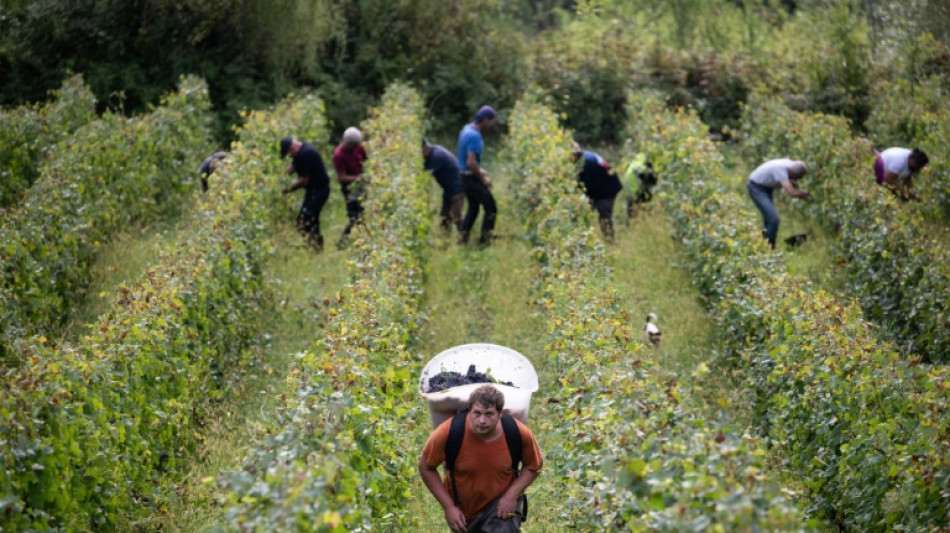
'Historic': Bad weather slashes wine harvest in France's Jura / Photo: SEBASTIEN BOZON - AFP

 Kenya's economy faces climate change risks: World Bank

 Tech rebound fuels record-breaking rally in South Korean stocks

 Cables and cooling bring AI windfall to Indian suppliers

 Anthropic's models gained unauthorized 'real-world' access during testing

 Apple tops estimates in CEO Cook's final quarter, but shares fall

 Milei demands expulsion of foreigners expressing 'hate' against Argentina

 Italy's Po River valley on drought alert

 Prada profits pinched as growth hard to chase

 Stocks climb on earnings and rates, oil retreats

 US economic growth slows in second quarter, missing expectations

 Russia adds Telegram founder Durov to 'terrorist' blacklist

 Stocks diverge on earnings, as oil steadies

 Eurozone economy grows despite Middle East war

 Singapore group will develop 'most promising' Ebola vaccine

 Shell profit surges as Mideast war fuels oil prices

 Car maker Stellantis says back in profit in second quarter

 Samsung quarterly operating profit up 1,800% on AI boom

 South Korean stocks bounce after rout, oil holds gains on Mideast woes

 South Korea's women web sleuths fight AI deepfake porn

 Anything but programmable: New cost-efficient EC-power-supply-series for the DIN rail by CAMTEC PS

 Meta misses profit expectations, sticks to massive AI spending

 Campari - king of the spritz - hopes to conquer American heartland

 Air France-KLM and Lufthansa bid for Portugal's TAP airline

 Profits soar at Airbus as it delivers more planes

 Rheinmetall shares surge after armsmaker reports record profit
Heavy rainfall, hail and mildew have destroyed most of the wine harvest in eastern France's Jura region for this year, leaving winegrowers struggling.
The Jura, nestled between the famous Burgundy wine region and Switzerland, is one of France's oldest wine-growing areas, featuring some 200 vineyards spread over 2,000 hectares.
Their unusual elevation and the region's cool climate give a distinctive flavour to its wines some of which are famous, notably the white wine known as "Vin Jaune" (yellow wine).
But this year is delivering a bitter taste for winegrowers as the Jura -- the smallest of France's 17 major wine-growing regions -- is headed for a spectacular drop of 71 percent in this year's wine production volume, according to a government estimate.
The main culprit is a period of frost in April that destroyed many of the budding vines.
"The vines had already grown shoots of three or four centimetres (1.1-1.2 inches)," said Benoit Sermier, 33, a winegrower in the Jura. "Those leaves were very thin and fragile, and sub-zero temperatures destroyed them, costing us 60 percent of the harvest."
- 'Particularly unfavourable' -
Although this year's harvest is expected to be of high quality, a lack in quantity is putting winegrowers in a precarious position, as frost in previous years has not allowed them to build up enough wine stock for lean times, said Sermier, who heads a local wine cooperative.
Winegrowers were also hit hard by incessant rain in July, which forced them to reapply protective vine treatments "every three or four days", said Patrick Rolet, who grows organic wine and owns cattle. "I don't think any winegrower remembers having ever seen this much rainfall," he said.
The persistent humidity also facilitated the spread of mildew, a fungus that can devastate entire vineyards.
"Compared with the past 25 years, our losses are historic," said Olivier Badoureaux, director of the Jura winegrowers committee.
France's overall wine volumes are headed for a fall of almost a fifth this year because of the unfavourable weather, France's agriculture ministry said last week.
Overall wine production is now estimated to drop by 18 percent to 39.3 million hectolitres.
A little over a month ago before wine harvesting began, the ministry had still targeted up to 43 million hectolitres.
But "particularly unfavourable" weather forced the revision, as the extent of damage done by frost, hail and also mildew became clearer.
- 'Humid conditions' -
The Charente region, in the southwest of France, is looking at a 35 percent drop in wine production this year, the biggest fall in terms of volume of any French region.
This, said the agriculture ministry, was due to "a smaller number of grape bunches" and "insufficient flowering because of humid conditions".
Losses in the Val de Loire and Burgundy-Beaujolais regions are also expected to come in above average.
Champagne production, meanwhile, is likely to drop by 16 percent, but will remain some eight percent above its average over the past five years.
The impact of bad weather is being compounded by winegrowers' decision over recent years to reduce the size of vineyards in response to falling wine consumption in France, especially of red wine.
Ch.Lefebvre--CPN