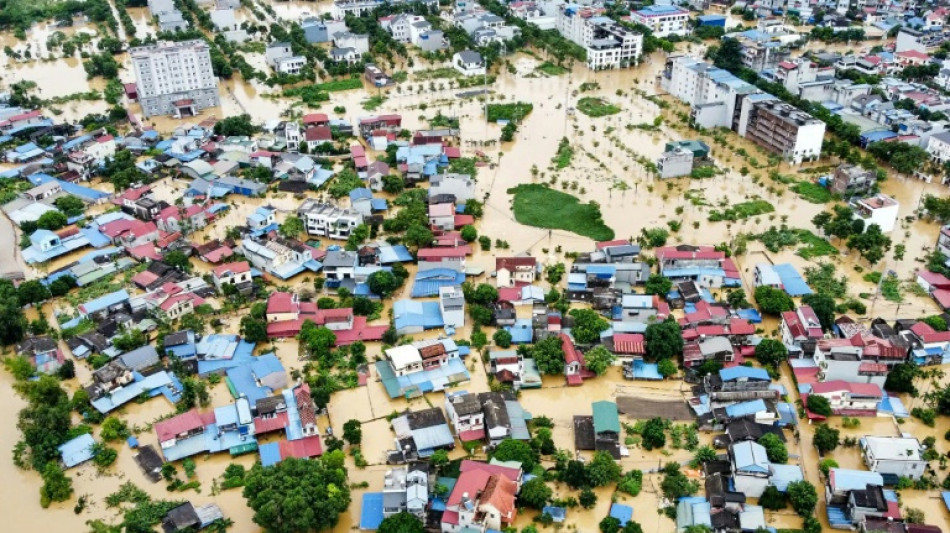
SE Asia battles floods, landslides as death toll passes 200 / Photo: Xuan Quang - AFP

 Kenya's economy faces climate change risks: World Bank

 Far right and far left battle for power in polarised Berlin

 The last trio: S.Africa's zoo elephants await their fate

 Oil industry sees war windfall but girds for political blowback

 Amazon beats expectations with cloud and AI growth

 Blowout Microsoft results lift US stocks as oil retreats

 'Beginning of the end': Relief but no party as French wildfire winds down

 Southern Europe 'becoming more flammable' in hotter climate, experts say

 Mammoth bones found on parched bed of Danube in Bulgaria

 MEXC Lists Grvt (GRVT) with $60,000 Worth of GRVT and 10,000 USDT in Airdrop+ Rewards

 George and Amal Clooney flee French home due to wildfire

 MEXC Ventures Supports Alpha Arena's APAC Debut at Coinfest Bali

 AI data centre supplier Zhongji InnoLight slips on Hong Kong debut

 May, June heatwaves caused 2,877 extra deaths in England: govt

 BMW profit down a third as carmaker plans job cuts

 Seoul extends losses as most Asian markets drop, oil rises again

 Gambling.com Group Is Now Grandstand

 Meet the astronomer digging into the Milky Way's 'fossils'

 AI data centre supplier Zhongji InnoLight falls on Hong Kong debut

 Samsung operating profit up 1,800% in second quarter on AI boom

 Japanese population below 120 million for first time in decades

 US actor Jared Leto denies latest accusations of sexual assault

 Danube drops to 'historic lows' as fresh heatwave hits

 BTS pulls out of Grammys after Asian pop category introduction

 OpenAI says rogue AI agent attack hit other companies

Millions of people across Southeast Asia struggled Thursday with flooded homes, power cuts and wrecked infrastructure after Typhoon Yagi swept through the region, as the death toll passed 200.
In worst-hit Vietnam the fatalities rose to 197, with eight confirmed dead in northern Thailand -- where one district is suffering its worst floods in 80 years.
Yagi smashed into Vietnam at the weekend, bringing a colossal deluge of rain that has inundated a swathe of northern Vietnam, Laos, Thailand and Myanmar, triggering deadly landslides and widespread river flooding.
One farmer told AFP his entire 1,800 square metre peach blossom plantation was submerged, destroying all 400 of his trees.
"It will be so hard for me to recover from this loss -- I think I will lose up to $40,000 this season," the farmer, who gave his name only as Tu, told AFP.
"I really don't know what to do now, I'm just waiting for the water to recede."
- Communications cut off -
The high waters have devastated more than 250,000 hectares of crops and huge numbers of livestock, Vietnam's agriculture ministry said, with farmland around Hanoi hit hard.
Commuters in parts of the Vietnamese capital trudged to work through shin-deep brown floodwaters, though officials said river levels in the city are slowly falling after hitting a 20-year high on Wednesday.
Thousands have been forced to evacuate their homes, while others are struggling with power cuts, and in one badly hit district on the outskirts of Hanoi, more than 15,000 people have been affected by the floods.
Vietnamese state media said a landslide in mountainous Lao Cai province killed seven people with left 11 missing.
The incident happened on Tuesday but details have only just got through because communication with the area was cut off, officials told state media.
This comes in addition to a separate landslide in the same province that annihilated an entire village of 37 houses, killing at least 34 people with 46 still unaccounted for.
- Luang Prabang warning -
The Mekong River Commission, the international body overseeing the crucial waterway, issued a flood warning on Thursday for the historic Laotian city of Luang Prabang.
The Mekong is expected to hit flood levels in Luang Prabang, a UNESCO world heritage site, on Thursday, the commission said in a bulletin.
In Thailand the death toll has risen to eight, with four more deaths reported from a landslide in Chiang Mai province, according to provincial governor Nirat Pongsitthaworn.
Further north, Mae Sai district on the border with Myanmar is suffering its worst floods in 80 years, Suttipong Juljarern, a senior interior ministry official said in a statement.
The Thai government has mobilised the military to help relief efforts, deploying three helicopters to carry out an aerial survey of the situation.
Buddhist temples, along with hotels and resorts, have opened their doors to accommodate almost 1,000 people flooded out of their homes, the government said.
Flooding in Myanmar is most severe around the junta's sprawling low-lying capital Naypyidaw, while the town of Taungoo is also threatened by rising river levels.
The Global New Light of Myanmar, the state-run newspaper, said train services on the main line between Yangon and Mandalay were suspended because some sections were flooded.
Heavy monsoon rains lash Southeast Asia every year, but human-made climate change is causing more intense weather patterns that can make destructive floods more likely.
Climate change is causing typhoons to form closer to the coast, intensify faster and stay longer over land, according to a study published in July.
burs-pdw/hmn
A.Zimmermann--CPN