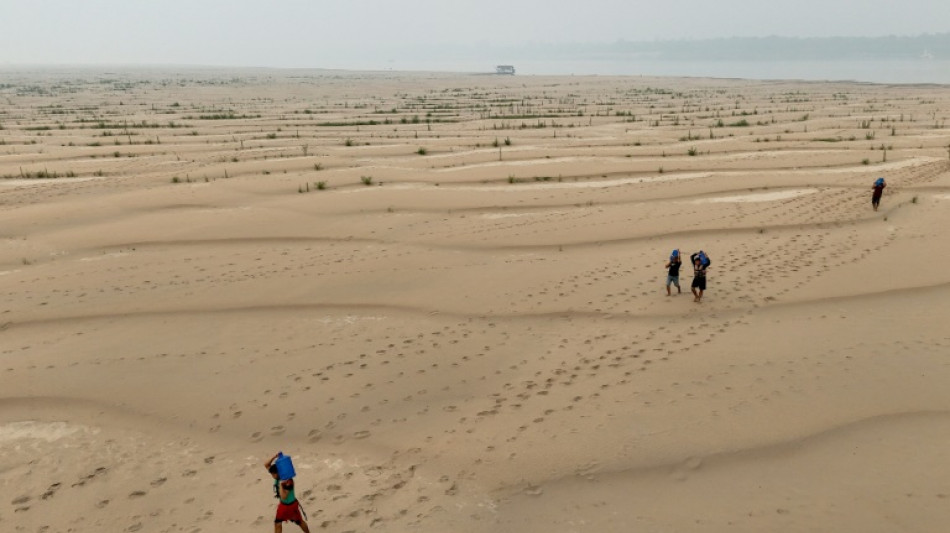
An Amazon river dries up, creating hellish crossing for villagers / Photo: MICHAEL DANTAS - AFP

 Kenya's economy faces climate change risks: World Bank
 Far right and far left battle for power in polarised Berlin

 The last trio: S.Africa's zoo elephants await their fate
 Oil industry sees war windfall but girds for political blowback

 Amazon beats expectations with cloud and AI growth

 Blowout Microsoft results lift US stocks as oil retreats

 'Beginning of the end': Relief but no party as French wildfire winds down

 Southern Europe 'becoming more flammable' in hotter climate, experts say

 Mammoth bones found on parched bed of Danube in Bulgaria

 MEXC Lists Grvt (GRVT) with $60,000 Worth of GRVT and 10,000 USDT in Airdrop+ Rewards

 George and Amal Clooney flee French home due to wildfire

 MEXC Ventures Supports Alpha Arena's APAC Debut at Coinfest Bali

 AI data centre supplier Zhongji InnoLight slips on Hong Kong debut

 May, June heatwaves caused 2,877 extra deaths in England: govt
 BMW profit down a third as carmaker plans job cuts

 Seoul extends losses as most Asian markets drop, oil rises again

 Gambling.com Group Is Now Grandstand

 Meet the astronomer digging into the Milky Way's 'fossils'

 AI data centre supplier Zhongji InnoLight falls on Hong Kong debut

 Samsung operating profit up 1,800% in second quarter on AI boom

 Japanese population below 120 million for first time in decades

 US actor Jared Leto denies latest accusations of sexual assault
 Danube drops to 'historic lows' as fresh heatwave hits
 BTS pulls out of Grammys after Asian pop category introduction

 OpenAI says rogue AI agent attack hit other companies

Only the youngest and strongest villagers now brave the crossing of a vast, blistering stretch of sand where, in normal times, the waters of the mighty Madeira River flow in the Brazilian Amazon.
Residents of the village of Paraizinho -- or "Little Paradise" -- usually cross the river by canoe to reach the larger city of Humaita, a vital link to buy food and water, get healthcare and send their children to school.
In drier times, this typically involves a short walk along a beach that appears as water levels drop.
But as Brazil grapples with its worst drought in 70 years, the waters have continued to shrink, leaving a stretch of almost a kilometer (about 0.6 miles) of sand baking under temperatures of about 40 degrees Celsius (104 Fahrenheit).
"Every year it is worse. Last year more than half (of the river) dried up. This year it has dried up almost to the other side," Reis Santos Vieira, a 69-year-old farmer, told AFP.
"And it is expected to get worse," he added.
The Madeira River, a major tributary of the Amazon River that stretches for 3,300 km (2,050 miles) over Brazil and Bolivia, reached its lowest level since monitoring began in 1967 this week, according to the Brazilian Geological Service (SGB).
- 'A very difficult time' -
Experts link Brazil's historic drought to climate change. The parched conditions have fueled wildfires in the Amazon and elsewhere in the country that have clouded major cities in smoke pollution.
For much of the day, the dry riverbed becomes an inferno underfoot.
The roughly one hundred residents of Paraizinho "are tackling that beach on foot to transport the food and water we need here. It's a very difficult time," complained Sandra Gomes Vieira.
Last year, which also saw drought conditions, one of her daughters burned her foot crossing the riverbed. She has refused to go to school since the sand appeared this year.
"My sister is undergoing treatment for cancer and can't go to the city. Health personnel go to her house. I'm not very healthy either, but I still manage to get there," said Gomes.
Five community volunteers recently carried containers of drinking water barefoot from Humaita to Paraizinho that used to be easily transported on canoes across the river.
"Here, we only have the help of these people. Only them and God," said Francisca de Chaga da Silva, one of the water recipients.
Community leader Joao Ferreira explained the water goes to "the most vulnerable families, who have patients with high blood pressure and diabetes."
Faced with the water shortage, residents treat river water with chlorine to bathe and wash dishes or clothes.
- 'More smoke' -
The prolonged drought is also impacting economic activities in Paraizinho, mainly fishing and the sale of agricultural products.
"The beach has grown a lot. Before, it was only two or three months" of drought, "now we are going for four, five months," said Ferreira.
Communities all along the banks of the Madeira River -- an important route for the trade of soybeans, fish and fuel -- are struggling. Some areas which also rely on Humaita have it worse than Paraizinho, residents of the village say, as they are even further away.
Intense fires elsewhere in the Amazon have also brought a haze of smoke to the village and surrounding locale.
Authorities blame human activity for most of the recent fires in the country, which are often linked to clearing land for agriculture.
The weather "is hotter this year. There is also more smoke," said Sandra Gomes.
One of her daughters "has been feeling chest pains from the smoke. Before, she didn't suffer from this problem."
President Luiz Inacio Lula da Silva is expected to announce measures to tackle the effects of the drought in the Amazon during a visit to the city of Manaus on Tuesday.
St.Ch.Baker--CPN