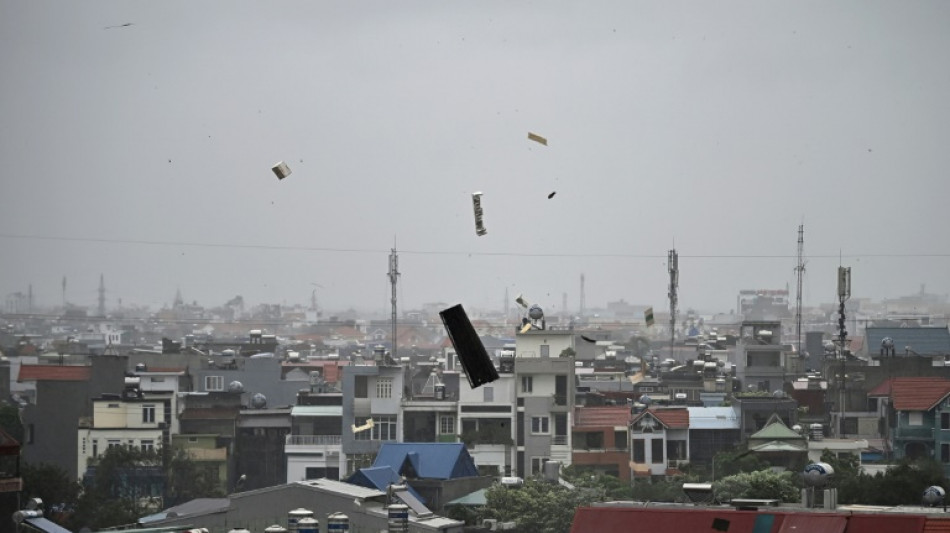
Super Typhoon Yagi hits Vietnam after killing two in China / Photo: NHAC NGUYEN - AFP

 Kenya's economy faces climate change risks: World Bank

 Far right and far left battle for power in polarised Berlin

 The last trio: S.Africa's zoo elephants await their fate

 Oil industry sees war windfall but girds for political blowback

 Amazon beats expectations with cloud and AI growth

 Blowout Microsoft results lift US stocks as oil retreats

 'Beginning of the end': Relief but no party as French wildfire winds down

 Southern Europe 'becoming more flammable' in hotter climate, experts say

 Mammoth bones found on parched bed of Danube in Bulgaria

 MEXC Lists Grvt (GRVT) with $60,000 Worth of GRVT and 10,000 USDT in Airdrop+ Rewards
 George and Amal Clooney flee French home due to wildfire

 MEXC Ventures Supports Alpha Arena's APAC Debut at Coinfest Bali

 AI data centre supplier Zhongji InnoLight slips on Hong Kong debut

 May, June heatwaves caused 2,877 extra deaths in England: govt

 BMW profit down a third as carmaker plans job cuts

 Seoul extends losses as most Asian markets drop, oil rises again

 Gambling.com Group Is Now Grandstand

 Meet the astronomer digging into the Milky Way's 'fossils'

 AI data centre supplier Zhongji InnoLight falls on Hong Kong debut

 Samsung operating profit up 1,800% in second quarter on AI boom

 Japanese population below 120 million for first time in decades

 US actor Jared Leto denies latest accusations of sexual assault

 Danube drops to 'historic lows' as fresh heatwave hits

 BTS pulls out of Grammys after Asian pop category introduction

 OpenAI says rogue AI agent attack hit other companies

Super Typhoon Yagi uprooted thousands of trees and swept ships and boats out to sea as it made landfall in northern Vietnam Saturday, state media said.
The typhoon made landfall in Hai Phong and Quang Ninh provinces, packing winds exceeding 149 kilometres (92 miles) per hour, VNExpress said, after blowing past southern China where it killed two people.
In Hai Phong, metal roof sheets and commercial sign boards were seen flying across the city sky as the typhoon hit.
"It has been years since I witnessed a typhoon this big," said Tran Thi Hoa, a 48-year-old woman from Hai Phong.
"It was scary. I stayed indoors, after locking all my windows. However, the sound of the wind and the rain was unbelievable," she told AFP.
The typhoon hit Vietnam after killing at least two people and injuring 92 others on southern China's Hainan island.
State broadcaster CCTV said Yagi brought winds of more than 230 kilometres (143 miles) per hour, uprooting trees and prompting the evacuation of around 460,000 people.
Southern China is frequently hit by typhoons in the summer and autumn, which form in the warm oceans east of the Philippines and Thailand.
Typhoons in the region are now forming closer to the coast, intensifying more rapidly, and staying over land for longer due to climate change, according to a study published in July.
P.Petrenko--CPN