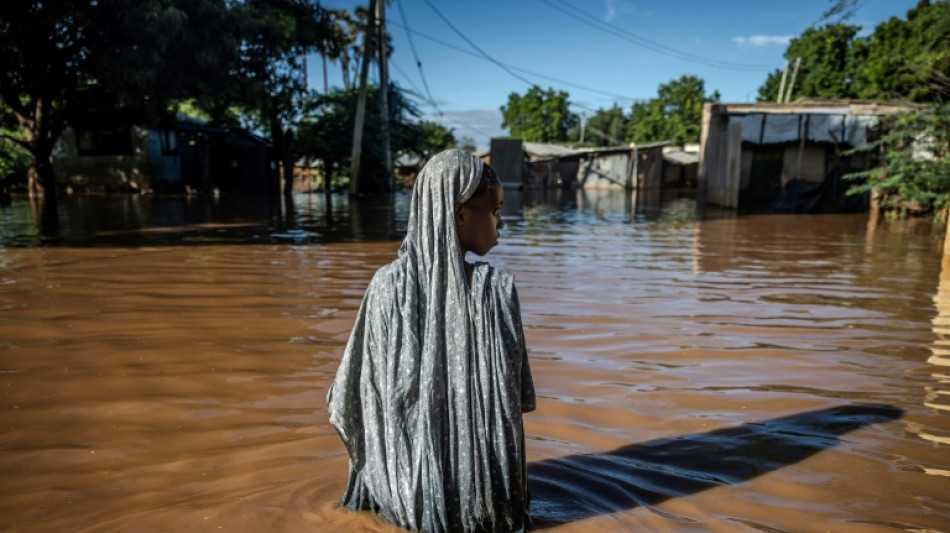
Africa faces disproportionate burden from climate change: UN / Photo: LUIS TATO - AFP/File

 Kenya's economy faces climate change risks: World Bank
 Far right and far left battle for power in polarised Berlin

 The last trio: S.Africa's zoo elephants await their fate
 Oil industry sees war windfall but girds for political blowback

 Amazon beats expectations with cloud and AI growth

 Blowout Microsoft results lift US stocks as oil retreats

 'Beginning of the end': Relief but no party as French wildfire winds down

 Southern Europe 'becoming more flammable' in hotter climate, experts say

 Mammoth bones found on parched bed of Danube in Bulgaria

 MEXC Lists Grvt (GRVT) with $60,000 Worth of GRVT and 10,000 USDT in Airdrop+ Rewards

 George and Amal Clooney flee French home due to wildfire

 MEXC Ventures Supports Alpha Arena's APAC Debut at Coinfest Bali

 AI data centre supplier Zhongji InnoLight slips on Hong Kong debut

 May, June heatwaves caused 2,877 extra deaths in England: govt

 BMW profit down a third as carmaker plans job cuts

 Seoul extends losses as most Asian markets drop, oil rises again

 Gambling.com Group Is Now Grandstand

 Meet the astronomer digging into the Milky Way's 'fossils'

 AI data centre supplier Zhongji InnoLight falls on Hong Kong debut

 Samsung operating profit up 1,800% in second quarter on AI boom

 Japanese population below 120 million for first time in decades

 US actor Jared Leto denies latest accusations of sexual assault

 Danube drops to 'historic lows' as fresh heatwave hits

 BTS pulls out of Grammys after Asian pop category introduction

 OpenAI says rogue AI agent attack hit other companies
Africa faces a disproportionate burden from climate change and the costs of adapting, the World Meteorological Organization (WMO) said in a new report on Monday.
The African continent has been warming at a slightly faster rate than the global average -- at about 0.3 degrees Celsius per decade between 1991 and 2023, the WMO said in its report on the state of the climate in Africa last year.
North Africa experienced the most rapid warming, it said. The city of Agadir in Morocco reached a new maximum temperature of 50.4 degrees.
Other countries saw extreme rainfall leading to flooding.
Climate activists have long pointed out that Africa pays one of the highest prices for climate change while the continent is responsible for just a fraction of global greenhouse gas emissions.
The UN's COP29 climate summit, which will be hosted by Azerbaijan in November, will focus in large part on how much wealthy industrialised nations should contribute to help poorer countries adapt to climate change.
"Africa faces disproportionate burdens and risks arising from climate change related weather events and patterns," Josefa Leonel Correia Sacko, commissioner for agriculture, rural development, blue economy and sustainable environment at the African Union Commission, said in the WMO report.
They "cause massive humanitarian crises with detrimental impacts on agriculture, and food security, education, energy, infrastructure, peace, and security, public health, water resources, and overall socio-economic development," she said.
In September and October, around 300,000 people were affected by flooding across 10 countries, with Niger, Benin, Ghana and Nigeria most heavily impacted.
That came months after flooding hit Libya and parts of East Africa, the WMO, the United Nations' weather and climate agency, said.
Zambia faced its worst drought in 40 years, affecting around six million people, while a string of other nations also grappled with severe drought in 2023, WMO said.
"Climate extremes including floods and droughts had a major impact on food security," the report said.
African countries on average are losing two to five percent of gross domestic product and "many are diverting up to nine percent of their budgets responding to climate extremes", the WMO said.
If adequate measures to respond are not implemented, by 2030 an estimated up to 118 million people who live on less than $1.90 a day will be exposed to drought, floods and extreme heat in Africa, it said.
"This will place additional burdens on poverty alleviation efforts and significantly hamper growth," according to the report.
The UN agency highlighted the urgent need to invest in improved data collection and forecasting and early warning capabilities.
"Between 1970 and 2021, Africa accounted for 35 percent of weather, climate and water-related fatalities. Yet only 40 percent of the African population has access to early warning systems –- the lowest rate of any region of the world," the WMO said.
X.Cheung--CPN