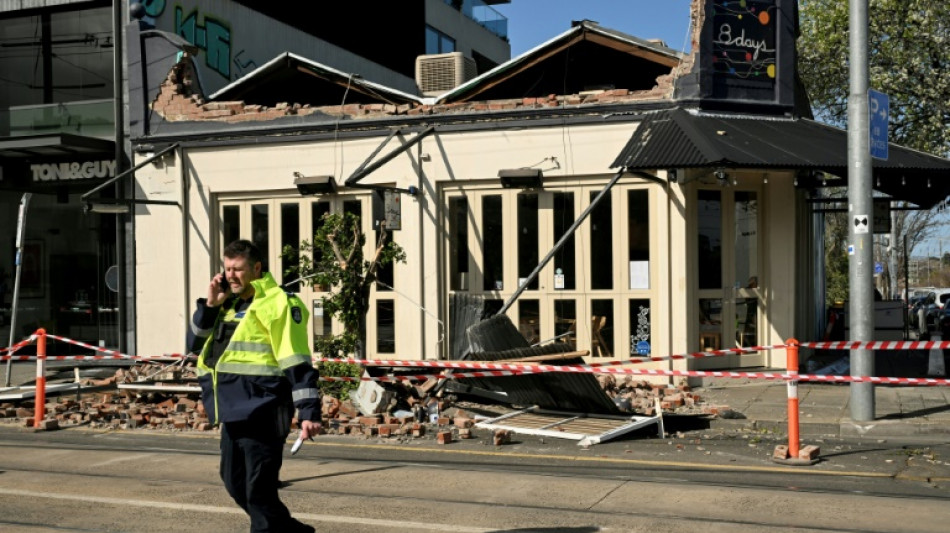
One dead as storms hit Australia's southeast / Photo: William WEST - AFP

 Kenya's economy faces climate change risks: World Bank

 Far right and far left battle for power in polarised Berlin

 The last trio: S.Africa's zoo elephants await their fate

 Oil industry sees war windfall but girds for political blowback

 Amazon beats expectations with cloud and AI growth

 Blowout Microsoft results lift US stocks as oil retreats

 'Beginning of the end': Relief but no party as French wildfire winds down

 Southern Europe 'becoming more flammable' in hotter climate, experts say

 Mammoth bones found on parched bed of Danube in Bulgaria

 MEXC Lists Grvt (GRVT) with $60,000 Worth of GRVT and 10,000 USDT in Airdrop+ Rewards

 George and Amal Clooney flee French home due to wildfire

 MEXC Ventures Supports Alpha Arena's APAC Debut at Coinfest Bali

 AI data centre supplier Zhongji InnoLight slips on Hong Kong debut

 May, June heatwaves caused 2,877 extra deaths in England: govt

 BMW profit down a third as carmaker plans job cuts

 Seoul extends losses as most Asian markets drop, oil rises again

 Gambling.com Group Is Now Grandstand

 Meet the astronomer digging into the Milky Way's 'fossils'

 AI data centre supplier Zhongji InnoLight falls on Hong Kong debut

 Samsung operating profit up 1,800% in second quarter on AI boom

 Japanese population below 120 million for first time in decades

 US actor Jared Leto denies latest accusations of sexual assault

 Danube drops to 'historic lows' as fresh heatwave hits

 BTS pulls out of Grammys after Asian pop category introduction

 OpenAI says rogue AI agent attack hit other companies

One woman has died, schools have been shuttered and tens of thousands of people were without power Monday, as wild storms lashed Australia.
Police said a 63-year-old woman died after a tree fell on a cabin in the country's southeast.
"Destructive" winds of more than 110 kilometres (68 miles) per hour are lashing the region, leaving about 150,000 people without power.
Victorian state premier Jacinta Allan warned power outages could take up to three days to fix.
"There are some areas where the conditions remain too dangerous to make repairs," she said.
Meanwhile, coastal areas have been hit by high tides -- in some cases swallowing up sand dunes.
People have been warned to avoid unnecessary travel, while some schools have closed.
Authorities in New South Wales were concerned the damaging winds would increase fire danger on Monday, with many areas on high alert.
New South Wales Rural Fire Service inspector Ben Shepherd warned Sydney and surrounding areas that they would see the worst of the fire danger on Monday, but conditions would ease in the afternoon.
Parts of Tasmania have been inundated by flooding and destructive winds -- with gusts peaking at 150 kilometres (93.2 miles) per hour over the weekend.
Bureau of Meteorology senior forecaster Christie Johnson said a series of cold fronts sweeping across Australia's southeast had caused "damaging to destructive winds".
But conditions were set to ease Tuesday, she said.
Johnson warned further cold fronts would impact the country later in the week, but she did not anticipate conditions to be as extreme.
- Australia's exposure -
Australia is highly exposed to extreme weather events, given its remoteness in the Pacific Ocean.
The country recorded its warmest winter last month, with the mercury hitting 41.6 degrees Celsius (106.7 degrees Fahrenheit) in part of its rugged and remote northwest coast.
Official data shows average temperatures for Australia steadily rising, with climate change fuelling more intense bushfires, floods, drought and heatwaves.
Shepard told AFP there was a high risk that the coming summer would see increased fire danger due to the rapid drying of vegetation.
With a few days of hot and windy weather, this vegetation would be primed for fire.
Climate scientists have already predicted that 2024 will be the planet's hottest year on record.
Temperature records have tumbled worldwide in recent decades as human-caused carbon emissions have risen.
Record temperatures have been recorded in the Mediterranean Sea and Norway's Arctic Svalbard archipelago in the past few weeks alone.
P.Schmidt--CPN