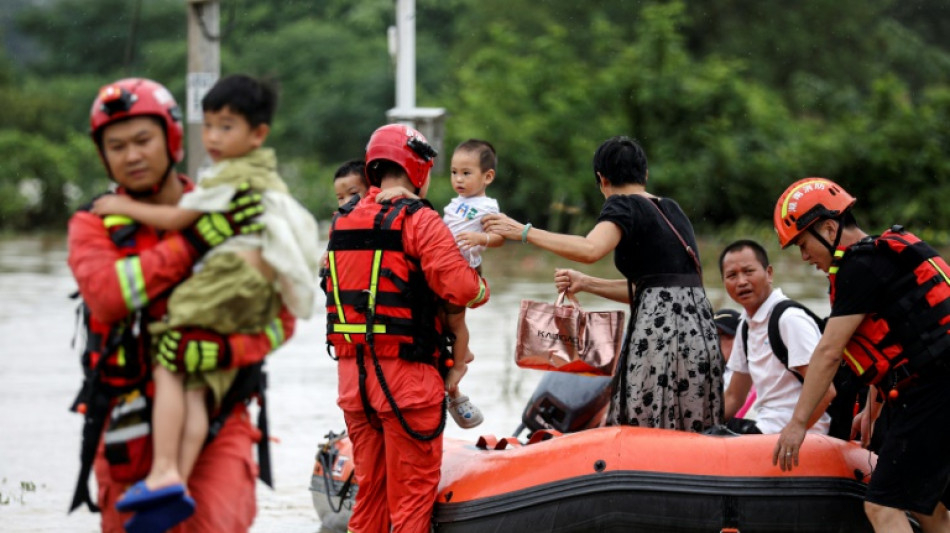
Climate change fuelled deadly Typhoon Gaemi: study / Photo: STR - AFP

 Kenya's economy faces climate change risks: World Bank

 Far right and far left battle for power in polarised Berlin

 The last trio: S.Africa's zoo elephants await their fate

 Oil industry sees war windfall but girds for political blowback

 Amazon beats expectations with cloud and AI growth

 Blowout Microsoft results lift US stocks as oil retreats

 'Beginning of the end': Relief but no party as French wildfire winds down

 Southern Europe 'becoming more flammable' in hotter climate, experts say

 Mammoth bones found on parched bed of Danube in Bulgaria

 MEXC Lists Grvt (GRVT) with $60,000 Worth of GRVT and 10,000 USDT in Airdrop+ Rewards

 George and Amal Clooney flee French home due to wildfire

 MEXC Ventures Supports Alpha Arena's APAC Debut at Coinfest Bali

 AI data centre supplier Zhongji InnoLight slips on Hong Kong debut

 May, June heatwaves caused 2,877 extra deaths in England: govt

 BMW profit down a third as carmaker plans job cuts

 Seoul extends losses as most Asian markets drop, oil rises again

 Gambling.com Group Is Now Grandstand

 Meet the astronomer digging into the Milky Way's 'fossils'

 AI data centre supplier Zhongji InnoLight falls on Hong Kong debut

 Samsung operating profit up 1,800% in second quarter on AI boom

 Japanese population below 120 million for first time in decades

 US actor Jared Leto denies latest accusations of sexual assault

 Danube drops to 'historic lows' as fresh heatwave hits

 BTS pulls out of Grammys after Asian pop category introduction

 OpenAI says rogue AI agent attack hit other companies

Climate change turbocharged the winds and rain of Typhoon Gaemi, which killed dozens of people across the Philippines, Taiwan and China earlier this year, a group of scientists said Thursday.
Gaemi skirted the Philippines in July, triggering floods and landslides that killed at least 40 people, before making landfall in Taiwan and China.
In China, the weather system caused torrential downpours that killed 50 people and prompted authorities to evacuate 300,000.
World Weather Attribution (WWA), a network of scientists who have pioneered peer-reviewed methods for assessing the role of climate change in extreme events, looked at three regions worst affected by the typhoon: the northern Philippines, Taiwan and China's Hunan province.
It found the system's wind speeds were seven percent more intense due to man-made climate change, and its rainfall was 14 percent heavier in Taiwan and nine percent heavier in Hunan.
The study could not draw definitive conclusions about the role of climate change on the rainfall in the Philippines, because of the region's complex monsoon rain patterns.
Still, they found the warm seas that helped form and fuel Typhoon Gaemi "would have been virtually impossible" in a world that had not warmed to the current 1.2 Celsius above pre-industrial levels.
And the group's modelling found this warming has already increased the number of similarly strong storms by 30 percent -- up from around five a year to six or seven.
"This study confirms what we've expected –- hotter seas and atmospheres are giving rise to more powerful, longer-lived and deadlier typhoons," said Ralf Toumi, director of the Grantham Institute-Climate Change and the Environment, at Imperial College London.
Teasing out the impact of climate change on tropical cyclones is complicated, but scientists are focusing more work on these weather systems.
WWA's method involves assessing how unusual an extreme event is, then modelling the likelihood of a similar event and its intensity in two scenarios: today's world, and one without current levels of warming.
The scientists used that method and a new approach developed by Imperial College London that is tailored specifically to tropical storms.
It uses computer modelling to overcome the relative lack of historical data on tropical cyclones.
While the Asia-Pacific region has long dealt with typhoons, the scientists warned that their work highlighted "gaps in typhoon preparedness and the massive impacts caused by Gaemi."
They called for better urban flood management and targeted warnings that offer more information on the likely impacts of a storm.
The study was released as Typhoon Shanshan made landfall in Japan, which issued its highest level warning for wind and storm surges.
U.Ndiaye--CPN