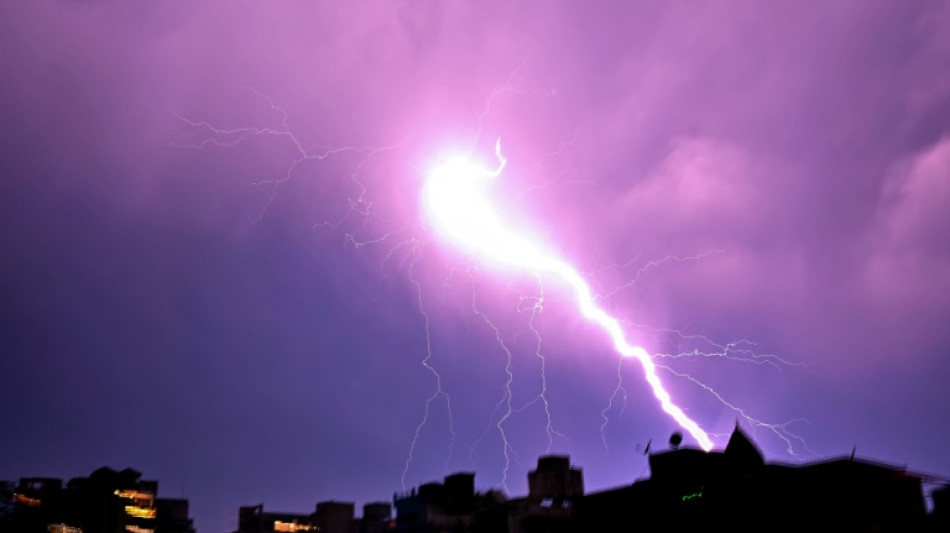
'Alarming' rise in deadly lightning strikes in India: scientists / Photo: Biju BORO - AFP

 Kenya's economy faces climate change risks: World Bank

 Far right and far left battle for power in polarised Berlin

 The last trio: S.Africa's zoo elephants await their fate

 Oil industry sees war windfall but girds for political blowback

 Amazon beats expectations with cloud and AI growth

 Blowout Microsoft results lift US stocks as oil retreats

 'Beginning of the end': Relief but no party as French wildfire winds down

 Southern Europe 'becoming more flammable' in hotter climate, experts say

 Mammoth bones found on parched bed of Danube in Bulgaria

 MEXC Lists Grvt (GRVT) with $60,000 Worth of GRVT and 10,000 USDT in Airdrop+ Rewards

 George and Amal Clooney flee French home due to wildfire

 MEXC Ventures Supports Alpha Arena's APAC Debut at Coinfest Bali

 AI data centre supplier Zhongji InnoLight slips on Hong Kong debut

 May, June heatwaves caused 2,877 extra deaths in England: govt

 BMW profit down a third as carmaker plans job cuts

 Seoul extends losses as most Asian markets drop, oil rises again

 Gambling.com Group Is Now Grandstand

 Meet the astronomer digging into the Milky Way's 'fossils'

 AI data centre supplier Zhongji InnoLight falls on Hong Kong debut

 Samsung operating profit up 1,800% in second quarter on AI boom

 Japanese population below 120 million for first time in decades

 US actor Jared Leto denies latest accusations of sexual assault

 Danube drops to 'historic lows' as fresh heatwave hits

 BTS pulls out of Grammys after Asian pop category introduction

 OpenAI says rogue AI agent attack hit other companies

Climate change is fuelling an alarming increase in deadly lightning strikes in India, killing nearly 1,900 people a year in the world's most populous country, scientists warn.
Lightning caused a staggering 101,309 deaths between 1967 and 2020, with a sharp increase between 2010 and 2020, a team of researchers led by Fakir Mohan University in the eastern state of Odisha said.
"The results indicate a steady increase in lightning activity in India, positioning it as a major killer among climate change-induced natural disasters," it said.
While the report looked at data on deaths, not the number of strikes, it said "lightning activity in India is becoming increasingly unpredictable".
Data showed that the average annual fatalities per Indian state rose from 38 in the period 1967 to 2002, to 61 from 2003 to 2020 -- a period when the country's population has also rapidly grown to 1.4 billion people.
Lightning strikes are common in India during the June-September monsoon rains, which is crucial to replenishing regional water supplies.
But scientists say their frequency is increasing due to rising global temperatures, unleashing a cascade of extreme weather events.
Higher air temperatures create more water vapour, which after it cools at altitude, creates electric charges that spark lightning.
The high number of fatalities in India is also due to ineffective early warning systems and a lack of awareness of how to reduce the risk, the report added, published in the international journal of Environment, Development and Sustainability.
Mass fatalities from a single strike are common, such as when farmers shelter in groups from lashing rain under a tree.
The report said the data on recorded deaths from lightning indicates "an increasing trend, with the last two decades showing the highest increase", calling it "an alarming development".
The "rising trend of extreme climate conditions is likely to exacerbate the situation", it added, with a "pressing need" for policy changes to mitigate the impact.
Ng.A.Adebayo--CPN