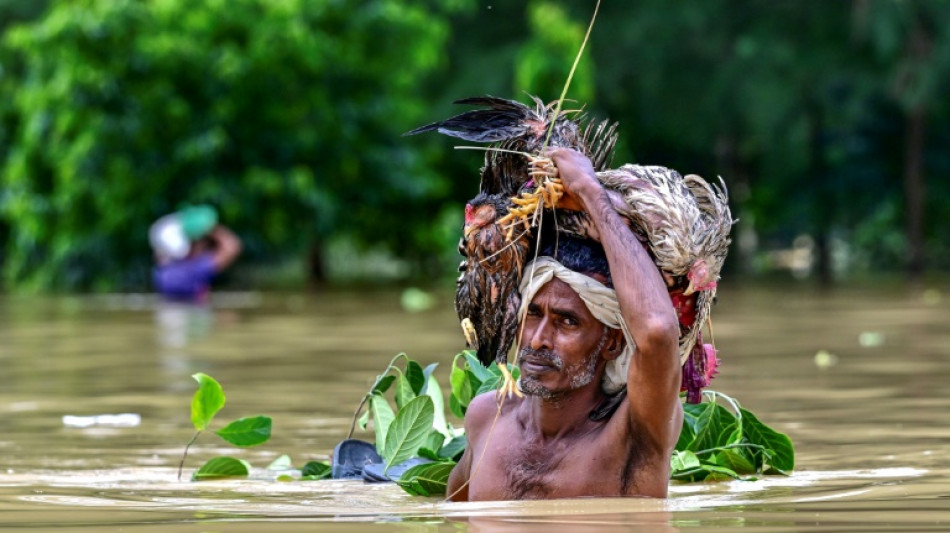
Nearly 300,000 Bangladeshis in emergency shelters after floods / Photo: Munir Uz Zaman - AFP

 Kenya's economy faces climate change risks: World Bank

 Far right and far left battle for power in polarised Berlin

 The last trio: S.Africa's zoo elephants await their fate
 Oil industry sees war windfall but girds for political blowback

 Amazon beats expectations with cloud and AI growth

 Blowout Microsoft results lift US stocks as oil retreats

 'Beginning of the end': Relief but no party as French wildfire winds down

 Southern Europe 'becoming more flammable' in hotter climate, experts say

 Mammoth bones found on parched bed of Danube in Bulgaria

 MEXC Lists Grvt (GRVT) with $60,000 Worth of GRVT and 10,000 USDT in Airdrop+ Rewards
 George and Amal Clooney flee French home due to wildfire

 MEXC Ventures Supports Alpha Arena's APAC Debut at Coinfest Bali

 AI data centre supplier Zhongji InnoLight slips on Hong Kong debut

 May, June heatwaves caused 2,877 extra deaths in England: govt

 BMW profit down a third as carmaker plans job cuts

 Seoul extends losses as most Asian markets drop, oil rises again

 Gambling.com Group Is Now Grandstand

 Meet the astronomer digging into the Milky Way's 'fossils'

 AI data centre supplier Zhongji InnoLight falls on Hong Kong debut

 Samsung operating profit up 1,800% in second quarter on AI boom

 Japanese population below 120 million for first time in decades

 US actor Jared Leto denies latest accusations of sexual assault

 Danube drops to 'historic lows' as fresh heatwave hits

 BTS pulls out of Grammys after Asian pop category introduction

 OpenAI says rogue AI agent attack hit other companies

Nearly 300,000 Bangladeshis were taking refuge in emergency shelters Saturday from floods that inundated vast areas of the low-lying South Asian country, disaster officials said.
The floods were triggered by heavy monsoon rains and have killed at least 42 people in Bangladesh and India since the start of the week, many in landslides.
"My house is completely inundated," Lufton Nahar, 60, told AFP from a relief shelter in Feni, one of the worst-hit districts near the border with India's Tripura state.
"Water is flowing above our roof. My brother brought us here by boat. If he hadn't, we would have died."
The nation of 170 million people is crisscrossed by hundreds of rivers and has seen frequent floods in recent decades.
Monsoon rains cause widespread destruction every year but climate change is shifting weather patterns and increasing the number of extreme weather events.
Highways and rail lines were damaged between the capital Dhaka and the main port city of Chittagong, making access to badly flooded districts difficult and disrupting business activity.
The flooding also comes just weeks after a student-led revolution toppled Bangladesh's government.
Among the worst affected areas is Cox's Bazar, a district home to around a million Rohingya refugees from neighbouring Myanmar.
Tripura state disaster agency official Sarat Kumad Das told AFP that 24 people had been killed on the Indian side of the border since Monday.
Another 18 had been killed in Bangladesh, according to disaster management ministry secretary Md Kamrul Hasan.
"285,000 people are living in emergency shelters," he said, adding that 4.5 million people in total had been affected.
- Recovering from unrest -
When the floods hit, Bangladesh was recovering from weeks of civil unrest that culminated in the August 5 toppling of autocratic ex-leader Sheikh Hasina.
With an interim government led by Nobel Peace Prize laureate Muhammad Yunus still finding its feet, ordinary Bangladeshis have been crowdfunding relief efforts.
They have been organised by the same students who led the protests that sparked the ouster of Hasina, who remains in India after fleeing Dhaka.
Crowds visited Dhaka University on Friday to offer cash donations as students loaded rice sacks and crates of bottled water onto vehicles for areas affected by the deluge.
Much of Bangladesh is made up of deltas where the great Himalayan rivers, the Ganges and the Brahmaputra, wind towards the sea after coursing through India.
Several tributaries of the two transnational rivers were still overflowing.
However, forecasts showed rain was likely to ease in the coming days.
- 'Creating a flood' -
India was Hasina's biggest patron and benefactor and many Bangladeshis have since been openly critical of their bigger and more powerful neighbour for backing her 15-year rule.
Asif Mahmud, a leader of the student protests who is now in Yunus' caretaker cabinet, accused India on Wednesday of "creating a flood" by deliberately releasing water from dams.
Hundreds of people also gathered at Dhaka University on Friday to protest against India's "water aggression", featuring a banner showing Indian Prime Minister Narendra Modi supposedly delighting at the sight of drowning people.
India's foreign ministry has rejected the charge, saying its own catchment area this week had experienced the "heaviest rains of this year" and that the flow of water downstream was due to "automatic releases".
The impact of floods remains severe in India's Tripura state, with around 65,000 people sheltering across 450 relief camps, according to local media reports.
S.F.Lacroix--CPN