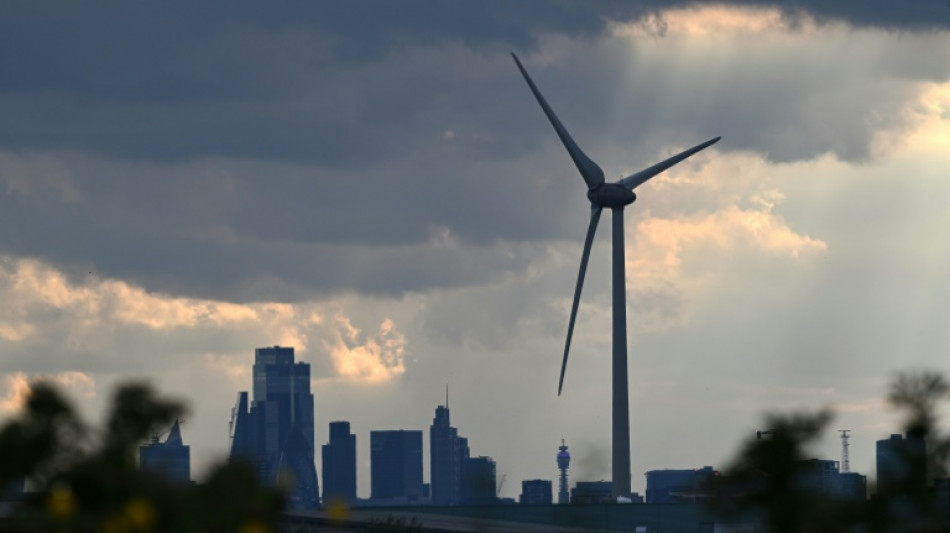
Combining climate measures key to slashing emissions: study / Photo: JUSTIN TALLIS - AFP

 Kenya's economy faces climate change risks: World Bank

 Far right and far left battle for power in polarised Berlin

 The last trio: S.Africa's zoo elephants await their fate

 Oil industry sees war windfall but girds for political blowback

 Amazon beats expectations with cloud and AI growth

 Blowout Microsoft results lift US stocks as oil retreats

 'Beginning of the end': Relief but no party as French wildfire winds down

 Southern Europe 'becoming more flammable' in hotter climate, experts say

 Mammoth bones found on parched bed of Danube in Bulgaria

 MEXC Lists Grvt (GRVT) with $60,000 Worth of GRVT and 10,000 USDT in Airdrop+ Rewards

 George and Amal Clooney flee French home due to wildfire

 MEXC Ventures Supports Alpha Arena's APAC Debut at Coinfest Bali

 AI data centre supplier Zhongji InnoLight slips on Hong Kong debut

 May, June heatwaves caused 2,877 extra deaths in England: govt

 BMW profit down a third as carmaker plans job cuts

 Seoul extends losses as most Asian markets drop, oil rises again

 Gambling.com Group Is Now Grandstand

 Meet the astronomer digging into the Milky Way's 'fossils'

 AI data centre supplier Zhongji InnoLight falls on Hong Kong debut

 Samsung operating profit up 1,800% in second quarter on AI boom

 Japanese population below 120 million for first time in decades

 US actor Jared Leto denies latest accusations of sexual assault

 Danube drops to 'historic lows' as fresh heatwave hits

 BTS pulls out of Grammys after Asian pop category introduction

 OpenAI says rogue AI agent attack hit other companies

A major new study published Thursday on the effectiveness of climate measures such as taxes or subsidies in reducing greenhouse gases has found stand-alone measures fail to make a big difference.
Published in the journal Science, the study examined 25 years of public policies in 41 countries across six continents.
It concluded that out of the 1,500 policies analysed in sectors including energy, transport and construction, "only 63 cases of successful climate policies, each leading to average emission reductions of 19 percent, were identified."
"The researchers show that bans on coal-fired power plants or combustion engine cars do not result in major emissions reductions when implemented alone," said the Potsdam Institute for Climate Impact Research (PIK) that led the study with Mercator Research Institute on Global Commons and Climate Change (MCC).
"Successful cases only arise in tandem with tax or price incentives in well-designed policy mixes, as shown in the UK for coal-fired power generation or in Norway for cars," the researchers said.
The study used a new OECD database and an innovative approach that combined machine learning methods with established statistical analyses.
It "identified 63 successful policy interventions with total emission reductions between 0.6 billion and 1.8 billion tonnes CO2".
By comparison, humanity emitted 57.4 billion tonnes of CO2 equivalent in 2022, according to United Nations estimates.
Among the successes identified was Britain's introduction in 2013 of a minimum carbon price, subsidies for renewable energy, and a coal phase-out plan.
The researchers hope their work will influence the climate roadmaps countries are updating and must submit to the UN by February 2025.
The aim of these roadmaps is to keep alive the Paris Agreement's flagship goal of limiting warming to 1.5 degrees Celsius from pre-industrial levels.
- 'Right mix is crucial' -
An interactive website, "Climate Policy Explorer", provides an overview of the results, analysis and methods, and is accessible to the public.
"Our findings demonstrate that more policies do not necessarily equate to better outcomes. Instead, the right mix of measures is crucial," explained the study's lead author Nicolas Koch of PIK and MCC.
"For example, subsidies or regulations alone are insufficient; only in combination with price-based instruments, such as carbon and energy taxes, can they deliver substantial emission reductions."
"But by focusing only on 69 statistically identifiable large trend breaks, they miss the impact of thousands of smaller efforts globally, and the cumulative and often self-reinforcing impact of many smaller measures", said Michael Grubb at University College London.
He also acknowledged "the most sophisticated study to date".
"Their conclusion that big impacts require combinations of policies makes absolute sense," he added.
"The study only looks for policies making sudden reductions, whereas most climate policies work on the efficiency of new things or the long-term trajectory of emissions, taking many years to build up greener infrastructure or ways of living," said Robin Lamboll at Imperial College London.
Y.Ponomarenko--CPN