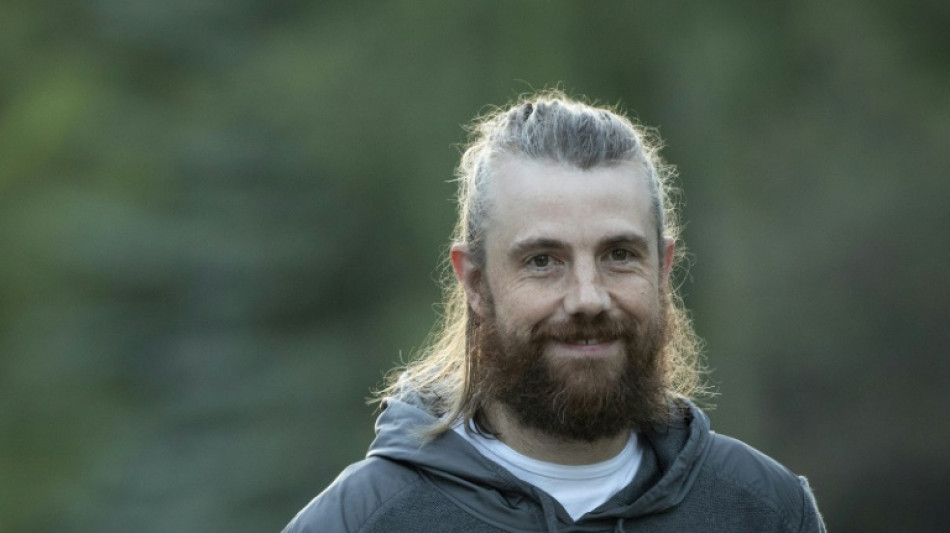
Cannon-Brookes: Australia's billionaire climate warrior / Photo: Drew Angerer - GETTY IMAGES NORTH AMERICA/AFP

 Kenya's economy faces climate change risks: World Bank
 Far right and far left battle for power in polarised Berlin
 The last trio: S.Africa's zoo elephants await their fate
 Oil industry sees war windfall but girds for political blowback
 Amazon beats expectations with cloud and AI growth

 Blowout Microsoft results lift US stocks as oil retreats

 'Beginning of the end': Relief but no party as French wildfire winds down

 Southern Europe 'becoming more flammable' in hotter climate, experts say

 Mammoth bones found on parched bed of Danube in Bulgaria

 MEXC Lists Grvt (GRVT) with $60,000 Worth of GRVT and 10,000 USDT in Airdrop+ Rewards

 George and Amal Clooney flee French home due to wildfire

 MEXC Ventures Supports Alpha Arena's APAC Debut at Coinfest Bali

 AI data centre supplier Zhongji InnoLight slips on Hong Kong debut

 May, June heatwaves caused 2,877 extra deaths in England: govt

 BMW profit down a third as carmaker plans job cuts

 Seoul extends losses as most Asian markets drop, oil rises again

 Gambling.com Group Is Now Grandstand

 Meet the astronomer digging into the Milky Way's 'fossils'

 AI data centre supplier Zhongji InnoLight falls on Hong Kong debut

 Samsung operating profit up 1,800% in second quarter on AI boom

 Japanese population below 120 million for first time in decades

 US actor Jared Leto denies latest accusations of sexual assault
 Danube drops to 'historic lows' as fresh heatwave hits
 BTS pulls out of Grammys after Asian pop category introduction

 OpenAI says rogue AI agent attack hit other companies
Tech billionaire Mike Cannon-Brookes once joked he could not tell the difference between an AA battery in his kids' toys and the gigantic lithium-ion units powering today's green energy revolution.
Today, he is the driving force behind a $24 billion project to build the world's largest solar battery hub in Australia's remote outback.
The 44-year-old was born in the United States before moving to Sydney at an early age.
He gained riches and public attention through software start-up Atlassian and investments in high-profile sports teams like the NBA's Utah Jazz.
But a lost wager with Elon Musk seven years ago set him on a path towards massive renewable energy investments -- and he has not looked back since.
He and university friend Scott Farquhar founded Atlassian in 2002 with few expectations.
"Our goals when we started were not to have to get a real job and to not have to wear a suit to work every day," Cannon-Brookes once recalled.
Atlassian now has 12,000 employees in 13 countries and "our software is being used on not just one, but two planets" he boasts, referencing the firm's involvement with NASA Mars rovers.
It also made him one of Australia's richest people -- with an estimated net worth of more than $10 billion.
His involvement with renewables began almost by accident -- thanks to self-described "idiocy on Twitter".
- Twitter 'idiocy' -
Back in March 2017, Australia was in the grip of an energy crisis, which Musk claimed Tesla batteries could solve in 100 days.
"Without thinking, I fired off a bunch of tweets, challenging them and saying 'were they really serious about this?'" Cannon-Brookes recalled in a TEDx talk a few months later.
If Musk could deliver what was then the world's biggest lithium-ion battery within 100 days, Cannon-Brookes promised to pay for it.
If Musk took longer than that, the battery would be free.
Within 60 days, the battery was switched on and Cannon-Brookes had lost the bet.
He was, he admits, "miles out of my depth".
"At the time, I really couldn't tell you the difference between a one-and-a-half volt battery that goes in my kids' toys and a 100-megawatt-hour industrial-scale battery facility," he later said.
"I remember thinking to myself, 'Shit. I've kind of started something here and I can't really get out."
"So I spent a week trying to learn everything I could about industrial-scale batteries and the electricity grid and renewables and the economics of all of this".
That was the spark that led to billions of dollars worth of green projects, including renewable energy initiatives and a plant-based meat startup.
He now holds the largest stake in AGL, Australia's largest electricity provider.
His ties with coal-hungry AGL might seem surprising at first, especially since he once called the company "one of the most toxic" on the planet.
But his Trojan Horse campaign is forcing the firm to decarbonise by closing two of its biggest coal-fired power stations years earlier than planned.
His latest SunCable project is perhaps even more radical.
It will include a vast array of solar panels, batteries and, eventually, a cable linking Australia with Singapore. It is slated to power three million homes.
Cannon-Brookes believes the case for renewables -- and projects like the one he is building in northern Australia -- make both business and climate sense.
"The green economy is Australia's golden ticket," he insists.
"At this point in history -- we no longer need to talk as much about stopping things, because the economy has done that for us.
"Fossil fuels are unreliable and expensive compared to renewables when it comes to energy generation. We'll see this filter through industry after industry. We will electrify everything."
For a man who never wanted a "real job", Cannon-Brookes has certainly kept himself busy.
H.Cho--CPN