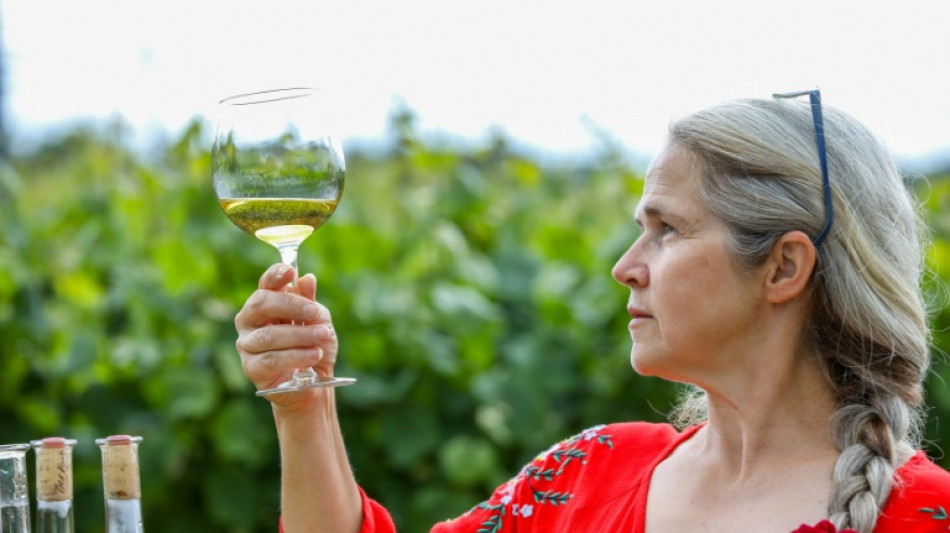
Climate change a mixed blessing for sun-starved Irish vintners
/ Photo: Paul Faith - AFP

 Kenya's economy faces climate change risks: World Bank

 Far right and far left battle for power in polarised Berlin

 The last trio: S.Africa's zoo elephants await their fate

 Oil industry sees war windfall but girds for political blowback

 Amazon beats expectations with cloud and AI growth

 Blowout Microsoft results lift US stocks as oil retreats

 'Beginning of the end': Relief but no party as French wildfire winds down

 Southern Europe 'becoming more flammable' in hotter climate, experts say

 Mammoth bones found on parched bed of Danube in Bulgaria

 MEXC Lists Grvt (GRVT) with $60,000 Worth of GRVT and 10,000 USDT in Airdrop+ Rewards

 George and Amal Clooney flee French home due to wildfire

 MEXC Ventures Supports Alpha Arena's APAC Debut at Coinfest Bali

 AI data centre supplier Zhongji InnoLight slips on Hong Kong debut

 May, June heatwaves caused 2,877 extra deaths in England: govt

 BMW profit down a third as carmaker plans job cuts

 Seoul extends losses as most Asian markets drop, oil rises again

 Gambling.com Group Is Now Grandstand

 Meet the astronomer digging into the Milky Way's 'fossils'

 AI data centre supplier Zhongji InnoLight falls on Hong Kong debut

 Samsung operating profit up 1,800% in second quarter on AI boom

 Japanese population below 120 million for first time in decades

 US actor Jared Leto denies latest accusations of sexual assault

 Danube drops to 'historic lows' as fresh heatwave hits

 BTS pulls out of Grammys after Asian pop category introduction

 OpenAI says rogue AI agent attack hit other companies

At a tiny outpost in the wine world, Ireland's handful of winemakers are cautiously eyeing long-term growth potential as climate change warms up its cool climate.
According to Ireland's meteorological service, typically rainy Irish summers are getting warmer and drier on average.
And at Ireland's largest vineyard, owner Esperanza Hernandez says "better weather makes it more possible than before to make high-quality wine" even on the sun-starved island.
Commercial vineyards, mostly dotted around the southern and eastern coasts and producing mainly white wines, are rare in Ireland.
Hernandez's 10-acre (4-hectare) vineyard lies near the village of Wellingtonbridge in the south-eastern coastal county of Wexford, statistically Ireland's sunniest corner.
"We need all the sun we can get," Hernandez, who moved from Spain to Ireland 20 years ago, told AFP as she pruned unproductive branches on a typically overcast and damp summer's day.
The rows of vines at the site which faces southwest but is sheltered from the wind, are planted wide apart to maximise sunlight reaching the grapes.
"If we take out this and that branch we can see the grapes, and the grapes can also see the sun..." said the diminutive 55-year-old who hails from a family of wine producers.
"...if it comes out at all," she smiled.
- Greater 'unpredictability' -
So far Ireland has been relatively shielded from dramatic impacts of climate change like wildfires, drought and death.
But agriculture still relies on a stable climate that is no longer guaranteed, even in moderate and mild Ireland.
"Climate change is not just about warmer temperatures, it brings unpredictability: frosts, storms, rain, and dry spells when there shouldn't normally be," Hernandez told AFP.
Irregular rain also means muddy soil that can prevent timely treatment of vines for fungus for example.
"You have to wait until the rain stops and the soil dries before a tractor can enter," she said.
After analysing the climate and soil in different locations Hernandez and her husband's "The Old Roots" company planted its first vines in 2015 to test the potential for quality viticulture in Ireland, and crafted their first wine in 2019.
Now they produce up to 10,000 bottles of red and white varieties annually, and have ambitious plans to expand.
But aside from the climate constraint, Irish producers face challenges unheard of in southern European climes, said Hernandez.
Machinery, technology, supplies and expert knowledge are all thin on the ground in Ireland.
"You have to bring in almost everything from abroad... it inflates threefold the cost of making wine," she told AFP.
- 'Far future' -
David Llewellyn, who has been making wine further up the east coast near Dublin for 20 years, said the emergence of Ireland as a mainstream wine region is in the "far, not near, future".
"Our climate would need to warm significantly for us to be able to grow classic grape varieties that the market wants," the 48-year-old told AFP at his vineyard in Lusk, one of the driest parts of Ireland according to data.
"The handful of varieties that we can grow successfully and relatively reliably in Ireland are really obscure for most consumers even though they can make a good wine," he said.
With a hint of envy, Llewellyn looks at "climactic advantages" enjoyed in southern England where average temperatures are a few degrees higher than in Ireland.
"But even there, where wine production now is millions of bottles a year and there are 500 odd vineyards, English wine is expensive relative to French, Italian, Chilean and so on," he said.
According to Aileen Rolfe, an England-based wine expert, climate change is undoubtedly pushing production northwards in Europe and having a material impact on existing traditional wine countries.
"Harvests are moving from September to August to prevent sunburned grapes while growers are planting grape varieties more able to cope with heat," she said.
Sounding an optimistic note for Irish wine trailblazers, she pointed to fashionable "newbie" markets like England, New Zealand and Argentina.
"There were no vines planted in New Zealand until the 1970s, it also took a generation for English wine to be taken seriously," she told AFP.
Some conditions favourable for grape growing like fertile soil and long hours of summer daylight are already present in Ireland, Rolfe added.
Irish winemakers who are clever with site selection and willing to "play the long game" can reap rewards, she said.
"The future can be bright for Irish wine, it could be the English wine industry of the next generation," she added.
D.Philippon--CPN