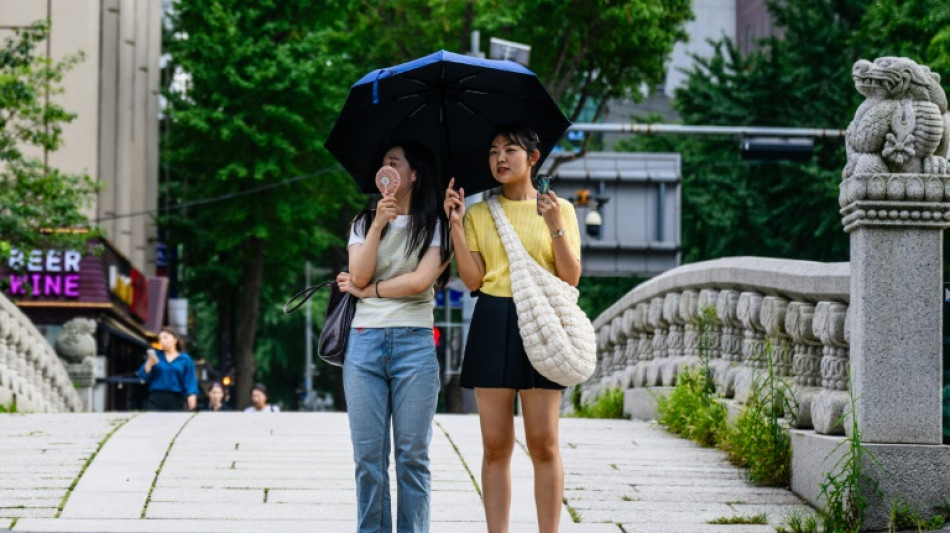
Seoul residents sweating with record 'tropical nights' weather / Photo: ANTHONY WALLACE - AFP

 Kenya's economy faces climate change risks: World Bank
 Far right and far left battle for power in polarised Berlin

 The last trio: S.Africa's zoo elephants await their fate
 Oil industry sees war windfall but girds for political blowback

 Amazon beats expectations with cloud and AI growth

 Blowout Microsoft results lift US stocks as oil retreats

 'Beginning of the end': Relief but no party as French wildfire winds down
 Southern Europe 'becoming more flammable' in hotter climate, experts say

 Mammoth bones found on parched bed of Danube in Bulgaria

 MEXC Lists Grvt (GRVT) with $60,000 Worth of GRVT and 10,000 USDT in Airdrop+ Rewards
 George and Amal Clooney flee French home due to wildfire

 MEXC Ventures Supports Alpha Arena's APAC Debut at Coinfest Bali

 AI data centre supplier Zhongji InnoLight slips on Hong Kong debut

 May, June heatwaves caused 2,877 extra deaths in England: govt
 BMW profit down a third as carmaker plans job cuts

 Seoul extends losses as most Asian markets drop, oil rises again

 Gambling.com Group Is Now Grandstand
 Meet the astronomer digging into the Milky Way's 'fossils'

 AI data centre supplier Zhongji InnoLight falls on Hong Kong debut

 Samsung operating profit up 1,800% in second quarter on AI boom

 Japanese population below 120 million for first time in decades

 US actor Jared Leto denies latest accusations of sexual assault

 Danube drops to 'historic lows' as fresh heatwave hits
 BTS pulls out of Grammys after Asian pop category introduction

 OpenAI says rogue AI agent attack hit other companies

Residents of South Korea's capital are resorting to novel ways to beat the heat as a century-old weather record fell Friday following a 26th "tropical night" in a row -- when the temperature stays above 25 degrees Celsius (77 Fahrenheit).
"I take a cold shower before bed and tie freezer packs around my electric fan to cool the air," Lee Ji-soo told AFP Friday.
Overnight temperatures in Seoul have sizzled above 25 degrees Celsius for 26 days in a row, officials said Friday, marking the longest streak since modern weather observation began in 1907.
Such evenings are widely known as "tropical nights" in South Korea.
Much of the world is enduring a summer of sweltering weather, with UN Secretary-General Antonio Guterres warning last month of an "extreme heat epidemic", and calling for action to limit the impact of climate change.
The intense heat in Seoul is expected to continue, according to the met office, setting a record every day until next week.
"The cold air is not coming down from the north," Youn Ki-han, director at Seoul's Meteorology Forecast Division, told AFP.
"Usually around this time the temperature drops in the morning and evening... but currently we aren't seeing any signs of that yet," said Youn.
As temperatures soar, residents struggle to find ways to cope with the sweltering nights.
"I think I turn on my air conditioner 23 hours a day," said Kim Young-sook, who lives in Gangnam district, an affluent neighbourhood in Seoul.
"I'm worried my dogs will become too hot -- even during at night."
That isn't an option for Lee Ji-soo, who straps icepacks to her fan.
"I do have an air conditioner but I just can't afford the electricity bill," she said.
"The air is suffocating sometimes. I don't know how long I can live like this."
- Power hungry -
Data from Korea Power Exchange showed South Korea's electricity demand hit an all-time high on Monday as people battled the heatwave with air conditioners and fans.
Some 102.3 gigawatts were used, passing the previous record of 100.6 gigawatts set last August, the agency said.
According to the International Institute for Environment and Development (IIED), the number of days with temperatures reaching 35 degrees Celsius in the world's largest capital cities has surged by 52 percent over the past 30 years.
In 2018 alone, Seoul experienced 21 days with temperatures over 35 degrees Celsius -- more than the previous 10 years combined.
"In just one generation, there's been an alarming increase," said Dr Tucker Landesman, a senior researcher at IIED.
Climate activists in South Korea are calling for more government action.
"There's no chance that this will get better and it's bound to get worse," Youn Se-jong, an environmental lawyer, told AFP.
"Strengthening the goal of reducing greenhouse gas emissions should be the priority," he added.
South Korea currently has the lowest proportion of renewable energy in its power mix among all OECD countries and is the G20's second-highest carbon emitter from coal per capita, according to energy think tank Ember.
North Korea is also sweltering under a heatwave and issued a warning earlier this week, with central areas including Pyongyang affected.
"Severe heat of 33 to 37 (degrees Celsius) is foreseen in some areas," said Kim Kwang Hyok, an official at the State Hydro-Meteorological Administration.
St.Ch.Baker--CPN