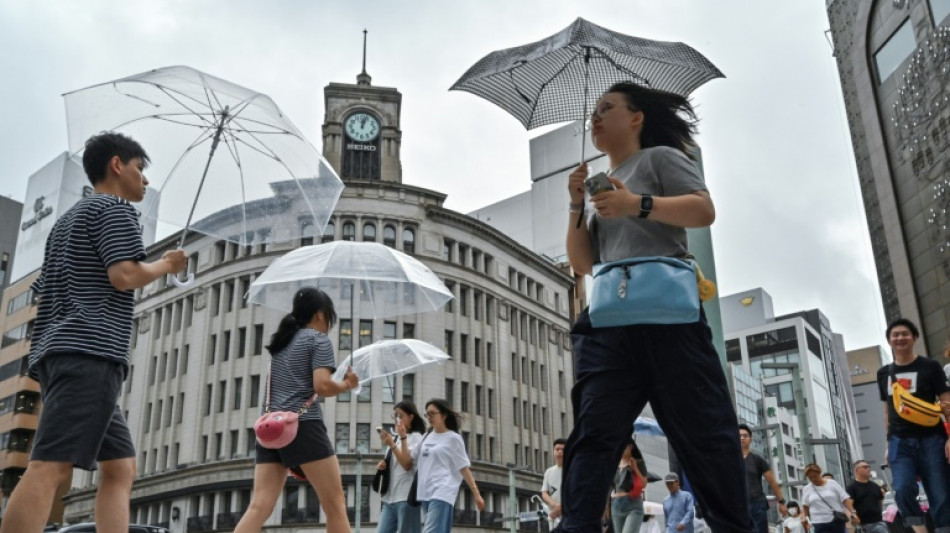
'Very strong' typhoon buffets Japan's Pacific coast / Photo: Richard A. Brooks - AFP

 Kenya's economy faces climate change risks: World Bank

 Far right and far left battle for power in polarised Berlin

 The last trio: S.Africa's zoo elephants await their fate

 Oil industry sees war windfall but girds for political blowback

 Amazon beats expectations with cloud and AI growth

 Blowout Microsoft results lift US stocks as oil retreats

 'Beginning of the end': Relief but no party as French wildfire winds down

 Southern Europe 'becoming more flammable' in hotter climate, experts say

 Mammoth bones found on parched bed of Danube in Bulgaria

 MEXC Lists Grvt (GRVT) with $60,000 Worth of GRVT and 10,000 USDT in Airdrop+ Rewards

 George and Amal Clooney flee French home due to wildfire

 MEXC Ventures Supports Alpha Arena's APAC Debut at Coinfest Bali

 AI data centre supplier Zhongji InnoLight slips on Hong Kong debut

 May, June heatwaves caused 2,877 extra deaths in England: govt

 BMW profit down a third as carmaker plans job cuts

 Seoul extends losses as most Asian markets drop, oil rises again

 Gambling.com Group Is Now Grandstand

 Meet the astronomer digging into the Milky Way's 'fossils'

 AI data centre supplier Zhongji InnoLight falls on Hong Kong debut

 Samsung operating profit up 1,800% in second quarter on AI boom

 Japanese population below 120 million for first time in decades

 US actor Jared Leto denies latest accusations of sexual assault

 Danube drops to 'historic lows' as fresh heatwave hits

 BTS pulls out of Grammys after Asian pop category introduction

 OpenAI says rogue AI agent attack hit other companies

A "very strong" typhoon buffeted Japan's Pacific coast with fierce winds and heavy rain on Friday, forcing the cancellation of hundreds of flights and trains in the Tokyo area and leaving over 4,000 homes without power.
Located about 300 kilometres (190 miles) south of Tokyo, Typhoon Ampil was packing gusts of up to 216 kph as it headed north, the Japan Meteorological Agency said.
The eye of the typhoon was not expected to make landfall, instead barrelling north-eastward up the Honshu coast and skirting the Tokyo region, home to around 40 million people, before heading back into the Pacific from Saturday.
The JMA rated the weather system as "very strong", one notch below its highest category of "violent typhoon", with maximum wind speeds of 105 knots (120 mph, 195 kmh).
The agency warned people they "should be on high alert for storms, high waves, landslides and flooding" in a social media post.
The US military's Joint Typhoon Warning Center forecast maximum sustained wind speeds of 110 knots and gusts of 135 knots by 3:00 pm off the coastal Chiba region east of the capital.
Over 4,000 households in Tokyo's neighbouring prefectures, mainly Chiba, were without power as of Friday morning due to the typhoon, according to the utility operator.
All Nippon Air cancelled 335 domestic and international flights on Friday, with more planned for Saturday, affecting about 72,000 passengers.
Japan Airlines has so far scrapped 361 flights, hitting 57,000 customers.
Major parts of Japan's network of bullet train services were also to be closed Friday -- including the busy section between Tokyo and Nagoya -- while Tokyo Disneyland's operator said the park would close from 3:00 pm.
The typhoon comes as Japan marks the "obon" holiday week when millions return to their hometowns, and days after Tropical Storm Maria dumped record rains in parts of the north.
"We will check our phones for any information on the internet and if the typhoon seems OK, then we'll go outside," said Isamu Teruya, 47, a visitor from Saga Prefecture who arrived in Tokyo on Thursday.
"If the rain is really bad, then we will stay inside our hotel and relax," Teruya told AFP.
Typhoons in the region have been forming closer to coastlines, intensifying more rapidly and lasting longer over land due to climate change, according to a study released last month.
Researchers from universities in Singapore and the United States analysed more than 64,000 modelled historic and future storms from the 19th century through the end of the 21st century to come up with the findings.
X.Cheung--CPN