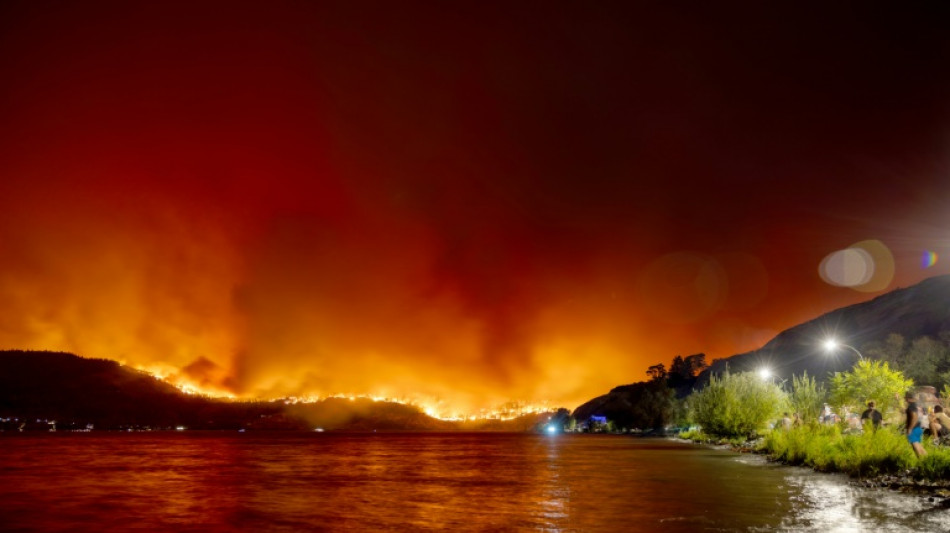
Wildfires caused major CO2 emissions last year: annual study / Photo: Darren HULL - AFP/File

 Kenya's economy faces climate change risks: World Bank

 Far right and far left battle for power in polarised Berlin

 The last trio: S.Africa's zoo elephants await their fate

 Oil industry sees war windfall but girds for political blowback

 Amazon beats expectations with cloud and AI growth

 Blowout Microsoft results lift US stocks as oil retreats

 'Beginning of the end': Relief but no party as French wildfire winds down

 Southern Europe 'becoming more flammable' in hotter climate, experts say

 Mammoth bones found on parched bed of Danube in Bulgaria

 MEXC Lists Grvt (GRVT) with $60,000 Worth of GRVT and 10,000 USDT in Airdrop+ Rewards

 George and Amal Clooney flee French home due to wildfire

 MEXC Ventures Supports Alpha Arena's APAC Debut at Coinfest Bali

 AI data centre supplier Zhongji InnoLight slips on Hong Kong debut

 May, June heatwaves caused 2,877 extra deaths in England: govt

 BMW profit down a third as carmaker plans job cuts

 Seoul extends losses as most Asian markets drop, oil rises again

 Gambling.com Group Is Now Grandstand

 Meet the astronomer digging into the Milky Way's 'fossils'

 AI data centre supplier Zhongji InnoLight falls on Hong Kong debut

 Samsung operating profit up 1,800% in second quarter on AI boom

 Japanese population below 120 million for first time in decades

 US actor Jared Leto denies latest accusations of sexual assault

 Danube drops to 'historic lows' as fresh heatwave hits

 BTS pulls out of Grammys after Asian pop category introduction

 OpenAI says rogue AI agent attack hit other companies

Wildfires made more frequent and intense by climate change released significant quantities of CO2 into the air in 2023-2024, said a first-of-its-kind annual study published Wednesday.
Fires in natural areas caused 8.6 billion tonnes of CO2 emissions worldwide between March 2023 and February 2024 -- 16 percent above average.
Only a relatively calm fires season in the African savannah prevented the 2023-2024 season from breaking a fresh record for CO2 emissions at the global level.
These were among the conclusions in a new study, "State of Wildfires", published in the journal Earth System Science Data.
It was carried out by the University of East Anglia and other institutions based in Britain and aims to be updated on an annual basis.
Emissions from fires in Canada's boreal forests were more than nine times greater than the average over the past two decades. They contributed to almost a quarter of global emissions.
In Canada alone, the fires forced the evacuations of 232,000 people and eight firefighters lost their lives.
Other areas that also suffered included the Amazon (Brazil, Bolivia, Peru, Venezuela), Hawaii and Greece.
"Last year, fires killed people, destroyed homes and infrastructure, caused mass evacuations, threatened livelihoods and damaged vital ecosystems," said Matthew Jones of the University of East Anglia and lead author of the study.
"These fires are becoming more frequent and intense with climate warming, and both society and the environment are suffering the consequences."
The authors of the report concluded that climate change has made weather conditions favouring the fires more likely.
They found that human influence has increased by at least a factor of 20 the probability of weather conditions conducive to fires in the western Amazon.
If humanity continues to produce large amounts of greenhouse gas, major fires -- like those that took place last year -- will become more likely.
But nothing is set in stone.
"The risk can be minimised. It is not too late," said Jones during a presentation of the report to media.
"A low-carbon future offers a lot of respite from the risks we face in the future."
Over the past two decades as human activity has warmed the planet, the frequency and intensity of extreme wildfires has more than doubled worldwide, according to a study published in June in Nature Ecology & Evolution.
H.Müller--CPN