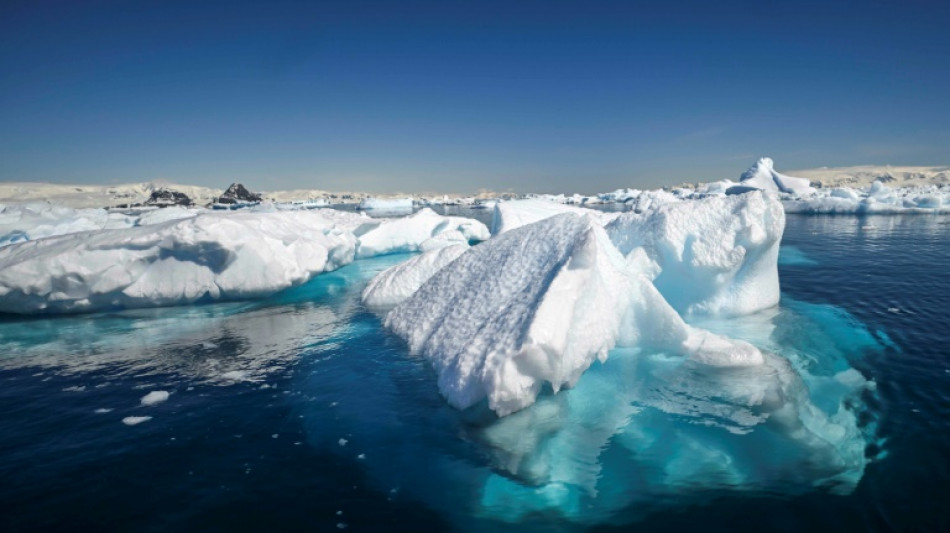
Antarctica winter experiences prolonged heatwave / Photo: Juan BARRETO - AFP

 Kenya's economy faces climate change risks: World Bank

 Far right and far left battle for power in polarised Berlin

 The last trio: S.Africa's zoo elephants await their fate

 Oil industry sees war windfall but girds for political blowback

 Amazon beats expectations with cloud and AI growth

 Blowout Microsoft results lift US stocks as oil retreats

 'Beginning of the end': Relief but no party as French wildfire winds down

 Southern Europe 'becoming more flammable' in hotter climate, experts say

 Mammoth bones found on parched bed of Danube in Bulgaria

 MEXC Lists Grvt (GRVT) with $60,000 Worth of GRVT and 10,000 USDT in Airdrop+ Rewards

 George and Amal Clooney flee French home due to wildfire

 MEXC Ventures Supports Alpha Arena's APAC Debut at Coinfest Bali

 AI data centre supplier Zhongji InnoLight slips on Hong Kong debut

 May, June heatwaves caused 2,877 extra deaths in England: govt

 BMW profit down a third as carmaker plans job cuts

 Seoul extends losses as most Asian markets drop, oil rises again

 Gambling.com Group Is Now Grandstand

 Meet the astronomer digging into the Milky Way's 'fossils'

 AI data centre supplier Zhongji InnoLight falls on Hong Kong debut

 Samsung operating profit up 1,800% in second quarter on AI boom

 Japanese population below 120 million for first time in decades

 US actor Jared Leto denies latest accusations of sexual assault

 Danube drops to 'historic lows' as fresh heatwave hits

 BTS pulls out of Grammys after Asian pop category introduction

 OpenAI says rogue AI agent attack hit other companies

Antarctica, the world's coldest continent, is experiencing an exceptionally long heatwave during its winter, according to Britain's national polar research institute.
Temperature anomalies are not unusual on the continent known as "The Ice" but "the longevity of the warm period is unusual", Thomas Caton Harrison, Polar Climate Scientist at British Antarctic Survey, said to AFP this week.
Provisional figures indicate the Antarctic-wide July 2024 average near-surface temperature was 3.1 degrees Celsius above normal for the month.
Calculated over land and land ice, this makes it the second warmest July in Antarctica since records began in 1979 -- the warmest was in July 1981.
Average daily temperatures ranged from -34.68C on July 15 to -28.12C on July 31, according to data posted online by the University of Maine.
It was -26.6C on average on the continent on August 7, the latest date available.
The July average temperature anomaly even reached 9-10C over limited parts of Dronning Maud Land and part of the eastern Weddell Sea offshore.
Daily temperature anomalies often occur during the Antarctica's winter, but "what is remarkable is prolonged high temperatures", said Caton Harrison.
"Very early figures suggest it could be on track to be an exceptionally warm Antarctic winter," he added.
"The Ice" is the coldest, windiest, and least populated continent on the planet, but it too is impacted by global warming.
Extreme heat on the continent has high stakes, notably as a trigger for greater ice loss.
According to a study published in June in the journal Nature Geoscience, scientists have discovered a new tipping point toward "runaway melting" of Antarctic ice sheets, caused by warm ocean water intruding between the ice and the land it sits on.
With the rise of ocean temperatures due to human-caused global warming, Antarctic ice sheets are melting, threatening a rise in global sea levels and putting coastal communities at risk.
D.Avraham--CPN