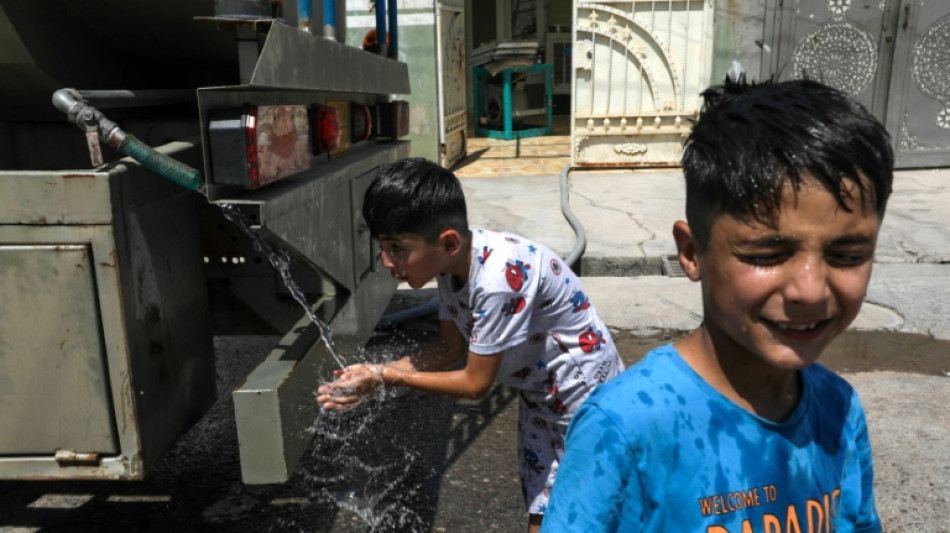
In Iraq's summer, residents of Kurdistan's Arbil ache for water / Photo: Safin HAMID - AFP

 Kenya's economy faces climate change risks: World Bank
 Far right and far left battle for power in polarised Berlin

 The last trio: S.Africa's zoo elephants await their fate

 Oil industry sees war windfall but girds for political blowback

 Amazon beats expectations with cloud and AI growth

 Blowout Microsoft results lift US stocks as oil retreats

 'Beginning of the end': Relief but no party as French wildfire winds down

 Southern Europe 'becoming more flammable' in hotter climate, experts say

 Mammoth bones found on parched bed of Danube in Bulgaria

 MEXC Lists Grvt (GRVT) with $60,000 Worth of GRVT and 10,000 USDT in Airdrop+ Rewards
 George and Amal Clooney flee French home due to wildfire

 MEXC Ventures Supports Alpha Arena's APAC Debut at Coinfest Bali

 AI data centre supplier Zhongji InnoLight slips on Hong Kong debut

 May, June heatwaves caused 2,877 extra deaths in England: govt
 BMW profit down a third as carmaker plans job cuts

 Seoul extends losses as most Asian markets drop, oil rises again
 Gambling.com Group Is Now Grandstand

 Meet the astronomer digging into the Milky Way's 'fossils'

 AI data centre supplier Zhongji InnoLight falls on Hong Kong debut

 Samsung operating profit up 1,800% in second quarter on AI boom

 Japanese population below 120 million for first time in decades

 US actor Jared Leto denies latest accusations of sexual assault

 Danube drops to 'historic lows' as fresh heatwave hits
 BTS pulls out of Grammys after Asian pop category introduction

 OpenAI says rogue AI agent attack hit other companies
The taps have run dry, and the wells are almost empty. In the capital of Iraq's autonomous Kurdistan region, 80-year-old Babir hasn't bathed in weeks and impatiently waits for trucked-in water deliveries.
"There is nothing worse than not having water," said Babir, who gave only his first name, in his modest house in Arbil's Darto suburb.
As in several other densely populated areas of Arbil and its suburbs, Babir and his neighbours rely on groundwater as their primary water source.
But for years, they have dreaded summer, when relentless drought, a lack of wells and power outages that bring pumps to a halt leave them cut off the supply of water.
For everything from bathing to watering plants, cooking and washing, they have been forced to depend on trucked-in water.
Usually "we bathe once every fortnight," said Babir, dressed in traditional Kurdish sarwal trousers.
From the roof of his house, he shouted for a water truck as it drove up into the street, then hurried downstairs to request a refill for his home.
This time, the truck belonged to a local aid group. When such assistance is unavailable, the retiree has to pay from his meagre pension or rely on family for water and other essentials.
Over the years, residents of several districts have taken to the streets many times to demand solutions, but Babir said appeals to officials had fallen on deaf ears. He said he was considering moving "to a place with water."
- Dried wells -
Iraq is known in Arabic as the Land of the Two Rivers, referring to the once mighty Tigris and Euphrates. But the rivers' water levels have plummeted and the UN classifies the country as one of the most impacted by some effects of climate change.
Authorities blame the drought as well as dams built upstream in neighbouring Turkey and Iran.
Arbil relies on 1,240 wells dotted across the city alongside the Ifraz water station that draws from the upper Zab River, which has its source in Turkey and joins the Tigris in Iraq.
Its governor, Omed Khoshnaw, told reporters earlier this month that "more than 25 percent of wells have dried up this year," adding that Arbil should rely less on groundwater.
Amid the crisis, the city's local authorities say they have allocated 1.5 billion Iraqi dinars ($1.1 million) to help solve it, including by digging new wells and providing power via generators and the electricity grid.
Local official Nabz Abdul Hamid said that power outages have heavily impacted pumps for wells in residential areas.
"We have now provided an uninterrupted electricity supply to most of the wells," he told AFP, adding that officials were working to fix the broader problem including by improving the Ifraz plant supply.
- 'Radical solutions' -
In the Darto district, one person skillfully manoeuvred the aid truck's hose as a torrent of water gushed into a tank.
A young girl waited to fill plastic bottles while other children joyfully splashed water on their faces, finding relief from the relentless heat.
But when it comes to washing, Surur Mohamad, 49, said that for anything more than basic clothes he goes to a nearby village where they have a steady water supply.
Trucked-in water from aid organisations "is not a solution," he said, adding that overcrowding has put further pressure on the water system while poor pipe infrastructure has exacerbated the problem.
"The government must find radical solutions as relying solely on wells" is no longer viable, especially considering the drought, he said.
His neighbour, Mahya Najm, said the lack of water had stopped her children and young families from visiting her.
"We cannot wash, cook or even receive guests," she said.
"We are in dire need of water. This is not a life," she added.
D.Goldberg--CPN