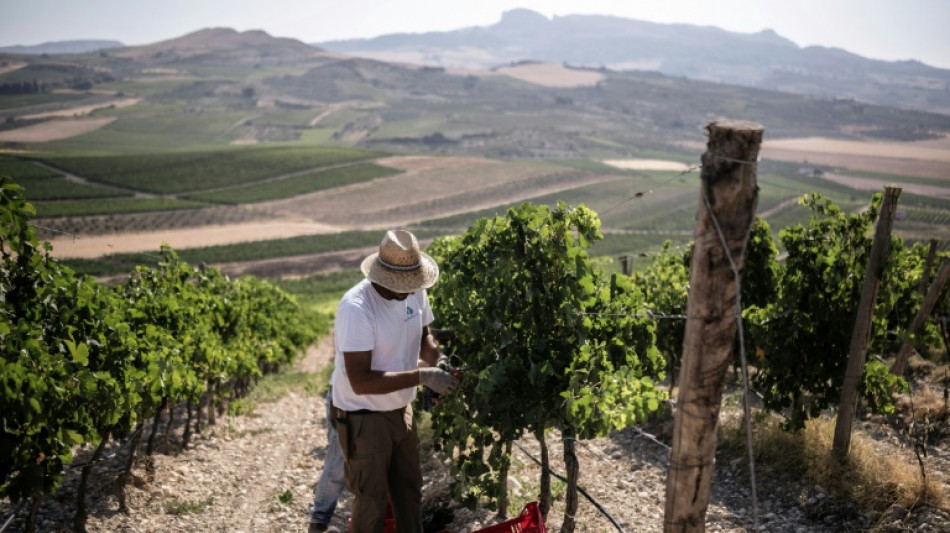
Harvest starts very early in Sicily's drought-hit vineyards / Photo: MARCO BERTORELLO - AFP

 Kenya's economy faces climate change risks: World Bank
 Far right and far left battle for power in polarised Berlin

 The last trio: S.Africa's zoo elephants await their fate
 Oil industry sees war windfall but girds for political blowback

 Amazon beats expectations with cloud and AI growth

 Blowout Microsoft results lift US stocks as oil retreats

 'Beginning of the end': Relief but no party as French wildfire winds down

 Southern Europe 'becoming more flammable' in hotter climate, experts say

 Mammoth bones found on parched bed of Danube in Bulgaria

 MEXC Lists Grvt (GRVT) with $60,000 Worth of GRVT and 10,000 USDT in Airdrop+ Rewards

 George and Amal Clooney flee French home due to wildfire

 MEXC Ventures Supports Alpha Arena's APAC Debut at Coinfest Bali

 AI data centre supplier Zhongji InnoLight slips on Hong Kong debut

 May, June heatwaves caused 2,877 extra deaths in England: govt
 BMW profit down a third as carmaker plans job cuts

 Seoul extends losses as most Asian markets drop, oil rises again

 Gambling.com Group Is Now Grandstand

 Meet the astronomer digging into the Milky Way's 'fossils'

 AI data centre supplier Zhongji InnoLight falls on Hong Kong debut

 Samsung operating profit up 1,800% in second quarter on AI boom

 Japanese population below 120 million for first time in decades

 US actor Jared Leto denies latest accusations of sexual assault
 Danube drops to 'historic lows' as fresh heatwave hits
 BTS pulls out of Grammys after Asian pop category introduction
 OpenAI says rogue AI agent attack hit other companies

On the hills of the Contessa Entellina vineyard in western Sicily, the harvest is already well underway, the grapes ripening earlier than usual because of drought and high temperatures.
The prestigious Donnafugata vineyards, which span the Italian island from the slopes of Marsala to the mantle of Mount Etna, began their harvest on July 22, an unprecedented two weeks early.
At Contessa Entellina, the company's main estate in the province of Agrigento, there has been almost no rain since May.
"Between October and the end of July, there has been 35 percent less rain," said Antonino Santoro, the estate's technical director and oenologist.
In 2022, the harvest had already begun on July 29.
The Sicily of myth is a fertile orchard blessed with rivers of pure water, but the modern day Mediterranean island suffers more and more from global warming.
Since the end of spring, water has stopped flowing, the soil and the springs parched.
Farmers here are used to the naturally arid territory, but they are being tested.
Even citrus fruits and olive trees are suffering from the drought and scorching temperatures which in 2021 set the European record of 48.8 degrees Centigrade (119.8 Fahrenheit).
- Drop by drop -
With 460 hectares of vines and 3.6 million bottles per year across all its territories, the Donnafugata company has the financial resources to adapt.
"Before, irrigation was useful, today it is essential," Santoro said.
Around Contessa Entellina the estate has installed several retention basins which meet around 75 percent of its irrigation needs, the rest covered by public reserves.
During June and July, it irrigates the vines using a micro-sprinkler system, which provides water at a rate of four litres per hour per vine.
"The aim is to optimise water use," said Giuseppe Milano, the estate's head of cultivation.
Irrigation is not cheap, costing between 4,000 and 6,000 euros per hectare per year. The average size of an Italian vineyard is 11 hectares.
At the end of July, the Italian government recognised Sicily was facing "force majeure conditions and exceptional circumstances" due to the drought, according to Sicilian authorities.
This eases some EU rules on agriculture and allows farmers to defer payments and charges, the region said, in response to a year-long drought it said was "one of the most serious in the last 50 years".
- Quantity and quality -
Donnafugata takes its name from the fictional town in "The Leopard", the novel by Giuseppe Tomasi di Lampedusa set in the area during the unification of Italy in the late 19th century.
Back then, the grape harvest did not begin before September.
As well as irrigation, Contessa Entellina adapts by growing its vines taller, up to 1.5 metres, so the upper foliage serves as a canopy to screen the grapes from the sun.
There is no such shade for the grape pickers, who use pruning shears to harvest the grapes under a blazing sun.
They started at dawn, and by 10:00am it is already 29 degrees Celsius.
For the first time, regional authorities have banned working in the fields during the hottest hours of the day, between 12:30 pm. and 4:00 pm.
They are now picking the Merlot grapes for red wine. The white Chardonnay ones were picked in July.
Depending on the varieties and the terroir, the grape harvest in Sicily this year will be spread out over three or four months -- "a unique situation in Europe", according to national agricultural association Coldiretti.
Contessa Entellina's harvest will be smaller than last year, with smaller grapes.
But Milano insisted that what it lacks in quantity is made up in quality.
Today, Donnafugata is involved in research projects to help prepare the vines for the evolving conditions.
"I am optimistic," said Santoro. "The vine adapts better than other crops."
It is not just heat that is affecting the harvest.
Last year, a combination of frost and floods in the north and mildew in the south cost the Italian wine industry a quarter of its production -- allowing France to take the title of the world's leading wine producer.
H.Cho--CPN