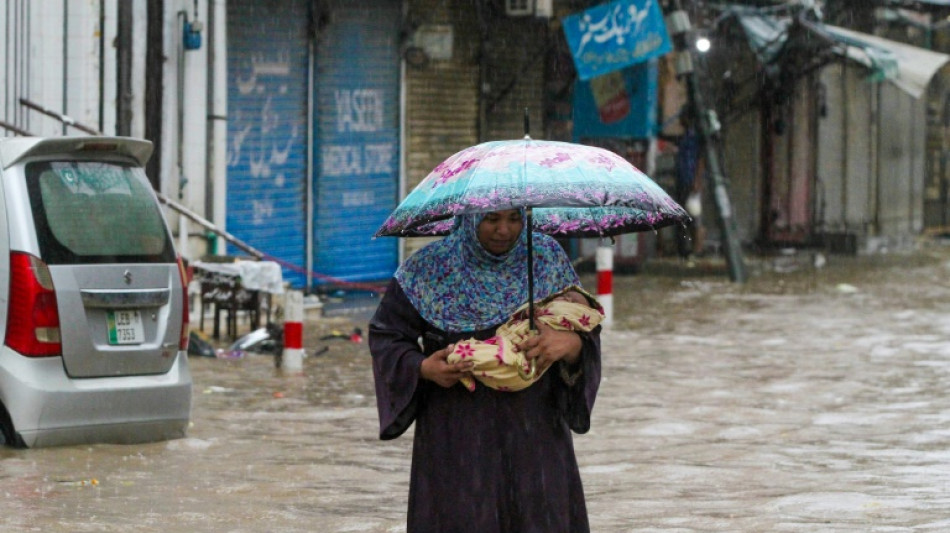
Pakistan's second-largest city Lahore hit by record rain / Photo: Syed MURTAZA - AFP

 Kenya's economy faces climate change risks: World Bank

 Far right and far left battle for power in polarised Berlin

 The last trio: S.Africa's zoo elephants await their fate

 Oil industry sees war windfall but girds for political blowback

 Amazon beats expectations with cloud and AI growth

 Blowout Microsoft results lift US stocks as oil retreats

 'Beginning of the end': Relief but no party as French wildfire winds down

 Southern Europe 'becoming more flammable' in hotter climate, experts say

 Mammoth bones found on parched bed of Danube in Bulgaria

 MEXC Lists Grvt (GRVT) with $60,000 Worth of GRVT and 10,000 USDT in Airdrop+ Rewards

 George and Amal Clooney flee French home due to wildfire

 MEXC Ventures Supports Alpha Arena's APAC Debut at Coinfest Bali

 AI data centre supplier Zhongji InnoLight slips on Hong Kong debut

 May, June heatwaves caused 2,877 extra deaths in England: govt

 BMW profit down a third as carmaker plans job cuts

 Seoul extends losses as most Asian markets drop, oil rises again

 Gambling.com Group Is Now Grandstand

 Meet the astronomer digging into the Milky Way's 'fossils'

 AI data centre supplier Zhongji InnoLight falls on Hong Kong debut

 Samsung operating profit up 1,800% in second quarter on AI boom

 Japanese population below 120 million for first time in decades

 US actor Jared Leto denies latest accusations of sexual assault

 Danube drops to 'historic lows' as fresh heatwave hits

 BTS pulls out of Grammys after Asian pop category introduction

 OpenAI says rogue AI agent attack hit other companies

Pakistan's second-largest city of Lahore was deluged with record-breaking rainfall on Thursday, the national weather agency said, with hospitals flooded, power interrupted and streets in the metropolis submerged.
The eastern city was lashed by almost 360 millimetres (14 inches) of rain in three hours, the Pakistan Meteorological Department (PMD) said.
"This was record-breaking rainfall," the agency's deputy director Farooq Dar told AFP.
The previous record dates to July 1980, when 332 millimetres fell over three hours.
"Look at all these buckets and how much water has accumulated. We're exhausted from trying to remove the water," Sadam, a 32-year-old shopkeeper, told AFP as he took stock of his considerable losses.
The PMD had forecast a wetter-than-usual monsoon season this year for Pakistan, one of the countries experts say is most vulnerable to extreme weather being spurred by climate change.
Over the past three days, 24 people have been killed by rainfall in the country's mountainous northwestern province of Khyber Pakhtunkhwa, the Provincial Disaster Management Authority said.
In Lahore, a city of 13 million in the eastern Punjab province, one person was killed by electrocution as a result of Thursday's cloudburst, according to local police.
The city's commissioner declared an emergency and said offices and schools would be shut for the day.
Yasir Ali, a 26-year-old resident, said it was a "sad day for the nation".
"For a poor person it is heartbreaking that he's been unable to go to work today," he told AFP.
- 'Pay some attention here' -
Two government hospitals in Lahore reported flooding in their wards, and there were intermittent power outages continuing into the afternoon.
Roads were also submerged, bringing traffic and businesses to a standstill.
Ahmed Khan, 48, who earns a daily wage, appealed to the government "to pay some attention here and resolve this water issue".
Maryam Sharif, the chief minister of Punjab province, posted on X that "the entire government machinery is in the field" to drain the water.
The summer monsoon brings to South Asia about 70 to 80 percent of the region's annual rainfall between June and September.
It is vital for agriculture, but changing weather patterns that scientists attribute to climate change are putting both lives and livelihoods at risk.
Earlier this year Pakistan -- home to 240 million people -- was hit by a succession of heatwaves and this April was the wettest since 1961.
At least 143 people died from lightning strikes and other storm-related incidents in April.
In neighbouring India, at least 160 people, most believed to be labourers and their families, have been killed by torrential rains causing landslides in the southern coastal state of Kerala.
In 2022, a third of Pakistan was submerged by unprecedented monsoon rains that displaced millions of people and cost $30 billion, according to a World Bank estimate.
A.Mykhailo--CPN