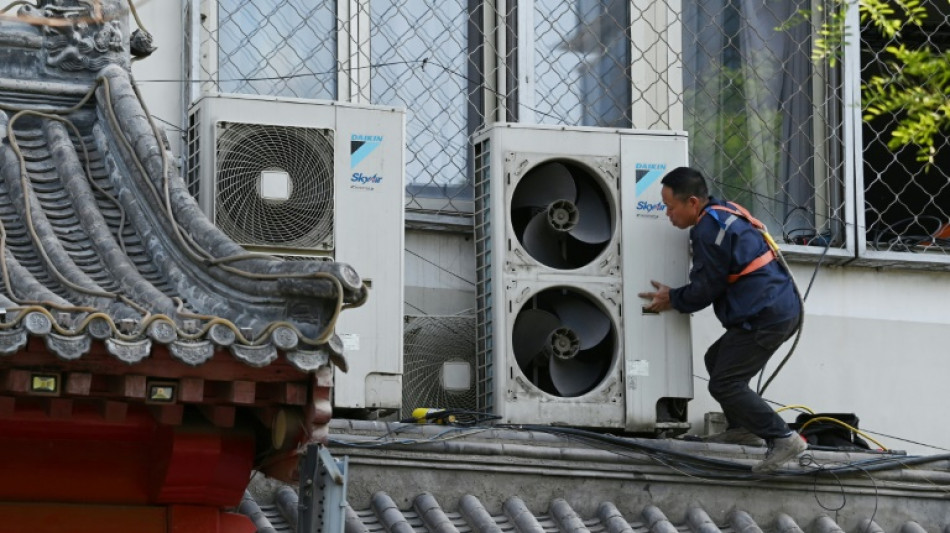
China says July was its hottest month since records began / Photo: GREG BAKER - AFP

 Kenya's economy faces climate change risks: World Bank

 Far right and far left battle for power in polarised Berlin

 The last trio: S.Africa's zoo elephants await their fate

 Oil industry sees war windfall but girds for political blowback

 Amazon beats expectations with cloud and AI growth

 Blowout Microsoft results lift US stocks as oil retreats

 'Beginning of the end': Relief but no party as French wildfire winds down

 Southern Europe 'becoming more flammable' in hotter climate, experts say

 Mammoth bones found on parched bed of Danube in Bulgaria

 MEXC Lists Grvt (GRVT) with $60,000 Worth of GRVT and 10,000 USDT in Airdrop+ Rewards
 George and Amal Clooney flee French home due to wildfire

 MEXC Ventures Supports Alpha Arena's APAC Debut at Coinfest Bali

 AI data centre supplier Zhongji InnoLight slips on Hong Kong debut

 May, June heatwaves caused 2,877 extra deaths in England: govt

 BMW profit down a third as carmaker plans job cuts

 Seoul extends losses as most Asian markets drop, oil rises again

 Gambling.com Group Is Now Grandstand

 Meet the astronomer digging into the Milky Way's 'fossils'

 AI data centre supplier Zhongji InnoLight falls on Hong Kong debut

 Samsung operating profit up 1,800% in second quarter on AI boom

 Japanese population below 120 million for first time in decades

 US actor Jared Leto denies latest accusations of sexual assault

 Danube drops to 'historic lows' as fresh heatwave hits

 BTS pulls out of Grammys after Asian pop category introduction

 OpenAI says rogue AI agent attack hit other companies

Chinese weather authorities said Thursday July was the country's hottest month since records began six decades ago, as extreme temperatures persist across the globe.
China is the world's biggest emitter of the greenhouse gases that scientists say are driving climate change and making extreme weather more frequent and intense.
Heatwaves this summer have scorched parts of northern China, while torrential rains have triggered floods and landslides in central and southern areas.
Last month was "the hottest July since complete observations began in 1961, and the hottest single month in the history of observation", the national weather office said Thursday.
It said the average air temperature in China in July was 23.21 degrees Celsius (73.78 degrees Fahrenheit), exceeding the previous record of 23.17C (73.71F) in 2017.
The mean temperature in every province was also "higher than the average for previous years", with the southwestern provinces of Guizhou and Yunnan logging their highest averages, the weather office said.
It forecast that the mercury would continue to climb in eastern regions this week, including Shanghai, where a red alert for extreme heat was in place on Thursday.
"Next week will be more of the same. It's like being on an iron plate," wrote one user of the Weibo social media platform in response to the megacity's heat warning.
"It's so hot. Did Shanghai do something to anger the gods?" quipped another.
The nearby city of Hangzhou may hit 43C (109F) on Saturday, which would break its all-time record, the weather office said.
Middle and lower reaches of the Yangtze River would likely see daily temperatures fall no lower than 30C (86F), it said.
As a result, people "must not relax efforts to avoid the heat and keep cool".
- Extreme summer -
The report came little more than a week after Earth experienced its warmest day in recorded history.
Preliminary data from the Copernicus Climate Change Service showed the daily global average temperature was 17.15C (62.9F) on July 22.
That was 0.06C hotter than the day before, which itself broke the all-time high temperature set a year earlier by a small margin.
China has pledged to bring emissions of carbon dioxide to a peak by 2030 and to net zero by 2060, but has resisted calls to be bolder.
It long depended on highly polluting coal power to fuel its massive economy but has emerged as a renewable energy leader in recent years.
Research showed last month that China is building almost twice as much wind and solar energy capacity than every other country combined.
Extreme weather across large parts of the country has triggered deadly natural disasters in the past few weeks.
State media reported Tuesday that at least seven people had died after heavy rain and flooding hit central Hunan province.
The downpours have been caused by the remnants of Typhoon Gaemi, which made landfall in eastern China last week.
A landslide in Hunan on Sunday destroyed a guesthouse and killed 15 people, while nearly 4,000 residents were evacuated after a dam breach elsewhere in the province.
Ch.Lefebvre--CPN