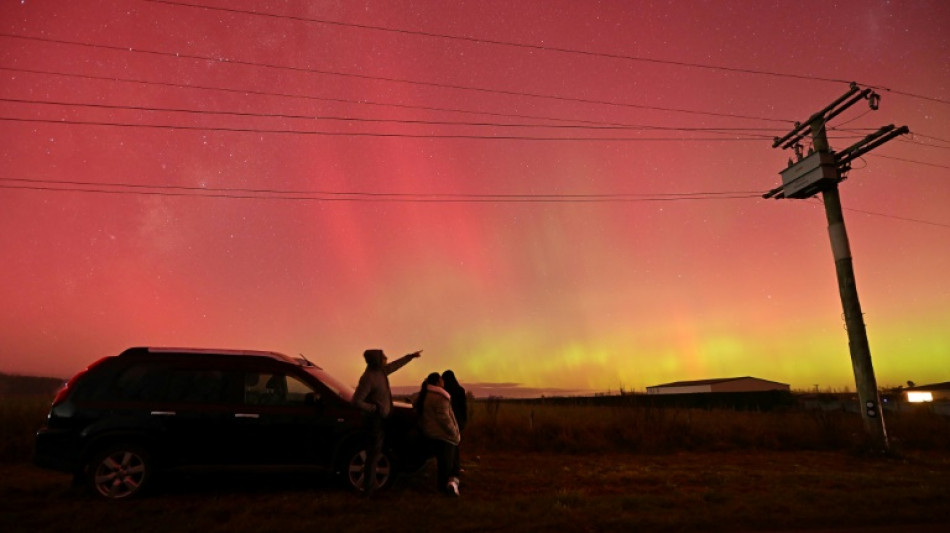
Solar storms could cause more auroras / Photo: Sanka Vidanagama - AFP/File

 Kenya's economy faces climate change risks: World Bank

 Far right and far left battle for power in polarised Berlin

 The last trio: S.Africa's zoo elephants await their fate

 Oil industry sees war windfall but girds for political blowback

 Amazon beats expectations with cloud and AI growth

 Blowout Microsoft results lift US stocks as oil retreats

 'Beginning of the end': Relief but no party as French wildfire winds down

 Southern Europe 'becoming more flammable' in hotter climate, experts say

 Mammoth bones found on parched bed of Danube in Bulgaria

 MEXC Lists Grvt (GRVT) with $60,000 Worth of GRVT and 10,000 USDT in Airdrop+ Rewards

 George and Amal Clooney flee French home due to wildfire

 MEXC Ventures Supports Alpha Arena's APAC Debut at Coinfest Bali

 AI data centre supplier Zhongji InnoLight slips on Hong Kong debut

 May, June heatwaves caused 2,877 extra deaths in England: govt

 BMW profit down a third as carmaker plans job cuts

 Seoul extends losses as most Asian markets drop, oil rises again

 Gambling.com Group Is Now Grandstand

 Meet the astronomer digging into the Milky Way's 'fossils'

 AI data centre supplier Zhongji InnoLight falls on Hong Kong debut

 Samsung operating profit up 1,800% in second quarter on AI boom

 Japanese population below 120 million for first time in decades

 US actor Jared Leto denies latest accusations of sexual assault

 Danube drops to 'historic lows' as fresh heatwave hits

 BTS pulls out of Grammys after Asian pop category introduction

 OpenAI says rogue AI agent attack hit other companies

Massive explosions on the Sun have triggered warnings of geomagnetic storms that could create dazzling auroras in the northern United States, Europe and southern Australia from Tuesday night.
In May, the most powerful geomagnetic storm to strike Earth in more than two decades lit up night skies with colourful displays in Hawaii, Spain, South Africa and other places far from the extreme latitudes where they are normally seen.
"We've seen several large coronal mass ejections -- plasma and other material from the sun's surface shooting out into space," Mike Bettwy, operations chief of the US-based Space Weather Prediction Center (SWPC), told AFP on Tuesday.
"As a result, the potential for space weather has ramped up significantly," he said.
The coronal mass ejections (CMEs) are expected to arrive from Tuesday to Thursday, with "geomagnetic storm watches" declared on those days.
But "the brunt of the activity is most likely" to come on Tuesday, when there is a "strong" geomagnetic storm warning of G3 on the US National Oceanic and Atmospheric Administration scale, the SWPC said.
May's record storms were classified as the most extreme level of G5. This means any potential auroras this week are unlikely to stray as far, or be as powerful, as those seen earlier this year.
But if the current forecast is correct, during the late evening hours in the United States on Tuesday, an "aurora could become visible as far south as the northeast US through the upper Midwest and across the rest of the northern states to include northern Oregon."
The aurora borealis -- also known as the northern lights -- may become visible in Scotland over the next three nights, but could be "impeded by limited hours of darkness", the UK's Met Office said Tuesday.
"With a bit of luck," auroras could also be spotted in northern Germany, the Netherlands and Belgium, according to the website SpaceWeatherLive.
Aurora australis -- the southern lights -- could be visible in the south of the Australian state of Tasmania and similar latitudes, the Met Office said.
- 'Cannibal CME' -
For those living in the right latitudes, auroras would be most visible away from city lights, in the darkest skies possible, before the Moon rises, Bettwy said.
People should use their cameras or phones to look, because today's digital imagery can often pick them up even when the naked eye cannot, he added.
When CMEs erupt, they shoot around a billion tons of plasma -- with an accompanying magnetic field -- from the Sun toward the Earth.
One of the CMEs coming towards Earth this week merged with another, forming what is called a "Cannibal CME", according to spaceweather.com.
The NOAA warned that more CMEs are continuing to erupt, so more could be coming.
When the CMEs slam into Earth's magnetosphere, they can create geomagnetic storms.
The storms can mess with satellites orbiting Earth and affect things like radio signals and GPS positioning systems.
They can also knock out electricity grids -- the "Halloween Storms" of October 2003 sparked blackouts in Sweden and damaged power infrastructure in South Africa.
Astronauts on the International Space Station often shelter during extreme solar activity to avoid being exposed to radiation.
Numerous strong solar flares -- huge explosions on the Sun's surface which can cause CMEs -- have also been emitted in recent days.
Most CMEs and flares come from sunspots, which are massive, darker areas of intense activity on the solar surface. The sunspot cluster that caused May's storms was 17 times the size of Earth.
As of Tuesday, there are 11 sunspots on the disc of the Sun, according to the Met Office in Britain.
More geomagnetic storms could be yet to come, because solar activity is only just approaching the peak of its roughly 11-year cycle.
The peak, called "solar maximum", is expected between late 2024 and early 2026.
D.Avraham--CPN