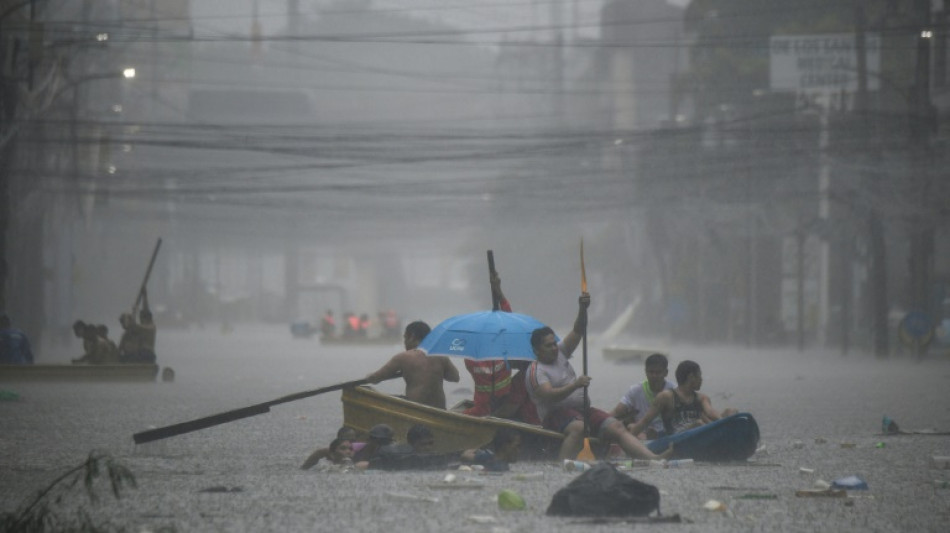
Streets turned into rivers as Typhoon Gaemi blows past Philippines / Photo: Ted ALJIBE - AFP

 Billionaire Ambani's Jio soars in market debut after India's biggest IPO
 AI chip giant SK hynix posts seven-fold surge in quarterly operating profit

 S.African activists push back on data centre rush

 Billionaire Ambani's Jio to debut after record India IPO
 UK set for cautious budget as borrowing costs climb

 US Fed expected to hold rates steady ahead of key midterm elections

 AI chip giant SK hynix says quarterly operating profit soars 630%

 Charles tackles thorny legacy of slavery on Caribbean trip

 UN nuclear watchdog chief urges Iran to grant access

 Boeing releases cautious growth plan as shares fall sharply

 Tech firms gain on Anthropic IPO optimism; HSBC slumps in London

Relentless rain drenched the northern Philippines on Wednesday, triggering floods in Manila and landslides in mountainous regions as Typhoon Gaemi intensified the seasonal monsoon.
In the densely populated capital, rescuers were deployed across the city to help evacuate people from low-lying homes after downpours turned streets into rivers, trapping vehicles.
People clutched flimsy umbrellas as they waded through thigh-deep murky water or used small boats and shopping trolleys to move around.
"The disturbance it caused is great. The waters reached the second floor of our house," Nora Clet, a homemaker, told AFP.
Restaurant employee Rex Morano said he wasn't able to work due to the "very high" floodwaters.
A state of calamity was declared for Manila, unlocking funds for relief efforts, after the state weather forecaster warned of "serious flooding" in some areas.
Government offices were shut and classes suspended, at least 80 domestic and international flights were cancelled, and tens of thousands of customers lost power because of the weather.
Some shopping malls offered temporary shelter to people affected.
"Many areas are flooded so we have rescuers deployed all over the city. There is an overwhelming number of people asking for help," Peachy de Leon, a disaster official in suburban Manila, told AFP.
"We were told last night the rain will not hit us, then the rain suddenly poured so we were quite shocked. There is an ongoing search and rescue now."
Typhoon Gaemi, which has swept past the Philippines as it heads towards Taiwan, intensified the southwest monsoon rains typical for this time of year, the state weather forecaster said.
"Usually the peak of rainy season is July and August and it so happens that there is a typhoon in the eastern waters of the Philippines that enhances the southwest monsoon," senior weather specialist Glaiza Escullar told AFP.
More than 200 millimetres (nearly eight inches) of rain fell in the capital in the past 24 hours, Escullar said, which was "not unusual".
More heavy rain was expected on Thursday.
Landslides killed a pregnant woman and three children in Batangas province, south of Manila, and blocked three major roads in the mountainous Benguet province, police and disaster officials said Wednesday.
That takes the death toll from heavy rains over swaths of the country in the past two weeks to at least 12, as tens of thousands sheltered in evacuation centres.
President Ferdinand Marcos on Wednesday ordered disaster response officials to ensure they had sufficient stockpiles of food for the hardest-hit areas because "their situation is critical".
Hard-scrabble neighbourhoods near Manila Bay were badly affected, with most of the streets under water and more than 2,000 people forced to flee their homes.
About 20 big storms and typhoons hit the Philippines or its surrounding waters each year, damaging homes and infrastructure and killing hundreds of people.
L.K.Baumgartner--CPN