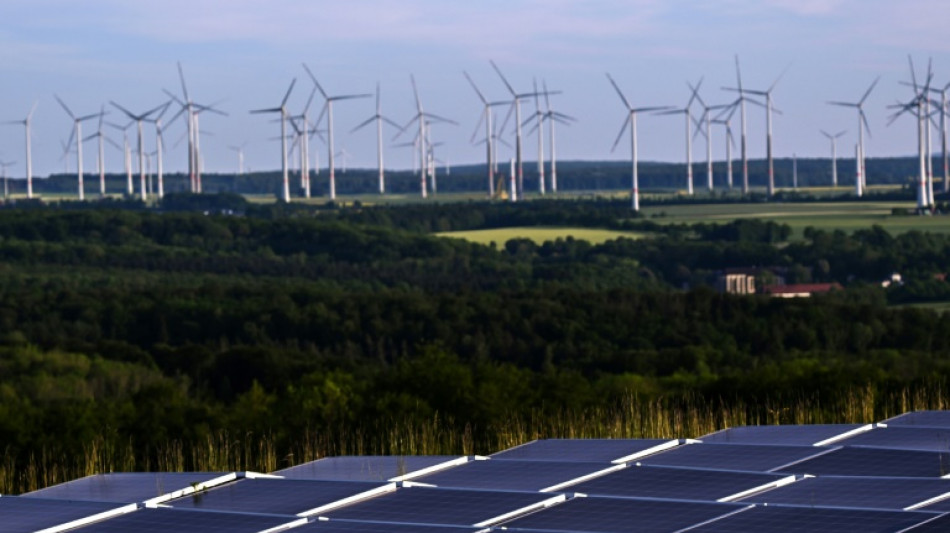
Renewables overproduction turns electricity prices negative / Photo: Ina FASSBENDER - AFP/File

 Kenya's economy faces climate change risks: World Bank

 Far right and far left battle for power in polarised Berlin

 The last trio: S.Africa's zoo elephants await their fate

 Oil industry sees war windfall but girds for political blowback

 Amazon beats expectations with cloud and AI growth

 Blowout Microsoft results lift US stocks as oil retreats

 'Beginning of the end': Relief but no party as French wildfire winds down

 Southern Europe 'becoming more flammable' in hotter climate, experts say

 Mammoth bones found on parched bed of Danube in Bulgaria

 MEXC Lists Grvt (GRVT) with $60,000 Worth of GRVT and 10,000 USDT in Airdrop+ Rewards

 George and Amal Clooney flee French home due to wildfire

 MEXC Ventures Supports Alpha Arena's APAC Debut at Coinfest Bali

 AI data centre supplier Zhongji InnoLight slips on Hong Kong debut

 May, June heatwaves caused 2,877 extra deaths in England: govt

 BMW profit down a third as carmaker plans job cuts

 Seoul extends losses as most Asian markets drop, oil rises again

 Gambling.com Group Is Now Grandstand

 Meet the astronomer digging into the Milky Way's 'fossils'

 AI data centre supplier Zhongji InnoLight falls on Hong Kong debut

 Samsung operating profit up 1,800% in second quarter on AI boom

 Japanese population below 120 million for first time in decades

 US actor Jared Leto denies latest accusations of sexual assault

 Danube drops to 'historic lows' as fresh heatwave hits

 BTS pulls out of Grammys after Asian pop category introduction

 OpenAI says rogue AI agent attack hit other companies

With the proliferation of solar panels and wind turbines an unusual phenomenon is becoming more and more frequent: wholesale electricity prices turn negative.
While that may brighten the mood of consumers whose power bills have surged in recent years, it could undermine the further development of renewables, a key element in the fight against global warming.
The increasingly frequent phenomenon is "extremely problematic" for the wind and solar sector, said Mattias Vandenbulcke, strategy director of the renewables industry group France Renouvelables.
"It allows some to have harmful, even dangerous rhetoric which says 'renewables are useless'," Vandenbulcke said.
In southern Australia, wholesale electricity prices have been negative some 20 percent of the time since last year, according to the International Energy Agency.
The share of negatively priced hours in southern California was above 20 percent in the first half of the year, more than triple from the same period in 2023, the IEA said.
In the first six months of the year in France, there were negative prices around five percent of the time, beating the record set last year, according to the electricity grid operator RTE.
In Switzerland the price tumbled as far as -400 euros (-$436) per megawatt hour on July 14. The lowest prices are usually recorded around midday during the summer when solar production is at its peak.
- 'A warning signal' -
The trend has been accelerating for the past three years as demand in Europe has unexpectedly dropped since the Covid pandemic and the war in Ukraine.
Prices turn negative on the spot wholesale electricity market when production is strong while demand is weak.
Around a fifth of the total is traded on this market, where electricity is bought for the following day.
Negative prices help reduce the bills of consumers, said Rebecca Aron, head of electricity markets at French renewables firm Valorem, but the impact is delayed and difficult to discern among the other factors that send prices higher and lower.
Large, industrial consumers that can shift production to times when prices are negative and buy on wholesale markets can reap the biggest rewards.
Negative prices are "a warning signal that there is way too much production on the electrical grid", said energy analyst Nicolas Goldberg at Colombus Consulting.
Electricity grids need to be kept constantly in balance. Too much can lead to the electricity to increase in frequency beyond norms for some equipment. Too little can lead to some or all customers losing power.
There are currently few options to stock surplus electricity production so producers have to reduce output.
Many renewable producers stop their output when prices are set to turn negative. It takes one minute to stop output at a solar park, two to three minutes for a wind turbine.
But not all stop their production.
- Tripling renewables -
"Renewable energy can be controlled, but depending on production contracts, there might not necessarily be an incentive to stop," said Mathieu Pierzo at French grid operator RTE, which has the responsibility for balancing the electricity load.
Some producers are paid a fixed price under their contract or are compensated by the state if prices fall below a certain level.
Fossil fuel and nuclear power plants can adjust their production to some extent, but halting and restarting output is costly.
In the future, solar and wind will also have to "participate more in balancing the electricity system", Pierzo said.
Solar and wind production is set to rise further as nations agreed at the COP28 climate conference last year to triple renewable energy capacity by 2030 as part of efforts to limit warming to 1.5 degrees Celsius compared with pre-industrial levels.
"Rising frequency of negative prices sends an urgent signal that greater flexibility of supply and demand is needed," the Paris-based IEA warned last week.
"The appropriate regulatory frameworks and market designs will be important to allow for an uptake in flexibility solutions such as demand response and storage," it said.
M.P.Jacobs--CPN