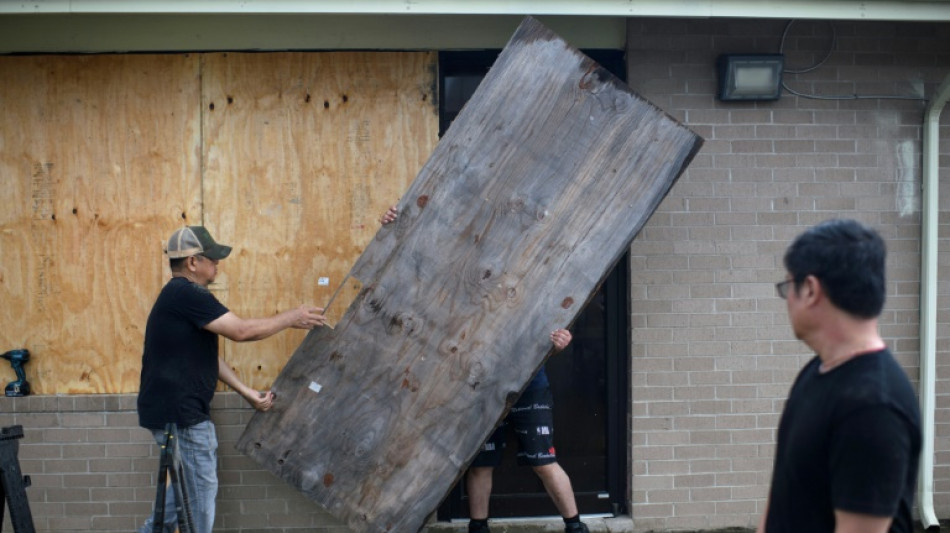
Texas braces as Hurricane Beryl hits coast / Photo: Mark Felix - AFP

 Kenya's economy faces climate change risks: World Bank

 Far right and far left battle for power in polarised Berlin

 The last trio: S.Africa's zoo elephants await their fate

 Oil industry sees war windfall but girds for political blowback

 Amazon beats expectations with cloud and AI growth

 Blowout Microsoft results lift US stocks as oil retreats

 'Beginning of the end': Relief but no party as French wildfire winds down

 Southern Europe 'becoming more flammable' in hotter climate, experts say

 Mammoth bones found on parched bed of Danube in Bulgaria

 MEXC Lists Grvt (GRVT) with $60,000 Worth of GRVT and 10,000 USDT in Airdrop+ Rewards

 George and Amal Clooney flee French home due to wildfire

 MEXC Ventures Supports Alpha Arena's APAC Debut at Coinfest Bali

 AI data centre supplier Zhongji InnoLight slips on Hong Kong debut

 May, June heatwaves caused 2,877 extra deaths in England: govt

 BMW profit down a third as carmaker plans job cuts

 Seoul extends losses as most Asian markets drop, oil rises again

 Gambling.com Group Is Now Grandstand

 Meet the astronomer digging into the Milky Way's 'fossils'

 AI data centre supplier Zhongji InnoLight falls on Hong Kong debut

 Samsung operating profit up 1,800% in second quarter on AI boom

 Japanese population below 120 million for first time in decades

 US actor Jared Leto denies latest accusations of sexual assault

 Danube drops to 'historic lows' as fresh heatwave hits

 BTS pulls out of Grammys after Asian pop category introduction

 OpenAI says rogue AI agent attack hit other companies

Hurricane Beryl made landfall Monday in the southern US state of Texas, where some residents were evacuated over warnings of flooding and power outages.
The US National Hurricane Center (NHC) said Beryl, a Category 1 storm, hit the town of Matagorda with wind speeds of 80 miles (130 kilometers) per hour.
As rain and wind lashed Houston, home to 2.3 million people, the NHC warned in its latest bulletin of "life-threatening storm surge, damaging winds and flooding rainfall" across southeastern Texas.
"We have to take Beryl very, very seriously. Our worst enemy is complacency," Houston Mayor John Whitmire said ahead of the hurricane's arrival.
Some 1.8 million households were without electricity as of early Monday, according to the poweroutage.us tracker.
George Bush Intercontinental Airport was facing nearly 1,000 flight cancellations, according to tracking service FlightAware, while the National Weather Service warned of the potential for tornadoes.
The NHC said rainfall of up to 15 inches (38 centimeters) was expected in parts of Texas, warning that it could cause flash flooding in some areas.
Several areas of the Texas coast had already been placed under hurricane and storm warnings over the weekend. Matagorda lies roughly midway between the port city of Corpus Christi and Galveston Island.
Authorities in Nueces County, home to Corpus Christi, asked tourists to leave the city, while neighboring Refugio County -- yet to fully recover from Hurricane Harvey in 2017 -- issued a mandatory evacuation order.
The city of Galveston, southeast of Houston, had issued a voluntary evacuation order for some areas, with videos on social media showing lines of cars heading out of town.
- 'A deadly storm' -
Acting Governor Dan Patrick called on Texans to stay alert, listen to local officials and leave the danger zone if possible.
"It will be a deadly storm for people who are directly in that path," Patrick told a state emergency management news conference.
Beryl left at least seven dead after it tore through the Caribbean and Venezuela, with winds at times reaching the maximum Category 5 strength.
It hit Mexico as a Category 2 hurricane on Friday, flattening trees and lampposts and ripping off roof tiles, although there were no reported deaths or injuries there.
Before that, it hit the Cayman Islands and Jamaica, slamming Grenada, St Vincent and the Grenadines, as well as Venezuela.
Beryl is the first hurricane since NHC records began to reach the Category 4 level in June, and the earliest to hit the highest Category 5 in July.
It is also the earliest hurricane to make landfall in Texas in a decade, according to expert Michael Lowry.
It is extremely rare for such a powerful storm to form this early in the Atlantic hurricane season, which runs from early June to late November.
Scientists say climate change likely plays a role in the rapid intensification of storms such as Beryl because there is more energy in a warmer ocean for them to feed on.
North Atlantic waters are between two and five degrees Fahrenheit (one to three degrees Celsius) warmer than normal, according to the US National Oceanic and Atmospheric Administration.
Y.Jeong--CPN