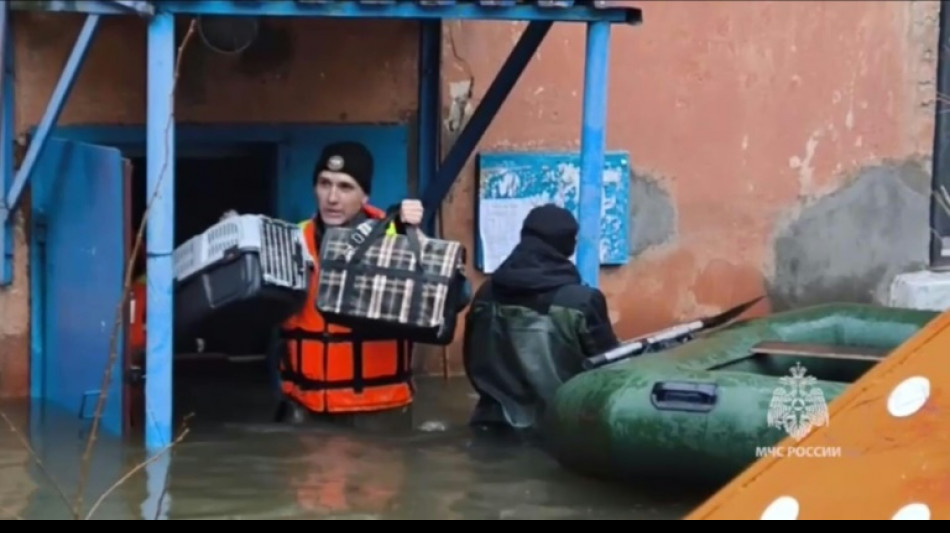
Locals protest as Russian regions face worst flooding for decades / Photo: Handout - Russian Emergencies Ministry/AFP

 Kenya's economy faces climate change risks: World Bank
 British oil giant BP aims to sell North Sea business

 China factory activity slides as leaders seek spending boost

 Tech rebound fuels record-breaking rally in South Korean stocks

 Cables and cooling bring AI windfall to Indian suppliers

 Anthropic's models gained unauthorized 'real-world' access during testing

 Apple tops estimates in CEO Cook's final quarter, but shares fall

 Milei demands expulsion of foreigners expressing 'hate' against Argentina

 Italy's Po River valley on drought alert

 Prada profits pinched as growth hard to chase

 Stocks climb on earnings and rates, oil retreats

 US economic growth slows in second quarter, missing expectations

 Russia adds Telegram founder Durov to 'terrorist' blacklist

 Stocks diverge on earnings, as oil steadies

 Eurozone economy grows despite Middle East war

 Singapore group will develop 'most promising' Ebola vaccine

 Shell profit surges as Mideast war fuels oil prices

 Car maker Stellantis says back in profit in second quarter

 Samsung quarterly operating profit up 1,800% on AI boom

 South Korean stocks bounce after rout, oil holds gains on Mideast woes

 South Korea's women web sleuths fight AI deepfake porn

 Anything but programmable: New cost-efficient EC-power-supply-series for the DIN rail by CAMTEC PS

 Meta misses profit expectations, sticks to massive AI spending

 Campari - king of the spritz - hopes to conquer American heartland

 Air France-KLM and Lufthansa bid for Portugal's TAP airline

Russia on Monday warned of "unprecedented" flooding over the next 48 hours as locals in a city partially submerged by rising waters took to the streets in rare protest at the authorities' handling of the crisis.
Fast-melting ice and torrential rain have caused major rivers -- the Ural and Tobol -- near the Russian border with Kazakhstan to overflow, with officials warning the flood waters are set to rise dangerously high over the next 48 hours.
Dozens of protestors in the city of Orsk, which was submerged in metres of flood water over the weekend after a dam burst, on Monday protested against the government's weak response in a rare show of dissent in Russia.
Videos posted by local social media channels showed the crowds shouting, "Shame! Shame! Shame!" and "Putin, help!"
The Kremlin earlier on Monday said that the Russian president had no plans to visit the flooded areas.
Public demonstrations against the government are illegal in Russia under strict anti-protest laws.
The Orenburg regional prosecutor's office, which covers Orsk, explicitly on Monday warned residents that they faced arrest if they participated in "unauthorised" rallies.
The protestors were demanding more financial help and were angry that a dam designed to protect the city had burst.
In a compensation scheme published over the weekend, the regional government said it would pay up to 100,000 roubles ($1,100) per person for household items "completely destroyed" in the floods.
The Orenburg governor on Monday said that it would fully reimburse the cost of damage to housing, the state-run RIA Novosti news agency reported.
- 'Do not wait' -
In Orsk, the worst affected city so far, 99 people were treated for injuries with nine people admitted to hospital, state media cited health officials as saying.
More cities, including the regional hub of Orenburg with a population of 550,000, were bracing for a surge in water levels over the coming days.
Governors in the neighbouring regions of Kurgan and Tyumen each introduced a state of emergency.
"The flood forecast is rapidly deteriorating, much more water is arriving, and faster," Vadim Shumkov, the governor of the Kurgan region said in a post on Telegram.
He called on people to evacuate while they still could.
"Everyone who lives in settlements along the floodplain of the Tobol River: evacuate. Do not wait for the water to come. It will come at night and unexpectedly, quickly arriving in the form of a large wave," Shumkov said in a post on Telegram.
The regional capital, also called Kurgan, is home to 300,000 people and sits on the river.
Water levels were receding in Orsk on Monday but had risen close to dangerous levels in the city of Orenburg.
The Kremlin called the situation "critical" and said it would likely "worsen".
"Nature has caused a lot of inconvenience. But the local residents are handling it stoically, as are the local authorities," Kremlin spokesman Dmitry Peskov said, hours before the protests in Orsk.
Thousands of people have been evacuated from flooded areas.
The Emergency Situations ministry on Monday said that more than 10,000 residential buildings had been flooded, mostly in the Urals, Volga area and western Siberia.
- 'Unprecedented' -
Orenburg Mayor Sergei Salmin told Russian television that the city "has not seen so much water" in decades.
"The highest (water) mark was in 1942. That was 946 centimetres," Salmin said.
"Since then there have been no floods. This is unprecedented."
Russia's weather monitor Rosgidromet said it did not expect the flood in Orenburg to peak until Wednesday.
The Ural river flows through Orenburg and into Kazakhstan, where President Kassym-Jomart Tokayev said the floods were one of the worst natural disasters to affect his country in decades.
Emergency authorities also warned that the Irtysh river was "very likely" to flood parts of Tobolsk, one of Russia's oldest Siberian cities.
Putin, who has been a vocal climate sceptic for much of his rule, has in recent years ordered his government to do more to prepare Russia for extreme weather events.
The country has seen severe floods and fires in recent springs and summers.
O.Ignatyev--CPN