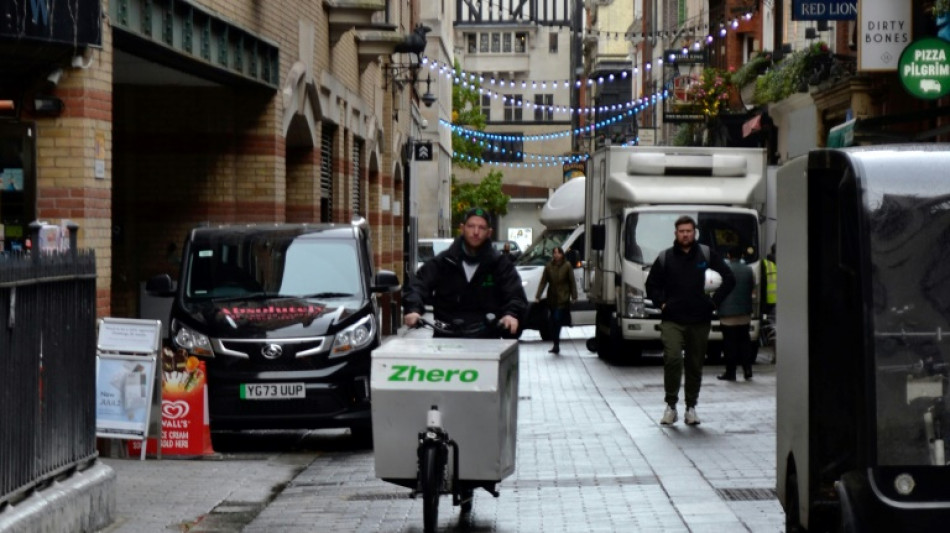
On yer bike: London firms turn to cargo bikes / Photo: Daniel MATTHEWS - AFP

 Kenya's economy faces climate change risks: World Bank

 New York sues online prediction markets giant Kalshi

 Profits surge at US oil giant amid Iran war supply shock

 Stock markets rally on tech rebound

 France, Spain assess scorched terrain as new wildfires threaten other regions

 Chipmaker Kioxia reports AI-driven 45-fold surge in quarterly net profit
 Far right and far left battle for power in polarised Berlin

 The last trio: S.Africa's zoo elephants await their fate

 Oil industry sees war windfall but girds for political blowback

 Amazon beats expectations with cloud and AI growth

 Blowout Microsoft results lift US stocks as oil retreats

 'Beginning of the end': Relief but no party as French wildfire winds down

 Southern Europe 'becoming more flammable' in hotter climate, experts say

 Mammoth bones found on parched bed of Danube in Bulgaria

 MEXC Lists Grvt (GRVT) with $60,000 Worth of GRVT and 10,000 USDT in Airdrop+ Rewards
 George and Amal Clooney flee French home due to wildfire

 MEXC Ventures Supports Alpha Arena's APAC Debut at Coinfest Bali

 AI data centre supplier Zhongji InnoLight slips on Hong Kong debut

 May, June heatwaves caused 2,877 extra deaths in England: govt

 BMW profit down a third as carmaker plans job cuts

 Seoul extends losses as most Asian markets drop, oil rises again
 Gambling.com Group Is Now Grandstand

 Meet the astronomer digging into the Milky Way's 'fossils'

 AI data centre supplier Zhongji InnoLight falls on Hong Kong debut

 Samsung operating profit up 1,800% in second quarter on AI boom

On a busy north London street, plumber Ben Hume-Wright zipped through the heavy rush-hour traffic to his next job by bike.
Trades such as his used to rely on vans but many are now choosing to do more business using two or sometimes three wheels.
Since switching his Ford diesel pickup truck for an electric cargo bike two years ago, Hume-Wright said he has been busier than ever.
"I used to take on a maximum of five or six appointments" a day, he told AFP as the traffic ground forward behind him.
"I'll now book in six, seven and possibly even eight, because I know that I'm not going to get stuck in traffic."
Hume-Wright set up in 2010 and was reliant on his van for 11 years. But now describes it as a "glorified shed" handy for storing parts and tools.
When faced with a big installation job, he gets a supplier to deliver bulkier items directly to the client's address.
He then shows up on his bike with just the tools needed for the job.
"It's cheaper, I don't have any of the fuel costs and I just enjoy it. It's a lot more fun," he said.
- Growth strategy -
Transport for London (TfL), the local government body responsible for most of the British capital's transport network, launched its first "Cargo Bike Action Plan" earlier this year.
It wants to "promote and enable" their growth, given a rise in polluting van deliveries from online shopping since the pandemic.
The use of cargo bikes, which can cost several thousand pounds (dollars), also increased during lockdown and encouraging their use chimes with Mayor Sadiq Khan's aim of a carbon net-zero city by 2030.
TfL estimates that the move towards cargo bikes could save up to 30,000 tonnes of CO2 emissions a year across Greater London by that time.
Cargo bikes were popular across northern Europe until the mid-20th century but fell out of favour as motorised vehicles gained ground.
Their revival began in the early 2000s in cycling-crazy Denmark and the Netherlands, which unlike London are blessed with flat terrain and good cycling infrastructure.
The number of cargo bikes on the streets of Copenhagen increased from 20,000 in 2020 to more than 40,000 in 2022, the city said.
In Germany -- Europe's largest market for E-cargo bikes -- 165,000 units were sold in 2022.
Ben Jaconelli, chief executive of leading E-bike and E-cargo bike firm Fully Charged, said UK growth has been "astronomical".
He co-founded the firm in 2014, when the sight of an electric cargo bike was a rarity. "Nowadays, it's almost rare not to see," he added.
The Bicycle Association, a UK trade body, reported a 30-percent increase in UK sales of E-cargo bikes in the year to May 2023.
Contributory factors include the controversial expansion of London's ultra-low emission zone, which charges the drivers of the most polluting vehicles.
- Van fleet -
Logistics company Zhero is also committed to using the bikes. It transports fine art between studios, galleries and related businesses such as framers.
Like Hume-Wright, environmental considerations were a key factor for the switch. But co-founder Joe Sharpe called it a "straight-up financial decision".
"It's cheaper to move things by cargo bikes than it is by van," he said near Sadie Coles HQ gallery, a regular client in the busy Soho district.
"They're the most logical vehicle for moving things around the city... Sometimes we might be doing 30 to 40 deliveries a day on a cargo bike.
"In a van, eight to 10."
Vans -- or more specifically a fleet of E-vans -- are still a part of Zhero's business, in part for insurance reasons.
Zhero are insured for up to £25,000 (nearly $32,000) to transport artwork by bike, but that rises tenfold when transporting art in an E-van.
Sharpe hopes that the insurance world will adapt to the changing norms of logistics companies, but concedes that vans may always be "a part of the fabric" of cities.
Back in the warren of railway arches that make up Fully Charged HQ, an optimistic Jaconelli declared that this is "the decade of the E-cargo bike".
"Ultimately, I believe that all businesses will be using electric cargo bikes in some capacity in the future," he said. "Why would they not?"
video-phz/fg
Ch.Lefebvre--CPN