Japan, ASEAN to boost security ties with eye on China / Photo: Franck ROBICHON - POOL/AFP

 Kenya's economy faces climate change risks: World Bank
 New York sues online prediction markets giant Kalshi

 Profits surge at US oil giant amid Iran war supply shock

 Stock markets rally on tech rebound

 France, Spain assess scorched terrain as new wildfires threaten other regions
 Chipmaker Kioxia reports AI-driven 45-fold surge in quarterly net profit
 Far right and far left battle for power in polarised Berlin

 The last trio: S.Africa's zoo elephants await their fate
 Oil industry sees war windfall but girds for political blowback

 Amazon beats expectations with cloud and AI growth

 Blowout Microsoft results lift US stocks as oil retreats

 'Beginning of the end': Relief but no party as French wildfire winds down

 Southern Europe 'becoming more flammable' in hotter climate, experts say

 Mammoth bones found on parched bed of Danube in Bulgaria

 MEXC Lists Grvt (GRVT) with $60,000 Worth of GRVT and 10,000 USDT in Airdrop+ Rewards

 George and Amal Clooney flee French home due to wildfire

 MEXC Ventures Supports Alpha Arena's APAC Debut at Coinfest Bali

 AI data centre supplier Zhongji InnoLight slips on Hong Kong debut

 May, June heatwaves caused 2,877 extra deaths in England: govt

 BMW profit down a third as carmaker plans job cuts

 Seoul extends losses as most Asian markets drop, oil rises again

 Gambling.com Group Is Now Grandstand

 Meet the astronomer digging into the Milky Way's 'fossils'

 AI data centre supplier Zhongji InnoLight falls on Hong Kong debut

 Samsung operating profit up 1,800% in second quarter on AI boom

Southeast Asian and Japanese leaders will agree to boost "maritime security cooperation", according to a draft statement seen by AFP from a summit that kicked off Saturday against the backdrop of growing tensions in the South China Sea.
China claims almost the entire waterway, a vital trade corridor, and its increasingly aggressive behaviour in disputed areas has riled nations across the region as well as Washington.
Close US ally Japan, which also has competing territorial claims with China, is upping its military spending and has already boosted security cooperation in the Asia-Pacific region, including with South Korea and Australia.
According to the draft of the weekend summit's final statement, Japan and the Association of Southeast Asian Nations (ASEAN) will commit to "(strengthen) security cooperation, including maritime security cooperation".
Japan on Wednesday expressed "serious concern" about "dangerous actions" after the latest tense confrontation between Philippine and Chinese vessels at flashpoint reefs that included a collision and Chinese ships shooting water cannon.
Tokyo added that it "concurs with the Philippines' long-standing objections to unlawful maritime claims, militarization, coercive activities and threat or use of force in the South China Sea".
Japan last month agreed to help the Philippines -- whose President Ferdinand Marcos was due in Tokyo -- buy coastguard vessels and to supply a radar system, and the two are discussing allowing troop deployments on each other's soil.
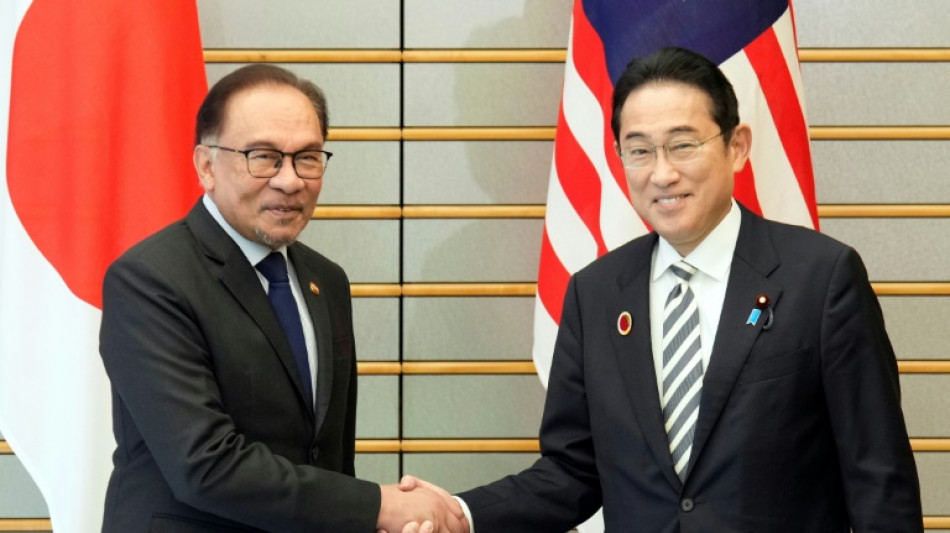
With Malaysia, Japanese Prime Minister Fumio Kishida said on Saturday that he had agreed with counterpart Anwar Ibrahim to deepen strategic ties and provide 400 million yen ($2.8 million) for "warning and surveillance" equipment.
Kishida said that with the world "at a historical turning point, Japan places great importance on promoting cooperation with ASEAN, including Malaysia, to maintain and strengthen a free and open international order based on the rule of law and to ensure a world where human dignity is protected".
Malaysia, along with the Philippines, Vietnam, Brunei and Taiwan, have overlapping claims in the South China Sea.
- Joint drills -
In September, militaries from ASEAN nations held their first-ever joint exercises, although host Indonesia insisted they were non-combat drills, focusing on areas such as disaster relief and maritime patrols.
Asked about the ASEAN summit, China's foreign ministry said Friday that Beijing "believed that any cooperation should be conducive to advancing mutual trust among regional countries and promoting common development".
"We hope that relevant countries can truly do things conducive to regional peace and stability. At the same time, any cooperation should not target third parties," spokeswoman Mao Ning told a regular briefing.
- 'Zero emission community' -
Japan is also expected to use the summit to push energy cooperation, with a meeting of its Asian Zero Emission Community (AZEC) initiative scheduled for Monday that will be attended virtually by Australian Prime Minister Anthony Albanese, officials said.
Tokyo is boosting its renewables sector but has also come under fire from environmental groups for providing large-scale public financing for fossil fuel projects around Asia.
Japan has also been seeking to push the export of tech aimed at reducing emissions by coal plants, such as co-firing with ammonia and carbon capture. But critics say these methods are unproven and expensive.
"This push to lock in fossil fuel-based energy across the continent is delaying the transition from fossil fuels to renewables," the Climate Action Network said this month.
Ammonia "fails to meaningfully reduce emissions, jeopardises the decarbonization of Japan's energy and any possibility of phasing out fossil fuels", it said.
ASEAN's 10 member states are Brunei, Cambodia, Indonesia, Laos, Malaysia, Philippines, Singapore, Thailand, Vietnam and Myanmar. The summit marks 50 years of ties with Japan.
While Myanmar is a member, the leaders of its junta have been banned from the bloc's high-level meetings since failing to implement an agreed five-point peace plan following the 2021 coup in which they took power.
burs-stu/sco
L.K.Baumgartner--CPN