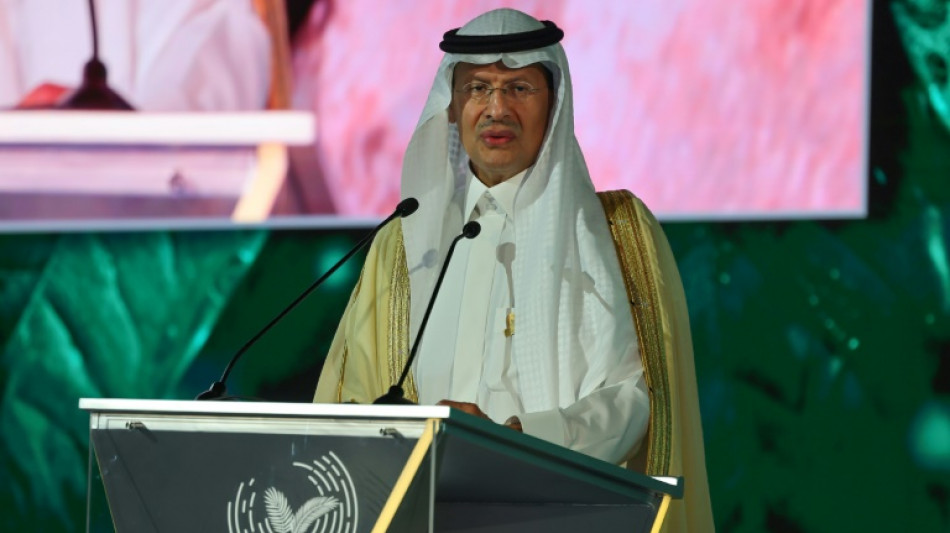
Saudi Arabia says 'absolutely not' to oil phaseout at COP28 / Photo: Fayez Nureldine - AFP

 Kenya's economy faces climate change risks: World Bank
 New York sues online prediction markets giant Kalshi
 Profits surge at US oil giant amid Iran war supply shock
 Stock markets rally on tech rebound

 France, Spain assess scorched terrain as new wildfires threaten other regions
 Chipmaker Kioxia reports AI-driven 45-fold surge in quarterly net profit
 Far right and far left battle for power in polarised Berlin

 The last trio: S.Africa's zoo elephants await their fate
 Oil industry sees war windfall but girds for political blowback

 Amazon beats expectations with cloud and AI growth

 Blowout Microsoft results lift US stocks as oil retreats

 'Beginning of the end': Relief but no party as French wildfire winds down

 Southern Europe 'becoming more flammable' in hotter climate, experts say

 Mammoth bones found on parched bed of Danube in Bulgaria

 MEXC Lists Grvt (GRVT) with $60,000 Worth of GRVT and 10,000 USDT in Airdrop+ Rewards

 George and Amal Clooney flee French home due to wildfire

 MEXC Ventures Supports Alpha Arena's APAC Debut at Coinfest Bali

 AI data centre supplier Zhongji InnoLight slips on Hong Kong debut

 May, June heatwaves caused 2,877 extra deaths in England: govt

 BMW profit down a third as carmaker plans job cuts

 Seoul extends losses as most Asian markets drop, oil rises again

 Gambling.com Group Is Now Grandstand

 Meet the astronomer digging into the Milky Way's 'fossils'

 AI data centre supplier Zhongji InnoLight falls on Hong Kong debut

 Samsung operating profit up 1,800% in second quarter on AI boom

Saudi Arabia's energy minister has slammed the door shut on agreeing to phase out fossil fuels at the UN's COP28 climate talks, setting the stage for difficult negotiations in Dubai.
A tentative "phasedown/out" was included in a first draft of an agreement on climate action that delegates are haggling over during talks that are scheduled to finish on December 12.
But Energy Minister Prince Abdulaziz bin Salman, a half-brother of de facto ruler Crown Prince Mohammed bin Salman, told Bloomberg that Saudi Arabia, the world's biggest oil exporter, would not agree.
"Absolutely not," he said in an interview in Riyadh.
"And I assure you not a single person -- I'm talking about governments -- believes in that."
About 200 countries must come to a consensus decision at the meeting in Dubai, held at the end of the hottest year on record.
In an interview with AFP last week, United Nations Secretary-General Antonio Guterres called for a total phaseout of fossil fuels, warning "complete disaster" awaits mankind on its current trajectory.
But Prince Abdulaziz said: "I would like to put that challenge for all of those who... comes out publicly saying we have to (phase out), I'll give you their name and number, call them and ask them how they are gonna do that.
"If they believe that this is the highest moral ground issue, fantastic. Let them do that themselves. And we will see how much they can deliver."
- 'Small change' -
Separately, the Saudi royal also derided Western donations to a new climate loss and damage fund as "small change" and trumpeted Riyadh's pledges to developing countries.
The fund for vulnerable nations -- a major win at the start of COP28 -- has attracted about $655 million so far from donors including the European Union and the United States, a sum criticised as insufficient by campaigners.
"Unlike the small change offered for loss and damage from our partners in developed countries, the Kingdom through its South-South cooperation announced in the Saudi Africa Summit in Riyadh last month the allocation of up to $50 billion," he said in a video message to Monday's Saudi Green Initiative forum, held on the sidelines of COP28.
"This will help build resilient infrastructure and strengthen climate resilience and adaptation in the African continent directly through Saudi stakeholders," added the prince, without giving further details.
Such private funds have been criticised by campaigners for lacking transparency and because the pledges are non-binding and include loans and investments.
Saudi Arabia has revamped its energy sources, invested in renewables and improved energy-efficiency as it tries to decarbonise its economy by 2030, Prince Abdulaziz added.
But that target does not include emissions from the 8.9 million barrels of oil a day exported by Saudi Arabia.
Africa and its energy mix is an area of focus for both Saudi and the UAE, which in September pledged $4.5 billion for clean-energy investments in the continent.
"You cannot go to undeveloped countries or developing countries and ask them to do the same measures of the transition," Yasir Al-Rumayyan, chairman of Saudi state oil giant Aramco, told the forum.
"Especially people who don't have access to the energy."
He said he heard an African minister say "in order for us to have growth, we have to carbonise first then to decarbonise."
P.Schmidt--CPN