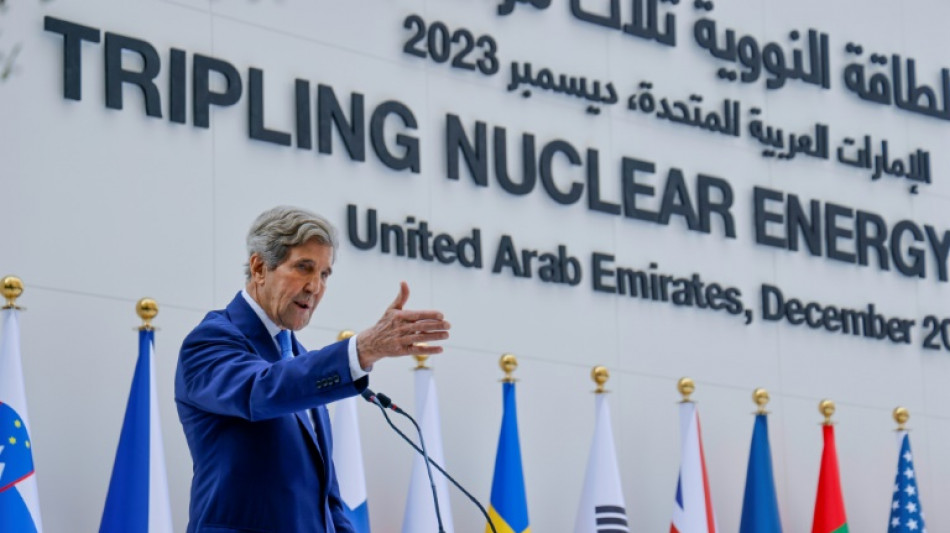
US leads call to triple nuclear power at COP28 / Photo: Ludovic MARIN - AFP

 Kenya's economy faces climate change risks: World Bank
 New York sues online prediction markets giant Kalshi

 Profits surge at US oil giant amid Iran war supply shock

 Stock markets rally on tech rebound

 France, Spain assess scorched terrain as new wildfires threaten other regions
 Chipmaker Kioxia reports AI-driven 45-fold surge in quarterly net profit
 Far right and far left battle for power in polarised Berlin

 The last trio: S.Africa's zoo elephants await their fate
 Oil industry sees war windfall but girds for political blowback

 Amazon beats expectations with cloud and AI growth

 Blowout Microsoft results lift US stocks as oil retreats

 'Beginning of the end': Relief but no party as French wildfire winds down

 Southern Europe 'becoming more flammable' in hotter climate, experts say

 Mammoth bones found on parched bed of Danube in Bulgaria

 MEXC Lists Grvt (GRVT) with $60,000 Worth of GRVT and 10,000 USDT in Airdrop+ Rewards

 George and Amal Clooney flee French home due to wildfire

 MEXC Ventures Supports Alpha Arena's APAC Debut at Coinfest Bali

 AI data centre supplier Zhongji InnoLight slips on Hong Kong debut

 May, June heatwaves caused 2,877 extra deaths in England: govt

 BMW profit down a third as carmaker plans job cuts

 Seoul extends losses as most Asian markets drop, oil rises again

 Gambling.com Group Is Now Grandstand

 Meet the astronomer digging into the Milky Way's 'fossils'

 AI data centre supplier Zhongji InnoLight falls on Hong Kong debut

 Samsung operating profit up 1,800% in second quarter on AI boom

More than 20 nations including the United States called for a tripling of nuclear energy to drive down emissions on Saturday as world leaders assembled for a second day at UN climate talks in Dubai.
With smoggy skies in Dubai highlighting the challenges facing the world, other pledges are expected at the COP28 conference, including stepping up the deployment of renewable energy and cutting methane emissions.
The use of nuclear power as a cleaner alternative to fossil fuels is highly controversial as environmental groups are concerned about safety and the disposal of nuclear waste.
But more than 20 nations ranging from the US to Ghana, Japan and several European countries said in a declaration that it plays a "key role" in the global goal of achieving carbon neutrality by mid-century.
They called for the tripling of nuclear energy capacity by 2050 from 2020 levels.
"We are not making the argument to anybody that this is absolutely going to be a sweeping alternative to every other energy source," US climate envoy John Kerry said at the COP28 conference in Dubai.
"But we know because the science and the reality of facts and evidence tell us that you can't get to net zero 2050 without some nuclear," he said.
The other signatories include Britain, France, South Korea, Ukraine and the United Arab Emirates, but nuclear powers Russia and China did not sign up.
Environmental group 350.org said the Fukushima nuclear disaster in 2011 in Japan highlighted the dangers of atomic power.
"While we appreciate that the Biden administration is looking to invest in alternatives to fossil fuels, we don't have time to waste on dangerous distractions like nuclear energy," said its North American director Jeff Ordower.
- Methane 'most destructive' -
The declaration came as more world leaders took the stage at COP28 for the second day in a row, though US President Joe Biden and Chinese leader Xi Jinping are skipping the talks.
"We want to make the energy transition a global success story. It has to be now," German Chancellor Olaf Scholz said.
"We all have to demonstrate the same determination to phase out fossil fuels, beginning with coal," he said.
Nations at the COP28 talks are also expected to adopt a goal of tripling renewable energy and doubling energy efficiency by 2030.
The European Union first appealed for the new targets earlier this year, and the cause has since been taken up by COP28 hosts the UAE, then the G7 and G20 groups of nations.
The discussions about the renewables goal are closely linked to far more difficult negotiations about whether a final COP28 deal will commit nations to phasing down -- or phasing out -- all fossil fuels.
The United States and China, the world's two biggest emitters of greenhouse gases, and the UAE will host later Saturday a summit on methane emissions.
Methane, a non-CO2 gas, is the second largest contributor to climate change, accounting for around 16 percent of the warming effect.
China agreed for the first time to include all greenhouse gases in its next national climate pledge for 2035 in an agreement with the US last month.
But Beijing has stopped short of joining a US-backed Global Methane Pledge that has been signed by more than 150 countries and seeks to reduce global methane emissions by at least 30 percent from 2020 levels by 2030.
Methane "is the most destructive gas", Kerry said.
J.Bondarev--CPN