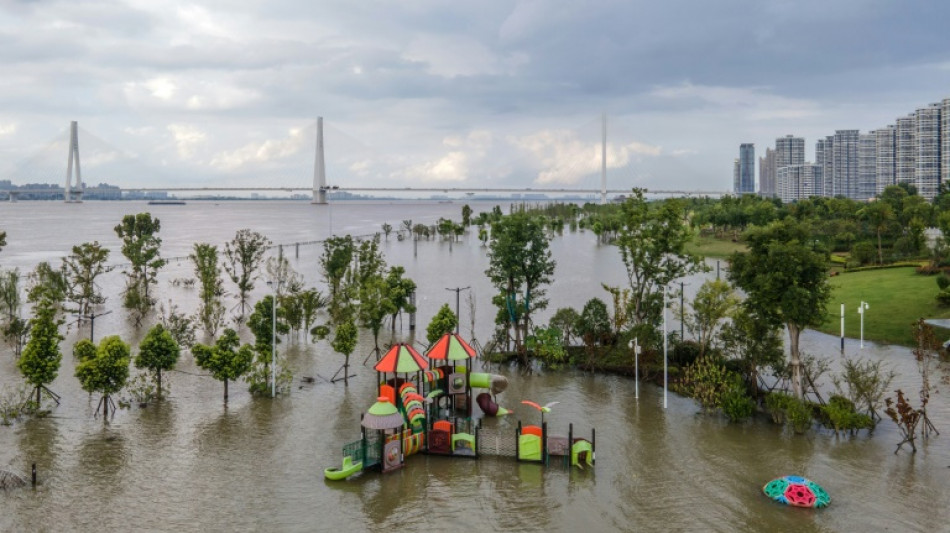
Climate change worsened Chinese extreme heat and flooding event in 2020: study / Photo: STR - AFP

 Kenya's economy faces climate change risks: World Bank

 US Fed dissenters call for rate hikes over sustained inflation
 New York sues online prediction markets giant Kalshi

 Profits surge at US oil giant amid Iran war supply shock

 Stock markets rally on tech rebound

 France, Spain assess scorched terrain as new wildfires threaten other regions
 Chipmaker Kioxia reports AI-driven 45-fold surge in quarterly net profit
 Far right and far left battle for power in polarised Berlin

 The last trio: S.Africa's zoo elephants await their fate

 Oil industry sees war windfall but girds for political blowback

 Amazon beats expectations with cloud and AI growth

 Blowout Microsoft results lift US stocks as oil retreats

 'Beginning of the end': Relief but no party as French wildfire winds down

 Southern Europe 'becoming more flammable' in hotter climate, experts say

 Mammoth bones found on parched bed of Danube in Bulgaria

 MEXC Lists Grvt (GRVT) with $60,000 Worth of GRVT and 10,000 USDT in Airdrop+ Rewards

 George and Amal Clooney flee French home due to wildfire

 MEXC Ventures Supports Alpha Arena's APAC Debut at Coinfest Bali

 AI data centre supplier Zhongji InnoLight slips on Hong Kong debut

 May, June heatwaves caused 2,877 extra deaths in England: govt

 BMW profit down a third as carmaker plans job cuts

 Seoul extends losses as most Asian markets drop, oil rises again

 Gambling.com Group Is Now Grandstand

 Meet the astronomer digging into the Milky Way's 'fossils'

 AI data centre supplier Zhongji InnoLight falls on Hong Kong debut

Man-made global warming exacerbated an incident of extreme flooding and heat in eastern China in 2020, according to a study released Wednesday, which highlighted the need to prepare for increasingly intense episodes of such weather in the country.
Researchers said that warming created by human activity caused an increase in rain that summer by around 6.5 percent, and increased heat by around one degree Celsius (33.8 degrees Fahrenheit).
Record rains fell in June and July around the lower part of the Yangtze River during the monsoon, causing the deaths of more than 100 people and billions of dollars in damage, said the study published in the journal Science Advances.
At the same time, extreme heat hit the south of the country, putting pressure on health care and energy systems, as well as on agriculture and infrastructure.
These simultaneous heat and precipitation phenomena are physically interconnected, and commonly occur at the same time in that part of the world, but in 2020 they were exceptional, the researchers said.
To determine the impact of warming linked to human activity, scientists modeled the weather conditions leading up to and during the events, based on measurements in the real world.
They then constructed a scenario simulating conditions as they might have been without human-caused warming, by adjusting humidity levels, air and ocean temperatures. They finally compared the two models to determine the role of human influence.
The researchers also warned about future weather events, noting that by the end of the century, precipitation in the region could increase by 14 percent compared to 2020, and that the season could be 2.1 degrees Celsius warmer.
The results of the study "underscore the necessity of preparing for more intense spatially compounding flood-heat hazards over eastern China," the researcher said, since they "could lead to increased economic damage and loss of life."
P.Petrenko--CPN