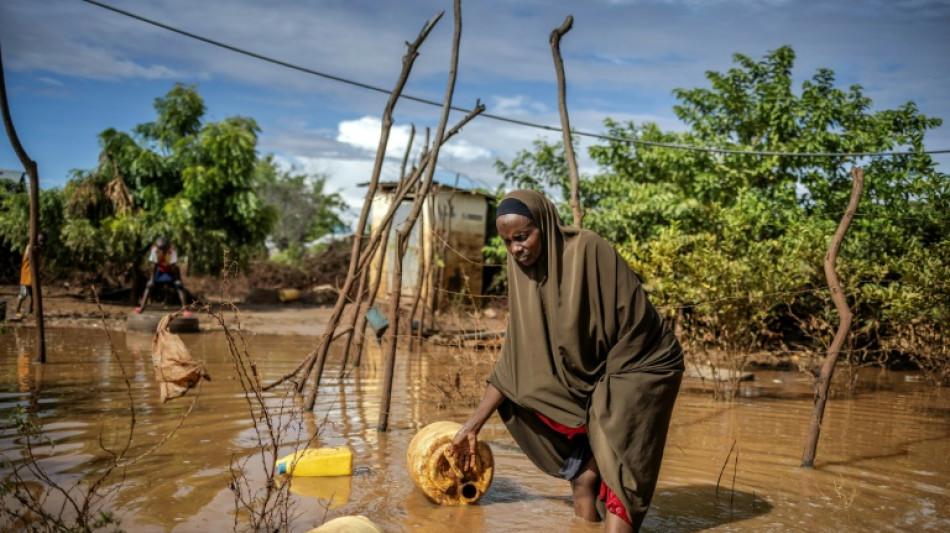
From drought to deluge: Kenyan villagers reel from floods / Photo: LUIS TATO - AFP

 Kenya's economy faces climate change risks: World Bank

 US Fed dissenters call for rate hikes over sustained inflation
 New York sues online prediction markets giant Kalshi

 Profits surge at US oil giant amid Iran war supply shock

 Stock markets rally on tech rebound

 France, Spain assess scorched terrain as new wildfires threaten other regions

 Chipmaker Kioxia reports AI-driven 45-fold surge in quarterly net profit

 Far right and far left battle for power in polarised Berlin

 The last trio: S.Africa's zoo elephants await their fate
 Oil industry sees war windfall but girds for political blowback

 Amazon beats expectations with cloud and AI growth

 Blowout Microsoft results lift US stocks as oil retreats

 'Beginning of the end': Relief but no party as French wildfire winds down

 Southern Europe 'becoming more flammable' in hotter climate, experts say

 Mammoth bones found on parched bed of Danube in Bulgaria

 MEXC Lists Grvt (GRVT) with $60,000 Worth of GRVT and 10,000 USDT in Airdrop+ Rewards

 George and Amal Clooney flee French home due to wildfire

 MEXC Ventures Supports Alpha Arena's APAC Debut at Coinfest Bali

 AI data centre supplier Zhongji InnoLight slips on Hong Kong debut

 May, June heatwaves caused 2,877 extra deaths in England: govt

 BMW profit down a third as carmaker plans job cuts

 Seoul extends losses as most Asian markets drop, oil rises again

 Gambling.com Group Is Now Grandstand

 Meet the astronomer digging into the Milky Way's 'fossils'

 AI data centre supplier Zhongji InnoLight falls on Hong Kong debut

Days after floodwaters swallowed her home in eastern Kenya, Fatuma Hassan Gumo waded through thigh-deep murky water to collect her only remaining possessions -- floating utensils.
Flash floods from the Tana river in Garissa, a county on the border with Somalia, forced the 42-year-old fruit vendor to flee at night from her submerged home built from mud and corrugated metal sheets to the nearest dry land with her family of 12, including seven children.
They are among thousands of people left homeless and destitute by torrential rains that have lashed much of Kenya, killing more than 70 people.
The Horn of Africa -- only slowly emerging from a devastating drought that left millions hungry -- is experiencing heavy rainfall and floods linked to the El Nino weather phenomenon. The latest disaster has claimed dozens of lives and caused large-scale displacement in Kenya as well as Somalia and Ethiopia.
"The waters have ruined everything," a distressed Gumo told AFP as she folded her soaked hijab, oblivious to the health risks from the overflowing pit latrine next to her.
"My life is in a very bad state right now."
At a camp for the displaced in the heart of Garissa town, hurriedly set up near an aid agency's warehouse, Mwana Juma Hassan sat outside her white domed tent, her eyes downcast.
"Eating here has become a luxury. We don't know when we will eat the next meal," she said.
It is the fourth time the 37-year-old widow has been displaced by floods in less than a decade, and the latest downpour has washed away her watermelon farm -- her only source of income.
Along with her teenage daughter, Hassan said they plan to return home after the water recedes, fearing starvation at the camp.
- 'Get out-of-hand' -
About 500 people there had to brave four nights of unrelenting rains, sleeping on sodden clothes, before the Kenya Red Cross provided tents, said 60-year-old mat weaver Amina Duke Gabuku.
There are growing concerns that the camp's poor sanitary conditions and lack of clean water could spread disease, but other concerns weigh on Gabuku's mind.
"How can one kilogram of rice be enough for seven kids when everyone wants a full belly?" Gakubu said, referring to the food handouts.
Fourteen such camps have been set up in Garissa in two weeks, housing more than 7,000 people.
The floods have hit at a time when most of the largely pastoral county's 800,000 people are suffering from food insecurity and rely on international aid.
Mohamed Dubow, Garissa county director for special programmes, said the situation could "get out of hand" if there are another two or three days of rain.
He told AFP at least 200,000 people are forecast to be affected by the flooding, with the Tana river already at about three metres (10 feet) above normal levels.
Almost the entire county was either "submerged, a no-go-zone or affected".
- 'Hunger crisis' -
The floods have wrecked the main road leading to Garissa's northern neighbours Wajir and Mandera and cut off the highway to Nairobi, leaving hundreds of trucks stranded.
"The damaged road has brought a lot of problems, food has become scarce and the cost of living has gone up," community leader Dagane Haji told AFP.
"The price of one kilogram of sugar has risen to 250 shillings (over $1.6) when it cost 150 before the rains."
In the camp, 49-year-old farmer Abubakar Maliyu Jillo said he feared the crisis could drag on and that he will not be able to provide for his four wives and 12 children.
"This is a hunger crisis," he told AFP, adding that a 300,000 shilling investment in his farm had been wiped out.
Humanitarian agencies and environmental campaigners have called for more financing to build the resilience of developing nations to the increasingly ferocious and expensive consequences of climate change -- countries that contributing least to its cause.
"This vicious cycle makes it nearly impossible for these communities to maintain any economic progress they have achieved," said Kunow Sheikh Abdi, country director for US development charity Mercy Corps.
"The scale and urgency of climate crisis is unprecedented, and while it can be daunting, it cannot paralyse us," he said.
Dubow, meanwhile, warned that local residents need to brace themselves for harsher days ahead.
"We have two hazards coming at us day and night. We are either in drought or are in floods."
A.Leibowitz--CPN