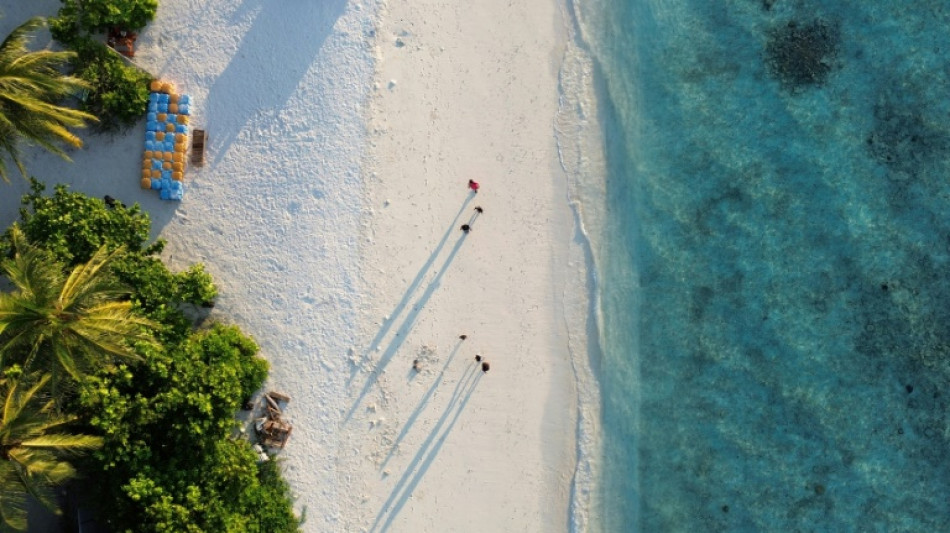
Maldives to battle rising seas by building fortress islands / Photo: Shubham KOUL - AFP

 Kenya's economy faces climate change risks: World Bank
 US Fed dissenters call for rate hikes over sustained inflation
 New York sues online prediction markets giant Kalshi

 Profits surge at US oil giant amid Iran war supply shock

 Stock markets rally on tech rebound
 France, Spain assess scorched terrain as new wildfires threaten other regions
 Chipmaker Kioxia reports AI-driven 45-fold surge in quarterly net profit
 Far right and far left battle for power in polarised Berlin
 The last trio: S.Africa's zoo elephants await their fate
 Oil industry sees war windfall but girds for political blowback

 Amazon beats expectations with cloud and AI growth

 Blowout Microsoft results lift US stocks as oil retreats

 'Beginning of the end': Relief but no party as French wildfire winds down

 Southern Europe 'becoming more flammable' in hotter climate, experts say

 Mammoth bones found on parched bed of Danube in Bulgaria

 MEXC Lists Grvt (GRVT) with $60,000 Worth of GRVT and 10,000 USDT in Airdrop+ Rewards

 George and Amal Clooney flee French home due to wildfire

 MEXC Ventures Supports Alpha Arena's APAC Debut at Coinfest Bali

 AI data centre supplier Zhongji InnoLight slips on Hong Kong debut

 May, June heatwaves caused 2,877 extra deaths in England: govt

 BMW profit down a third as carmaker plans job cuts

 Seoul extends losses as most Asian markets drop, oil rises again

 Gambling.com Group Is Now Grandstand

 Meet the astronomer digging into the Milky Way's 'fossils'
 AI data centre supplier Zhongji InnoLight falls on Hong Kong debut

Rising sea levels threaten to swamp the Maldives and the Indian Ocean archipelago is already out of drinking water, but the new president says he has scrapped plans to relocate citizens.
Instead, President Mohamed Muizzu promises the low-lying nation will beat back the waves through ambitious land reclamation and building islands higher -- policies, however, that environmental and rights groups warn could even exacerbate flooding risks.
The upmarket holiday destination is famed for its white sand beaches, turquoise lagoons and vast coral reefs, but the chain of 1,192 tiny islands is on the frontlines of the climate crisis and battling for survival.
Former president Mohamed Nasheed began his administration 15 years ago warning citizens they might become the world's first environmental refugees needing relocation to another country.
He wanted the Maldives to start saving to buy land in neighbouring India, Sri Lanka or even far away in Australia.
But Muizzu, 45, while asking for $500 million in foreign funding to protect vulnerable coasts, said his citizens will not be leaving their homeland.
"If we need to increase the area for living or other economic activity, we can do that," Muizzu told AFP, speaking from the crowded capital Male, which is ringed with concrete sea walls.
"We are self-sufficient to look after ourselves".
- 'Out of fresh water' -
The tiny nation of Tuvalu this month inked a deal to give citizens the right to live in Australia when their Pacific homeland is lost beneath the seas.
But Muizzu said the Maldives would not follow that route.
"I can categorically say that we definitely don't need to buy land or even lease land from any country," Muizzu said.
Sea walls will ensure risk areas can be "categorised as a safe island", he said.
But 80 percent of the Maldives is less than a metre (three feet) above sea level.
And while fortress-like walls ringing tightly-packed settlements can keep the waves at bay, the fate of the beach islands the tourists come for are uncertain.
Tourism accounts for almost one-third of the economy, according to the World Bank.
Nasheed's predecessor, Maumoon Abdul Gayoom, was the first to ring the alarm of the possible "death of a nation", warning the United Nations in 1985 of the threat posed by rising sea levels linked to climate change.
The UN's Intergovernmental Panel on Climate Change (IPCC) warned in 2007 that rises of 18 to 59 centimetres (7.2 to 23.2 inches) would make the Maldives virtually uninhabitable by the end of the century.
The warning lights are already flashing red.
Gayoom's fear of his country running out of drinking water has already come true, as rising salt levels seep into land, corrupting potable water.
"Every island in the Maldives has run out of fresh water," said Shauna Aminath, 38, the environment minister until last week, when Muizzu's government took power.
Almost all of the 187 inhabited islets in the archipelago depend on expensive desalination plants, she told AFP.
"Finding ways as to how we protect our islands has been a huge part of how we are trying to adapt to these changes", Aminath said.
- Environmental regulations 'ignored' -
The capital Male, where a third of the country's 380,000 citizens are squeezed onto a tiny island, is "one of the most densely populated pieces of land in the world" with 65,700 people per square kilometre, according to the environment ministry.
A giant sea wall already surrounds the city, but Muizzu said there is potential to expand elsewhere.
Reclamation projects have already increased the country's landmass by about 10 percent in the past four decades, using sand pumped onto submerged coral platforms, totalling 30 square kilometres (11 square miles).
Muizzu, a British-educated civil engineer and former construction minister for seven years, played a key part in that, overseeing the expansion of the artificial island of Hulhumale.
Linked to the capital by a Chinese-built 1.4-kilometre (0.8-mile) bridge, with tower blocks rising high over the blue seas, Hulhumale is double the area of Male, home to about 100,000 people.
But environmental and rights groups warn that, while reclamation is needed, it must be done with care.
In a recent report, Human Rights Watch (HRW) accused the authorities of failing to implement their own environmental regulations, saying reclamation projects were "often rushed" and lacked proper mitigation policies.
It gave the example of an airport on Kulhudhuffushi, where 70 percent of the island's mangroves were "buried", and a reclamation project at Addu which damaged the coral reefs fisherman depended on.
"The Maldives government has ignored or undermined environmental protection laws, increasing flooding risks and other harm to island communities," HRW said.
Ahmed Fizal, who heads the environmental campaign group Marine Journal Maldives (MJM), said he feared politicians and businessmen saw shallow lagoons as potential reclamation sites to turn a quick profit.
"You have to ask 'what is the limit, what is the actual cost of reclamation?'", he said.
Y.Jeong--CPN