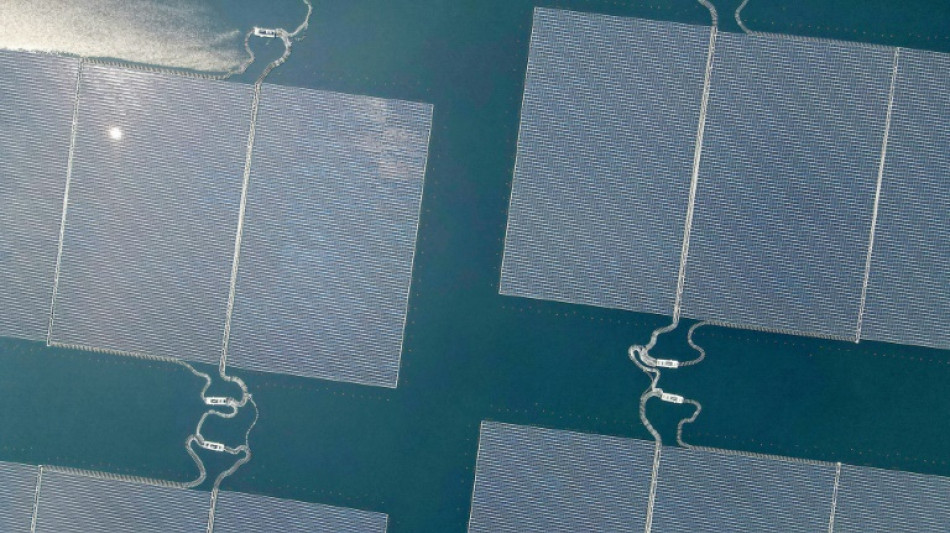
Indonesia inaugurates Southeast Asia's largest floating solar farm / Photo: BAY ISMOYO - AFP

 Kenya's economy faces climate change risks: World Bank

 US Fed dissenters call for rate hikes over sustained inflation
 New York sues online prediction markets giant Kalshi

 Profits surge at US oil giant amid Iran war supply shock

 Stock markets rally on tech rebound

 France, Spain assess scorched terrain as new wildfires threaten other regions
 Chipmaker Kioxia reports AI-driven 45-fold surge in quarterly net profit
 Far right and far left battle for power in polarised Berlin

 The last trio: S.Africa's zoo elephants await their fate
 Oil industry sees war windfall but girds for political blowback

 Amazon beats expectations with cloud and AI growth

 Blowout Microsoft results lift US stocks as oil retreats

 'Beginning of the end': Relief but no party as French wildfire winds down

 Southern Europe 'becoming more flammable' in hotter climate, experts say

 Mammoth bones found on parched bed of Danube in Bulgaria

 MEXC Lists Grvt (GRVT) with $60,000 Worth of GRVT and 10,000 USDT in Airdrop+ Rewards
 George and Amal Clooney flee French home due to wildfire

 MEXC Ventures Supports Alpha Arena's APAC Debut at Coinfest Bali

 AI data centre supplier Zhongji InnoLight slips on Hong Kong debut

 May, June heatwaves caused 2,877 extra deaths in England: govt

 BMW profit down a third as carmaker plans job cuts

 Seoul extends losses as most Asian markets drop, oil rises again
 Gambling.com Group Is Now Grandstand

 Meet the astronomer digging into the Milky Way's 'fossils'

 AI data centre supplier Zhongji InnoLight falls on Hong Kong debut

Indonesia inaugurated a $100 million floating solar farm on Thursday, the largest in Southeast Asia, as it seeks more opportunities to transition to green, renewable energy.
The Cirata floating solar farm, which is expected to generate enough electricity to power 50,000 households, is built on a 200-hectare (500-acre) reservoir in West Java, about 130 kilometres (80 miles) from the capital, Jakarta.
"Today is a historical day, because our big dream to build a renewable energy plant on a big scale is finally achieved," President Joko Widodo said in a speech to mark the occasion.
"We managed to build the largest floating solar farm in Southeast Asia, and the third biggest in the world," he said.
The project, a collaboration between Indonesia's national electricity company Perusahaan Listrik Negara (PLN) and the Abu Dhabi-based renewable energy company Masdar, took three years to complete and cost roughly $100 million.
Situated in a lush, green area surrounded by rice fields, the solar farm, funded by Sumitomo Mitsui Banking Corporation, Societe Generale and Standard Chartered, consists of 340,000 panels.
At 192 megawatt peak (MWp), the farm currently generates enough power to supply electricity for the Cirata area.
Widodo said the project would be expanded to 500 MWp, while PLN said it could eventually generate as much as 1,000 MWp.
The Indonesian government has said it will attempt to reach net-zero emissions by 2060.
It is also attempting to reach net-zero power sector emissions by 2050 in return for financing for its $20 billion Just Energy Transition Partnership (JETP) plan.
Under the plan, Jakarta has pledged to cut its power sector carbon emissions to a peak of 250 million metric tonnes by 2030, down from a previous cap of 290 million.
"We hope there will be more renewable energy built in our country such as solar, hydropower, geothermal and wind," Widodo said.
But solar and wind power each account for less than one percent of Indonesia's power mix, with Southeast Asia's largest economy still relying heavily on fossil fuels to generate electricity.
Indonesia set a target to expand renewable energy to 23 percent of its energy mix by 2025, although Widodo acknowledged it might not be able to reach that target because of delays caused by the Covid-19 pandemic.
The country has pledged to stop building new coal-fired power plants but it has gone ahead with the construction of those that were already planned despite an outcry from activists.
Indonesia is also trying to position itself as a key player in the electric vehicle market as the world's largest producer of nickel -- a crucial component of lithium-ion batteries -- but some industrial parks that host energy-guzzling nickel smelters are powered by coal.
Environmentalists welcomed the project but urged local involvement in the construction and management of the projects.
"Building floating solar farms by making use of vacant land or reservoirs should be the main generator of energy transition in Indonesia," Greenpeace Indonesia campaigner Didit Haryo Wicaksono told AFP.
M.García--CPN