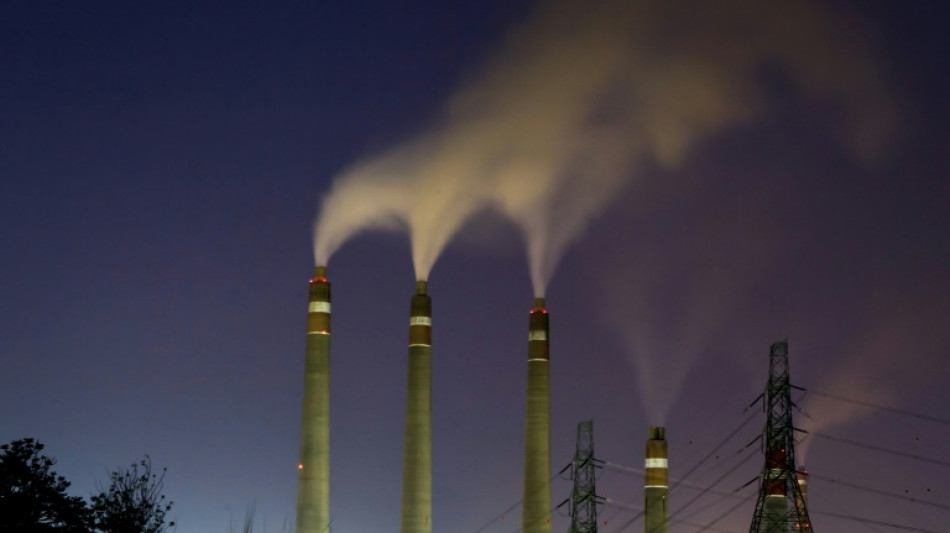
World's available CO2 'budget' for 1.5C smaller than thought: study / Photo: ADITYA AJI - AFP/File

 Kenya's economy faces climate change risks: World Bank
 Hungary to shut nuclear plant as heatwave hits central Europe
 Tech-fuelled rally fizzles as oil prices rise
 Alarm over climate-linked low level of German waterways

 Commerzbank agrees to talks with UniCredit after two-year standoff
 Fornaro Legal Releases Guidance to Help Businesses Maintain Clear Ownership Records During Growth

 Japan probe made closest-ever asteroid flyby: space agency
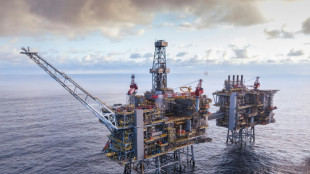 British oil giant BP aims to sell North Sea business

 China factory activity slides as leaders seek spending boost

 Tech rebound fuels record-breaking rally in South Korean stocks

 Cables and cooling bring AI windfall to Indian suppliers

 Anthropic's models gained unauthorized 'real-world' access during testing

 Apple tops estimates in CEO Cook's final quarter, but shares fall

 Milei demands expulsion of foreigners expressing 'hate' against Argentina

 Italy's Po River valley on drought alert

 Prada profits pinched as growth hard to chase

 Stocks climb on earnings and rates, oil retreats

 US economic growth slows in second quarter, missing expectations

 Russia adds Telegram founder Durov to 'terrorist' blacklist

 Stocks diverge on earnings, as oil steadies

 Eurozone economy grows despite Middle East war

 Singapore group will develop 'most promising' Ebola vaccine

 Shell profit surges as Mideast war fuels oil prices

 Car maker Stellantis says back in profit in second quarter

 Samsung quarterly operating profit up 1,800% on AI boom

The amount of CO2 the world can emit and still limit warming to 1.5C is much smaller than previously thought and could be used up in six years at current pollution levels, according to research published on Monday.
Scientists said the revised "carbon budget" meant that humanity was now more likely than not to blow past the Paris Agreement's safer temperature threshold of 1.5 degrees Celsius since the preindustrial era.
"The window to avoid 1.5 degrees of warming is shrinking, both because we continue to emit and because of our improved understanding of atmospheric physics," said lead author Robin Lamboll, of Imperial College London.
But with climate impacts magnifying as warming increases, the researchers stressed that the findings make every fraction of a degree worth fighting for.
"It's not that the fight against climate change will be lost after six years," Lamboll said, adding however that if there was not a "strong downward trajectory" by then, it would be too late for that 1.5 degree limit.
The most recent reports from the UN's IPCC climate expert panel said to keep 1.5C in play the world had a carbon budget of some 500 gigatons, from 2020, warning that emissions would need to be slashed in half by 2030.
This new assessment, which focuses on the main greenhouse gas CO2, calculated that the budget has now dwindled to 250 gigatons, measured from the beginning of 2023.
The study, published in the journal Nature Climate Change, was presented as an update to the IPCC figures, incorporating new expectations for the role of other pollutants, particularly the cooling impacts of aerosols -- emitted with planet-heating fossil fuels.
Meanwhile emissions remain stubbornly high, despite a slight dip at the beginning of the Covid-19 pandemic, and are around 40 gigatons a year.
The findings come a month ahead of crucial UN climate negotiations in the United Arab Emirates, tasked with salvaging the Paris deal goals after the latest round of reports from the IPCC made clear that the world was far off track.
Co-author Joeri Rogelj, also of Imperial College London, said that high-likelihood options for limiting warming to 1.5C -- 50 percent or better -- "are gone".
"That doesn't mean that we're spinning out of control to three or four degrees, but it does mean that the best estimates suggest that we will be above 1.5 of global warming," he said.
- Net-zero 2034? -
Earth's average temperature has already risen nearly 1.2C, causing a cascade of deadly and costly weather extremes.
While temperatures this year, boosted by the El Nino weather phenomenon, could average out at 1.5C, the Paris target is measured over a period of decades.
The IPCC has said 1.5C could be passed by the mid-2030s, with scientists warning this could trigger dangerous tipping points in Earth's fragile life support systems.
The Paris deal's main target was to limit warming to "well below" 2C, but with greenhouse gas emissions still at record highs the world is currently on a path to warm 2.4C or more by the end of the century.
Lamboll said the researchers also calculated for 2C as a "last resort" and found the budget for a 50 percent chance of limiting warming to this threshold was 1,220 gigatons.
To improve the odds to 90 percent, the budget falls to 500 gigatons, or around 12 years at current emissions.
The study should make "uncomfortable reading" for policymakers, said a commentary published in Nature Climate Change by Benjamin Sanderson at Norway's Centre for International Climate and Environmental Research, who was not involved in the research.
He said the new carbon budget would mean the world would need to reach "net zero" emissions by 2034, not in the middle of the century as is envisaged in climate policies across the world.
Rogelj said the IPCC had already acknowledged uncertainties in calculating the remaining carbon budget and had given a one in three chance it could be as low as the latest study suggests.
"A one in three chance is far from unexpected, it's like playing Russian roulette with two bullets. Few people will be surprised if someone gets shot with such odds," he said.
A.Mykhailo--CPN