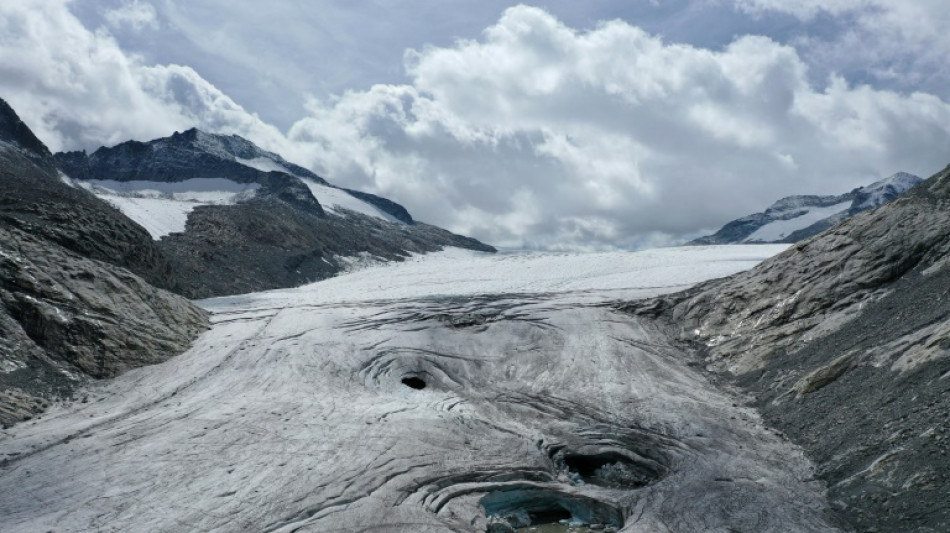
Measuring the retreat of Italy's largest glacier / Photo: Andrea BERNARDI - AFP

 Kenya's economy faces climate change risks: World Bank
 Hungary to shut nuclear plant as heatwave hits central Europe
 Tech-fuelled rally fizzles as oil prices rise

 Alarm over climate-linked low level of German waterways

 Commerzbank agrees to talks with UniCredit after two-year standoff
 Fornaro Legal Releases Guidance to Help Businesses Maintain Clear Ownership Records During Growth

 Japan probe made closest-ever asteroid flyby: space agency
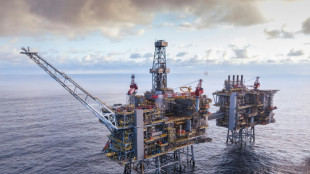 British oil giant BP aims to sell North Sea business

 China factory activity slides as leaders seek spending boost

 Tech rebound fuels record-breaking rally in South Korean stocks

 Cables and cooling bring AI windfall to Indian suppliers

 Anthropic's models gained unauthorized 'real-world' access during testing

 Apple tops estimates in CEO Cook's final quarter, but shares fall

 Milei demands expulsion of foreigners expressing 'hate' against Argentina

 Italy's Po River valley on drought alert

 Prada profits pinched as growth hard to chase

 Stocks climb on earnings and rates, oil retreats

 US economic growth slows in second quarter, missing expectations

 Russia adds Telegram founder Durov to 'terrorist' blacklist

 Stocks diverge on earnings, as oil steadies

 Eurozone economy grows despite Middle East war

 Singapore group will develop 'most promising' Ebola vaccine

 Shell profit surges as Mideast war fuels oil prices

 Car maker Stellantis says back in profit in second quarter

 Samsung quarterly operating profit up 1,800% on AI boom

The Adamello glacier, the largest in the Italian Alps, is slowly being destroyed by global warming, with experts giving it less than a century to survive.
"From the end of the 19th century until today, the glacier has lost approximately 2.7 kilometres," said Cristian Ferrari, president of the Glaciological Commission of the Tridentine Alpinists Society.
"In the last five years, we have had average losses of 15 metres per year. But last year alone (2022) we saw the loss of 139 metres in a year."
Every summer for the past four years, Italian environmental association Legambiente has organised a journey across the Alps to illustrate the effects of climate change on glaciers.
Like other Alpine glaciers, the Adamello is suffering from reduced snowfall -- down 50 percent last year.
The snow cover is thinner, and longer and hotter summers give it less time to freeze.
The glacier is also splitting, proving more surface area exposed to the hot air.
It has also exposed traces of the mountains' history, as the scene of fierce battles between Italian and Austro-Hungarian fighters during World War II.
Today, rifles and shell cases emerge from the melting ice.
"We read the traces of the past, we read the traces of the present and we recognise that the trend is not positive," said Marco Giardino, vice president of the Italian Glaciological Committee and a professor at Turin university.
"Because the blocks that we see fall today will transform that part of the glacier into a glacier covered with debris, and it will destabilise the side of the mountain."
Legambiente's annual "caravan" through the mountains, involving scientists and environmentalists, has covered several glaciers in the past four years.
"Last year we wanted to return to the glaciers we observed two years previously, and the change that we saw was incredible," said its manager for the Alps, Vanda Bonario.
Last year was marked by drought and heat "but we saw situations that I couldn't have imagined".
The Forni glacier in Lombardy, for example, had retreated by more than 100 metres, she said.
"They (glaciers) truly convey to us to us an incredible impression of how climate change has accelerated, of the intensity of events, that is, everything is moving quickly."
According to the UN's Intergovernmental Panel on Climate Change (IPCC), temperatures in this part of the Alps will increase between one and three degrees Celsius in 2050 and between three and six degrees by the end of the century.
At this rate, the Adamello glacier could disappear before the end of the century.
M.P.Jacobs--CPN