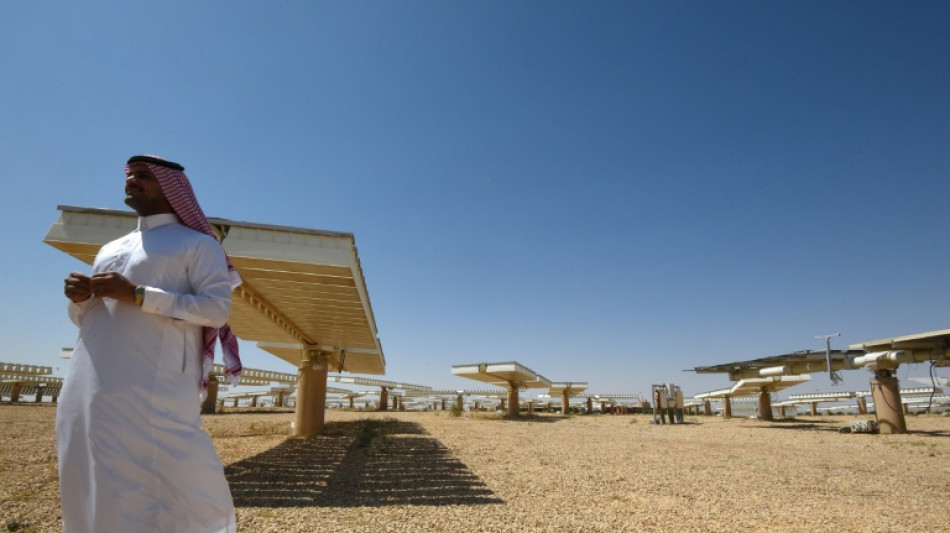
'Fuel of the future': Gulf states bet on 'green' hydrogen / Photo: FAYEZ NURELDINE - AFP/File

 iPhone 18預購後出現可疑扣款 四間銀行調查未授權交易

 Galaxy Tab S12系列效果圖曝光 Ultra擬配雙鏡頭及瀏海螢幕

 Altman tells Fortune OpenAI will not go public in 2026
 ستاندرد آند بورز تثبت تصنيف السعودية عند A+
 Steven Strogatz weighs AI mathematics advances and their consequences for researchers

 Venezuelans outside Caracas say capital not sharing blackout burden
 Anthropic boss calls for slowing pace of AI development
 BRICS nations urge 'maximum restraint' in Middle East war

 Europe eyes battle over 'pervert' AI glasses

 Children in flood-hit Nepal grapple with loss, cling to hope

 Venice Film Festival: A look back on the highlights

 DR Congo school fire stampede death toll rises to 26: UNICEF

 Dance Fitness Tempe Announces Expansion of Accessible Digital Movement Programs

 Europe saw record summer air traffic despite Mideast war: Eurocontrol

 Relatives of 9/11 victims hit out at Saudi Arabia -- and US leaders

 Relative of 9/11 victim unleashes searing attack on Saudi Arabia

 Czech antitrust office lets Turkey's Pegasus Airlines buy Smartwings

 Investors on edge as energy costs, surging bond yields roil markets

 UK lawmakers to vote again on failed assisted dying bill

 Yemen's Houthis complete takeover of Bab al-Mandab area: govt official to AFP

 Fast-pace dance takes I.Coast's working-class streets by storm

 Fans celebrate Celine Dion's Paris return with giant karaoke

 Appreciation, anger await as Trump heads to Irish golf resort

 Putin arrives in India for BRICS summit coloured by wars

 Carney says in touch with Trump, Canada ready for 'fair' trade deal

After riding a fossil-fuel boom for decades, Gulf Arab states are eyeing "green" hydrogen as they try to transition their economies and ease the climate crisis at a stroke.
Oil producers Saudi Arabia, the United Arab Emirates and Oman are investing heavily in the climate-friendly fuel in a search for alternative revenues to crude and gas.
Green hydrogen, which is the hydrogen created when renewable energy electrolyses water, appears to solve many problems: it is low-polluting and has widespread potential uses, which could make it lucrative and planet-saving at the same time.
But the fuel, which currently makes up less than one percent of total hydrogen production, is not yet commercially viable and needs a major scaling-up of renewable energy sources -- a process that could take years.
Despite this, the Gulf monarchies sense an opportunity to remain major players in energy markets as oil revenues fall.
"Gulf states aim to lead the global hydrogen market," said Karim Elgendy, associate fellow at Britain's Chatham House think tank.
"They see green hydrogen as critical to remain major energy powers, allowing them to continue their influence as fossil fuel demand declines."
Most hydrogen is produced from polluting fossil fuels, but green hydrogen is extracted from water using renewable energy such as wind, solar and hydropower.
While fossil fuels create harmful greenhouse gases when they burn, hydrogen emits only water vapour. It is touted for potential use in high-polluting industries such as transport, shipping and steel.
- 'Export leaders' -
Wielding its massive investment capital, oil-rich Saudi Arabia is constructing the world's largest green hydrogen plant at NEOM, the $500 billion futuristic megacity being built on the Red Sea.
The $8.4-billion plant will integrate solar and wind energy to produce up to 600 tonnes of green hydrogen a day by the end of 2026, officials say.
In July the UAE, which will host the United Nations' COP28 climate conference this year, approved a hydrogen strategy that aims to make it one of the top 10 producers by 2031.
"Hydrogen will be a critical fuel for the energy transition," said Hanan Balalaa, a senior official at the UAE's oil firm ADNOC, calling it a "natural extension" for the company.
But it is Oman, which lags Saudi Arabia and the UAE in fossil fuel production, that looks poised to lead the Gulf's clean hydrogen race.
The sultanate is on track to become the sixth-largest exporter globally and the biggest in the Middle East by the end of the decade, the International Energy Agency said in a June report.
Oman aims to produce at least one million tonnes of green hydrogen a year by 2030, and up to 8.5 million tonnes by 2050, "which would be greater than total hydrogen demand in Europe today", the IEA said.
According to auditing firm Deloitte, Middle Eastern countries, primarily the Gulf, will lead global clean hydrogen trade in the short-term, exporting around half of their domestic production by 2030.
By 2050, North Africa and Australia are projected to have the greatest potential, although Gulf states will remain "export leaders", the company said in a June report.
- Hope or hype? -
The investment in green hydrogen has not curbed expansion in oil and gas, with both the UAE and Saudi Arabia planning to grow their hydrocarbon industries.
Experts predict it could still take years before Gulf countries can produce green hydrogen at a cost competitive with fossil fuel-based alternatives.
While the cost of renewable energy has fallen due to technological advances, green hydrogen cannot yet be produced at a profit.
"Gulf countries will focus on maximising the sales of hydrocarbons as long as possible," said Aisha al-Sarihi, a research fellow at the National University of Singapore's Middle East Institute.
"It will take years of trial and error for green hydrogen to become a commercially traded commodity," the expert said, adding that it "can be the new fuel of the future" once the technology matures and costs fall.
Demand for hydrogen also remains unclear.
But Gulf states are long-time energy suppliers of import-dependent Asian countries such as Japan and South Korea that plan to incorporate it in their decarbonisation plans.
Abdullah al-Nuaimi, the UAE's former climate change minister, cautioned, however, that "the existing infrastructure for transporting hydrogen is not adequate and would require massive investment to modify".
"The time required to overcome and solve the challenges facing hydrogen is too long," he told AFP.
L.Peeters--CPN