13 die as Storm Eunice leaves thousands in Europe without power

 Lights out in Laos as electricity exports surge

 Steven Strogatz weighs AI mathematics advances and their consequences for researchers

 Anthropic boss calls for AI slowdown, Altman and Musk agree

 French IT giant Capgemini sells subsidiary after row over ICE links

 Quebec Brokerage Qubit Insurance Announces New Data on Coverage Shortfalls as Rebuilding Costs Rise

 Lady Gaga welcomes first child with fiance: US media

 Bhutan business bets on hazelnuts for farming future

 'Widow's Bay' and 'The Pitt' are favorites for Emmys night

 Coastal erosion forces cancellation of California music festival

 Argentina's Dirty War rears its head in Venice film

 UK lawmakers throw out bill to legalise assisted dying

 US inflation steady in August, fueling Fed rate hike expectations

 New York marks 25th anniversary of 9/11 attacks

 Nepal flood reconstruction bill to be $4.78 bn: foreign ministry

 JUMO and Standard Bank launch Social Finance Framework to scale inclusive finance in Africa

 Doomsday tech: could AI really kill us all?

 French comedy show 'Call my agent' makes film comeback

 It's all coming back: Celine Dion fans gear up for Paris return

 Researchers eye AI revolution in natural disaster forecasts

 US braces for inflation report that may push Fed to hike rates

 Musk threatens legal action over documentary

 Latin America fact-check group asks Meta not to replace verification practice

 AI Risks to Enter 60–80% of Liability and Cyber Insurance Underwriting by 2028, ScienceSoft Predicts

 Tribal Launches Campfire, Letting Business and Technical Teams Build on Salesforce Together

 Stocks fall as fresh oil surge fans inflation fears

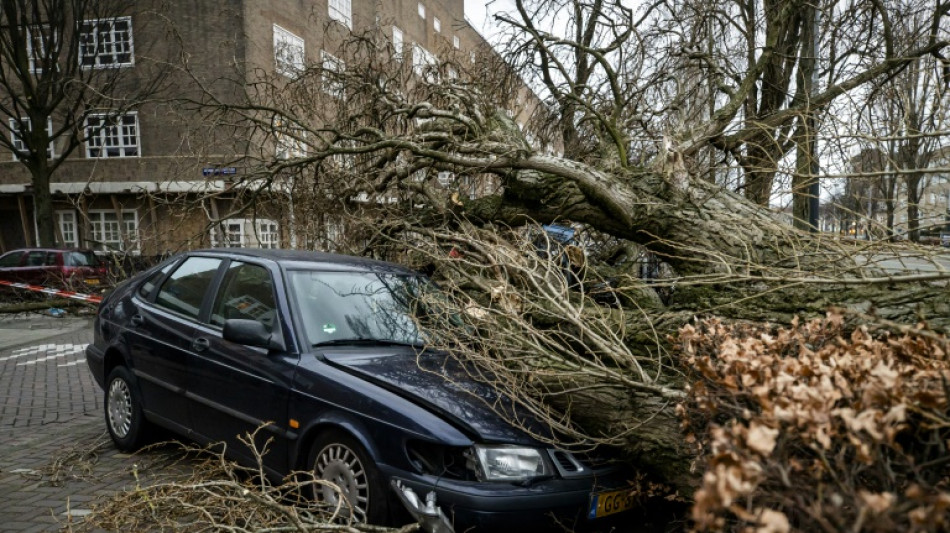
Emergency crews Saturday battled to restore power to hundreds of thousands of homes in Britain after Storm Eunice carved a deadly trail across Western Europe and left transport networks in disarray.
At least 13 people were killed by falling trees, flying debris and high winds in Britain, Ireland, the Netherlands, Belgium, Germany and Poland, emergency services said.
Train operators in Britain urged people not to travel, with trees still blocking several lines after most of the network was shut down when Eunice on Friday brought the largest wind gust ever recorded in England -- 122 miles (196 kilometres) per hour.
The train network in the Netherlands was also paralysed, with no Eurostar and Thalys international services running from Britain and France after damage to overhead power lines.
France was also grappling with rail disruption and about 37,000 households were without power, while some 8,000 remained cut off in Ireland and 194,000 in Poland.
The UK was worst hit by power cuts with nearly 400,000 homes cut off nationwide after one of the most powerful tempests since the "Great Storm" hit Britain and northern France in 1987, sparking the first-ever "red" weather warning for London on Friday.
The Met Office, Britain's meteorological service, issued a less-severe "yellow" wind warning for much of the south coast of England and South Wales on Saturday, which it said "could hamper recovery efforts from Storm Eunice".
Scientists said both the 1987 storm and Eunice packed a "sting jet", a rarely seen meteorological phenomenon borne out of an unusual confluence of pressure systems in the Atlantic that magnified the effects on Friday.
Planes struggled to land in high winds, a section of roof on London's O2 Arena was shredded, and the spire of a church in the historic city of Wells, southwest England, crashed to the ground.
The UK's total bill for damage could exceed £300 million ($410 million, 360 million euros), according to the Association of British Insurers, based on repairs from previous storms.
- 'Explosive storms' -
Hundreds of flights were cancelled or delayed at London's Heathrow and Gatwick airports and Schiphol in Amsterdam.
One easyJet flight from Bordeaux endured two aborted landings at Gatwick -- which saw wind gusts peak at 78 miles per hour -- before being forced to return to the French city.
Ferries across the Channel, the world's busiest shipping lane, were suspended, before the English port of Dover reopened Friday afternoon.
London's rush-hour streets, where activity has been slowly returning to pre-pandemic levels, were virtually deserted Friday as many heeded government advice to stay at home.
The London Fire Brigade declared a "major incident" after taking 550 emergency calls in just over two hours -- although it complained that several were "unhelpful", including one from a resident complaining about a neighbour's garden trampoline blowing around.
The RAC breakdown service said it had received unusually low numbers of call-outs on Britain's main roads, indicating that motorists were "taking the weather warnings seriously and not setting out".
Experts said the frequency and intensity of the storms could not be linked necessarily to climate change.
Therefore, he said, "flooding from coastal storm surges and prolonged deluges will worsen still further when these rare, explosive storms hit us in a warmer world".
A.Zimmermann--CPN