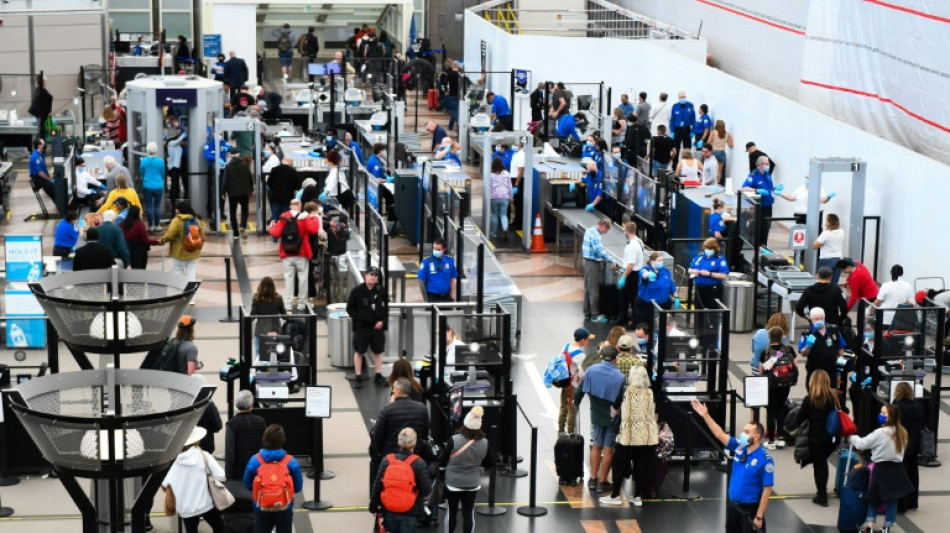
Wicked winter storm threatens US holiday travel chaos / Photo: Patrick T. FALLON - AFP

 Lights out in Laos as electricity exports surge

 Steven Strogatz weighs AI mathematics advances and their consequences for researchers

 Anthropic boss calls for AI slowdown, Altman and Musk agree

 French IT giant Capgemini sells subsidiary after row over ICE links

 Quebec Brokerage Qubit Insurance Announces New Data on Coverage Shortfalls as Rebuilding Costs Rise

 Lady Gaga welcomes first child with fiance: US media

 Bhutan business bets on hazelnuts for farming future

 'Widow's Bay' and 'The Pitt' are favorites for Emmys night

 Coastal erosion forces cancellation of California music festival

 Argentina's Dirty War rears its head in Venice film

 UK lawmakers throw out bill to legalise assisted dying

 US inflation steady in August, fueling Fed rate hike expectations

 New York marks 25th anniversary of 9/11 attacks

 Nepal flood reconstruction bill to be $4.78 bn: foreign ministry

 JUMO and Standard Bank launch Social Finance Framework to scale inclusive finance in Africa

 Doomsday tech: could AI really kill us all?

 French comedy show 'Call my agent' makes film comeback

 It's all coming back: Celine Dion fans gear up for Paris return

 Researchers eye AI revolution in natural disaster forecasts

 US braces for inflation report that may push Fed to hike rates

 Musk threatens legal action over documentary

 Latin America fact-check group asks Meta not to replace verification practice

 AI Risks to Enter 60–80% of Liability and Cyber Insurance Underwriting by 2028, ScienceSoft Predicts

 Tribal Launches Campfire, Letting Business and Technical Teams Build on Salesforce Together

 Stocks fall as fresh oil surge fans inflation fears

Life-threatening blizzards and bone-chilling winds are forecast across much of the United States over the next few days, threatening chaos for millions during the peak holiday travel period.
The National Weather Service (NWS) warned on Wednesday that a powerful winter storm would produce "a multitude of weather hazards" across the northern, central and eastern parts of the country.
Airlines told holiday travelers to brace for delays and cancellations as an Arctic cold front grips the northern Plains on Wednesday, sweeps through the Midwest and heads towards the East Coast on Friday just before Christmas.
"This will not be your average cold front as temperatures could drop 20 or more degrees within a few hours," the NWS said, bringing "record-breaking frigid temperatures" to the Gulf Coast and eastern United States by Friday.
It said the Great Lakes region could expect more than a foot (30.5 centimeters) of snow.
"Wind chill values could drop as low as minus 70 degrees Fahrenheit (minus 57 degrees Celsius) throughout parts of the central High Plains," the NWS said, warning that "cold of this magnitude could lead to frostbite on exposed skin within minutes."
"Prepare now for extreme cold and ensure outdoor animals and livestock have sufficient shelter," it said.
The NWS said wind gusts of over 50 miles (80 kilometers) per hour and snow will result in blizzard conditions from the northern and central Plains to the Great Lakes, creating "extremely dangerous travel conditions for both drivers and air travel."
- 'Bomb cyclone' -
The winter storm comes as the Transportation Security Administration said it expects holiday travel volume to be close to pre-pandemic levels, with the busiest day on Thursday.
The American Automobile Association estimated that more than 112 million people will travel 50 miles or more from home between Friday and January 2, the vast majority -- 102 million -- by car.
The Federal Aviation Administration warned that high winds and heavy snow could delay flights at major air travel hubs Minneapolis-St. Paul, Chicago and Denver.
AccuWeather forecasters said the storm could rapidly strengthen into what is known as a "bomb cyclone" through a process known as "bombogenesis," when the barometric pressure drops and a cold air mass collides with a warm air mass.
The NWS in Buffalo, New York called it a "once-in-a-generation storm" with wind gusts of over 65 mph, wind chill as low as 10 to 20 degrees below zero, and scattered or possibly widespread power outages.
Forecasters in Minneapolis described it a "high-end, life-threatening event" that "needs to be taken seriously."
In Fort Worth, Texas, the NWS told residents the cold snap was not expected to be as devastating as the one in February of last year, when freezing temperatures knocked out power to millions in the Lone Star State and caused dozens of deaths.
And in Washington, lawmakers were scrambling to complete work on a sweeping $1.7 trillion spending package before the massive winter storm complicates travel plans.
M.García--CPN