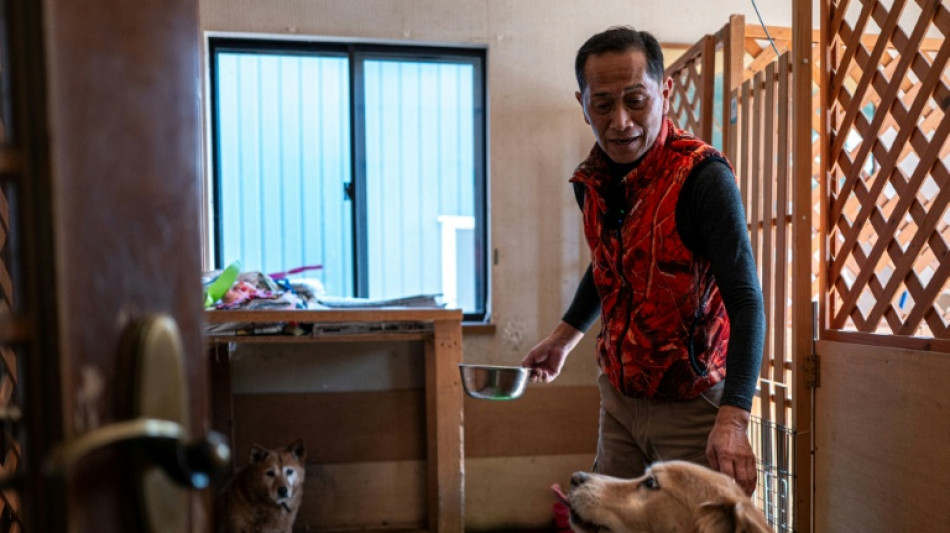
Former Fukushima worker devotes life to abandoned pets / Photo: Philip FONG - AFP

 Japan's busiest rail station tests robot bins

 Backpackers fret over Australian visa crackdown

 Bank of Japan hikes rates to 31-year high to battle inflation

 AI doomsday warnings unlikely to slow IPOs but questions linger

 In Brazil's Amazon, the hunt for oil fuels hopes and fears

 Baby orangutans in India expose 'frightening' scale of trafficking

 Oversight Board blasts 'inadequate' Meta safeguards for AI deepfakes

 Harry makes first public appearance since return to UK

 Princess Diana's brother makes new explosive claims against Charles

 Trump admin overhauls key protection for endangered species

 Mbappe draws political fire over Ceuta t-shirt controversy

 Third malaria death in Germany from outbreak tied to Frankfurt airport

 AtlasClear Holdings Reports Preliminary Fiscal 2026 Revenue of Approximately $20.1 Million, Up 85%; Revenue Plus Interest Income of Approximately $21.9 Million

 'Another arrow to the quiver': World Bank posts record private capital mobilization

 Ireland to boycott Eurovision 2027 over Gaza

 India's Tata Sons reappoints N. Chandrasekaran as chairman

 Germany urges EU action against China to defend carmakers

 Japan eyes changing prostitution law to punish sex buyers

 Modi pitches India as global chipmaking hub

 Ukraine plans record defence spending in 2027

 NASA scan discovers new, 'once in a century' Moon crater

 Most stocks rise as Fed hikes and indicates drive to curb inflation

 UK-Sudanese author pens book to give children 'African history of Africa'

 Argentine judge orders suspension of Falklands oil project

 US Fed raises rates to tackle 'too high' inflation, irking Trump

Not far from the Fukushima nuclear disaster site, former plant worker Toru Akama tends to dozens of pets abandoned after the catastrophe 15 years ago, work he sees as part of his quest for redemption.
Meows and barks break the silence of the countryside, once an evacuation zone, as the 63-year-old brings food to the animals left behind when their owners fled the triple disaster of March 11, 2011: earthquake, tsunami, and nuclear accident.
"It's because of this plant, where we worked for years, that these animals ended up like this," Akama told AFP at his home in northern Japan, surrounded by cats.
"They should have been able to go on living their lives as pets, but because of this accident they were abandoned.
"I felt it was my duty to protect them," he said.
Akama will never forget what he saw in the wake of the disaster, caused by Japan's strongest earthquake on record.
The tsunami it unleashed killed or left missing 18,500 people, and a wall of water crashed into the Fukushima nuclear plant on the northeast coast causing a devastating meltdown.
A day later, residents were ordered to evacuate and an unbroken line of cars formed on the national highway that runs past Akama's house.
"Then the dogs started wandering in search of something to eat -- least those that weren't chained up," he recalled.
"There was no one left, just my wife and me handing out food."
-'Outrage'-
Akama then began taking the animals into his home: first 40 dogs, then 50.
A decade and a half later, he has found adoptive families for more than 1,000 animals and continues to take in new pets who have been abandoned for other reasons.
He says he has "felt outrage" at the pet owners, who have sometimes left their animals in front of his house.
Some "are remorseful, but others simply do it because the animals have become a nuisance", he said.
In difficult moments, "of course... people's priority is human beings, but animals are living beings too, members of the family. It's as if people were abandoning their own children".
After the nuclear disaster, some residents had to flee by bus, and animals were not allowed aboard.
"There were elderly people in tears, asking if someone could take their pet," he recalled.
A month after the disaster Akama also had to leave, but he returned every day for his work at the plant and to look after his charges.
"Because they had known hunger, I absolutely wanted to give them a good life. Sometimes we went without ourselves in order to buy them quality food," he said.
-They 'watch over me'-
Over the past 15 years, Akama says he has spent almost all of the compensation he received after the plant accident on the animals, and he continues to cover most of their care and food costs.
"I don't have time to deal with collections or crowdfunding campaigns," he explained, although he has received some donations.
Akama's days are structured around cleaning the cages where new arrivals spend their first days, feeding, walking the dogs, and taking in new residents, leaving him little respite.
"It never stops. To be honest, I feel like my old job was easier," he said.
"But thanks to them I've never fallen ill: they force me to stay active. Maybe it's their way of thanking me, of watching over me in their own way."
At first, he kept the ashes of the deceased animals in his house, but he eventually had to build a grave outside to hold the remains of around thirty dogs and even more cats, beneath the inscription "rest in peace".
Akama's brother took over his subcontracting business for the plant, allowing him to devote himself full time to the 47 cats and 7 dogs with whom he currently shares his life.
"If I'm still able to keep going today, it's because I carry within me the distress these animals experienced. That's what keeps me going."
He would nevertheless like to find a successor.
"That's my biggest concern right now, because I too am starting to get older," he said.
"But I'd like to keep going like this until the end."
C.Smith--CPN