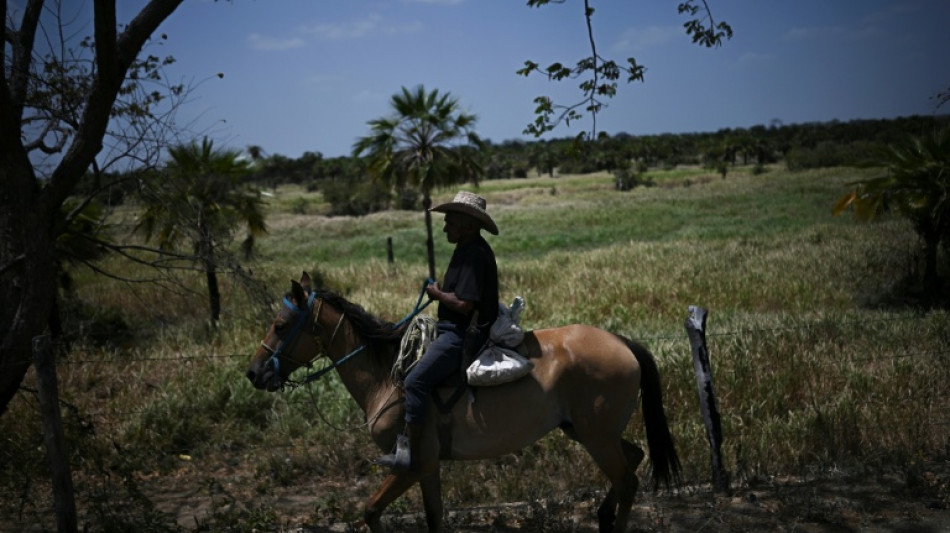
Grabbing the bull by the tail: Venezuela's cowboy sport / Photo: Federico PARRA - AFP

 UK actor Naomi Watts honoured at Spain film festival
 Trump signs bill authorizing sweeping Russia sanctions

 Anthropic picks Accenture for in-house AI safety evaluation

 Hushing and hedging: US companies retreat on climate

 Crisis-wracked Volkswagen warns of 10-bn-euro hit to profits

 Shakira to cap off world tour with Madrid 12-gig run

 Isolated Syrian-Druze city shortages

 UNESCO can be 'moderator' in AI debate: chief to AFP

 Russia seizes assets of Nestle, French firms

 Anthropic says AI systems moving towards building themselves

 Asian stocks boosted by falling oil, yen weakens after BoJ rate hike

 Afghan medical students in Pakistan hope court stops college expulsions

 Australia to detain tourists who overstay visa, minister says

 Asian stocks track Wall St rally as oil prices drop

 Prized Mexican relic returns on loan, two centuries on

 'In our lane': Fed's Warsh defies Trump but still fighting for credibility

 Trump admin makes major cut to endangered species protections

 GM delivers first components for US interceptor missiles

 Travis Scott and Keith Richards feature on GTA VI soundtrack

 King Charles warns tech bosses of 'existential dangers' of AI

 French fishermen block ports over petrol prices

 Micron's Taiwan workers say 68 months' bonus not enough

 Canada's Carney pushes 'new alliance' with EU despite Trump threats

 Beyond Investment Returns: Families Are Measuring Wealth by Freedom, Continuity, and Legacy, According to Nour Private Wealth

 King Charles disputes claims in book by Princess Diana's brother

Four mounted cowboys jostle for position near the bull pen gate.
When the bull bolts out into the ring, a mad scramble begins as the riders vie to grab its tail and knock it to the ground.
Bull tailing, or "coleo" is to Venezuela's "llanos" (tropical grasslands) what rodeo is to Texas -- an integral part of popular culture that has survived opposition from animal welfare groups.
Unlike their Texan counterparts, "coleadores" don't try to ride the bull or grab it by the horns but rather chase its tail.
The coleo is one of the high points of the annual "llanera" fair in the central city of San Fernando de Apure, a three-day extravaganza of cowboy culture, including fast-paced, swirling "joropo" partner dancing listed on the UN's Intangible Cultural Heritage list.
Experts trace coleo to Spanish colonial times and link it to cattle herding work.
It is also practiced across the border in Colombia's "llanos," as well as in Brazil and Mexico, countries with strong cattle breeding traditions.
Most of the "coleadores" or bull tumblers learn the sport from their fathers or grandfathers. Women and children have also been known to compete.
For Neomar Sanoja, one of the judges, it's Venezuela's "national sport" -- a bold claim in a baseball mad nation.
- 'Feel the adrenaline' -
Rafael Delgado, 35, started competing at around 10, encouraged by his father, a ranch hand.
"It's part of our 'llanero' culture, part of being Venezuelan," he told AFP before entering the ring.
To reach the bull’s tail, riders spur on their horses and when they draw alongside the animal's flanks, perform acrobatic maneuvers to try flip the beast.
The bull writhes, struggles back on its feet and tries to escape along the "manga de coleo," a 200-meter-long sand corridor, with the riders in hot pursuit.
Points vary depending on how the bull tumbles, with extra marks for those who manage to get all four legs in the air.
About 200 competitors took part in the four-minute bouts in San Fernando de Apure, wearing hockey helmets and padding on their arms and legs as armor.
Llanera music blared while a judge narrated the action with rapid-fire delivery.
Florelbis Linares told AFP she wanted to take up coleo despite the misgivings of her coleatero boyfriend, who she watched perform from the stands.
"You really feel the adrenaline watching from here," the 23‑year‑old said, her legs hanging over the guardrail around the ring.
- 'Defenseless animals' -
The bull's suffering is little cause for concern among aficionados of coleo.
Most of the animals who enter the ring are headed for the slaughterhouse.
Luis Garcia, a 32‑year‑old rider, accused critics of the sport of hypocrisy, noting that most show no outrage in the face of intensive cattle rearing and meat consumption.
The AnimaNaturalis animal rights NGO, which is active in Spain and Latin America, has called for the practice to be abolished.
"It is cruelty and an abuse of power by llaneros against defenseless animals," it argued on its website.
"Is this what you call culture?" the Napda Foundation, a Venezuelan animal rights foundation, asked, posting a video of coleo spectators kicking and throwing objects at a bull to force it to get back on its feet.
"The alleged 'humans' behave like beasts. This must stop now."
D.Goldberg--CPN