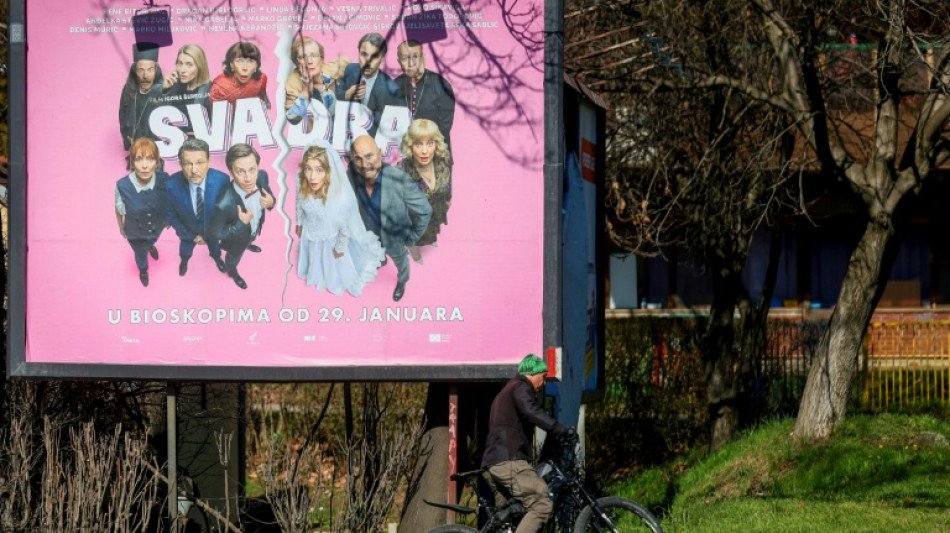
Balkan 'forbidden' love comedy smashes stereotypes and records / Photo: Oliver Bunic - AFP

 Thousands protest inaction over climate crisis in Switzerland
 UK actor Naomi Watts honoured at Spain film festival

 Trump signs bill authorizing sweeping Russia sanctions

 Anthropic picks Accenture for in-house AI safety evaluation

 Hushing and hedging: US companies retreat on climate

 Crisis-wracked Volkswagen warns of 10-bn-euro hit to profits

 Shakira to cap off world tour with Madrid 12-gig run

 Isolated Syrian-Druze city shortages

 UNESCO can be 'moderator' in AI debate: chief to AFP

 Russia seizes assets of Nestle, French firms

 Anthropic says AI systems moving towards building themselves

 Asian stocks boosted by falling oil, yen weakens after BoJ rate hike

 Afghan medical students in Pakistan hope court stops college expulsions

 Australia to detain tourists who overstay visa, minister says

 Asian stocks track Wall St rally as oil prices drop

 Prized Mexican relic returns on loan, two centuries on

 'In our lane': Fed's Warsh defies Trump but still fighting for credibility

 Trump admin makes major cut to endangered species protections

 GM delivers first components for US interceptor missiles

 Travis Scott and Keith Richards feature on GTA VI soundtrack

 King Charles warns tech bosses of 'existential dangers' of AI

 French fishermen block ports over petrol prices

 Micron's Taiwan workers say 68 months' bonus not enough

 Canada's Carney pushes 'new alliance' with EU despite Trump threats

 Beyond Investment Returns: Families Are Measuring Wealth by Freedom, Continuity, and Legacy, According to Nour Private Wealth

When two students in London tell their families they are going to get married, it should be one of the happiest moments of their lives.
But there's a catch -- she is Croatian and he is Serbian.
The rivalry between the two Balkan neighbours becomes comedy gold in the smash hit film "Wedding", which has audiences in both countries laughing at themselves.
The Croatian-Serbian co-production mocks stereotypes of the two peoples who share a very similar language but who ended up fighting in a bloody war in the 1990s when Yugoslavia, the country they shared for generations, collapsed.
The young couple's families are horrified by the looming "mixed marriage".
The Croat Catholic father senses something is amiss from his daughter's voice when she calls to share the news that a baby is on the way -- only to learn the "shocking truth" that the father and future son-in-law is a Serb.
There's a similar reception on the Serbian side, where the grandmother calls her future in-laws "Ustashas", a slur alluding to Croatia's World War II pro-Nazi regime.
- Most watched film ever -
The movie, called "Svadba" in Croatian, has become a box office phenomenon at a time when relations between Zagreb and Belgrade are among their lowest since the war.
In Croatia it has become the most-watched film ever, with nearly 700,000 people seeing it in just over a month -- one in five of the population -- sinking the three-decade-old record held by "Titanic" by around 200,000 tickets.
So far it has been seen by some two million people across the Balkans and in Austria, Switzerland and Germany, which have large diaspora populations.
Director Igor Seregi said its success showed people were missing the same thing: "Laughter -- to laugh at each other but also at ourselves.
"I think everyone recognised someone from their own family or wider circle and that resonated," Seregi told AFP.
He cast renowned actors from both nations in his "Romeo and Juliet" tale where the two fathers particularly struck a chord.
The politically-connected Croatian tycoon needs to expand into Serbia to avoid bankruptcy, while the father of the groom is a Serbian minister looking for funds from the European Union, of which Croatia is a member.
Marko Jovanovic, an administrator from Belgrade, told AFP that the comedy was a spot-on portrayal of the two countries' elites.
"A shady businessman with a gold chain and a politically connected schemer whose children study in London, felt almost like a documentary," he said.
- 'Strips prejudices bare' -
Ivana, a Serbian woman who married in Zagreb 20 years ago, loved it for stripping prejudices bare.
"The time has come for such a human story that reveals the reality beyond the politics," she said.
The movie gently mocks absurd traditions, the clergy and generational divides.
Lorna, a psychology student from Zagreb, liked it for "poking fun equally at Serbian and Croatian society and their absurdities".
Zagreb-born Seregi believes viewers outside the Balkans also relate to the movie as it is about division, whether between rich and poor, urban and rural, or along racial lines.
"Real life hasn't always been as smooth or romantic as depicted in the movie, but in the end, love always wins," the 42-year-old said.
Psychologist Petar Kraljevic echoed many viewers in praising the film's feelgood vibe.
"The baby's birth unites the families for good, letting optimism and hope for a better future prevail," he said.
St.Ch.Baker--CPN