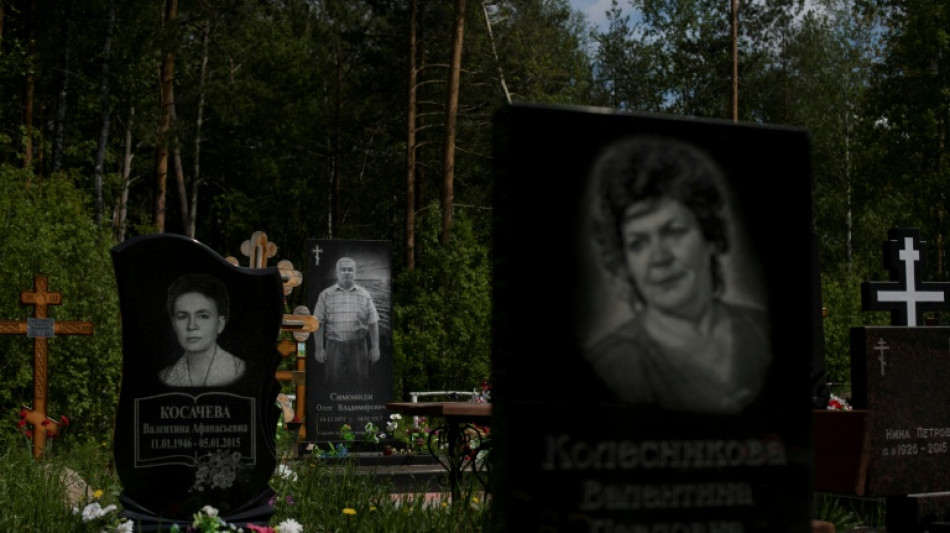
Russian family brings abandoned graves back to life / Photo: JORGE GUERRERO - AFP

 Multi-Asset Trading Venue Monochrome Exchange Announces IEO of Its Native Token, $MCR
 Data centre command hub keeps AI up and running
 Leo XIV, first US pope transcends his restrained style
 France's debt climbs to highest since 1978: ministry
 Thousands protest inaction over climate crisis in Switzerland
 UK actor Naomi Watts honoured at Spain film festival
 Trump signs bill authorizing sweeping Russia sanctions

 Anthropic picks Accenture for in-house AI safety evaluation

 Hushing and hedging: US companies retreat on climate

 Crisis-wracked Volkswagen warns of 10-bn-euro hit to profits

 Shakira to cap off world tour with Madrid 12-gig run

 Isolated Syrian-Druze city shortages

 UNESCO can be 'moderator' in AI debate: chief to AFP

 Russia seizes assets of Nestle, French firms

 Anthropic says AI systems moving towards building themselves

 Asian stocks boosted by falling oil, yen weakens after BoJ rate hike

 Afghan medical students in Pakistan hope court stops college expulsions

 Australia to detain tourists who overstay visa, minister says

 Asian stocks track Wall St rally as oil prices drop

 Prized Mexican relic returns on loan, two centuries on

 'In our lane': Fed's Warsh defies Trump but still fighting for credibility

 Trump admin makes major cut to endangered species protections

 GM delivers first components for US interceptor missiles

 Travis Scott and Keith Richards feature on GTA VI soundtrack

 King Charles warns tech bosses of 'existential dangers' of AI

Fearful that memories of the deceased could fade away, Natalia Kornilova and her family have made it their mission to bring Russia's old cemeteries back to life, one gravestone at a time.
Waves of post-Soviet emigration and a rapidly ageing population have left Russia with thousands of abandoned graves, many overgrown and covered with grime.
Kornilova and her family have posted videos of them cleaning headstones that have racked up hundreds of thousands of views -- but they say they are not motivated by the money.
"As long as people are remembered, they are alive. And the graves we tidy up -- those people are remembered," Natalia told AFP.
Every weekend, the family cleans abandoned graves in their hometown of Domodedovo, south of Moscow, meticulously scrubbing the headstones to reveal their inscriptions and the photographs sometimes attached to them.
Natalia's son Pavel has started accounts on YouTube, Instagram, and TikTok where he posts before-and-after videos of the family cleaning graves.
"At first, a headstone will be absolutely grimy. You can't see the name, the surname, the dates, nothing at all. And after our cleaning, as if by magic, the names appear, and sometimes even images," the 28-year-old told AFP, pointing to a drawing of a weeping baby rabbit etched onto an infant's tomb.
"We don't take any money for this. No one pays us, and we don't know the relatives of those buried there," he stressed.
But followers make small donations to buy plastic flowers that Pavel's grandmother Lida places on the cleaned graves.
Videos on the family's YouTube channel, named "Babushka Lida" (Grandmother Lida), have clocked up hundreds of thousands of views.
Their content has inspired others to take up grave cleaning, Pavel told AFP.
"They're even ready to clean up abandoned graves near their relatives' plots in different cities across Russia and even around the world."
- 'No-one left to come' -
"Unfortunately, many graves have been neglected," Pavel said.
"It's not even because the relatives don't want to come. Many may have moved to other cities or countries. And these are burials from the '70s, '60s -- their closest relatives, their children, may already be elderly too, or perhaps have passed away, and there's simply no one left to come."
In Russia, a country that spans 17 million square kilometres (more than six million square miles), people often move huge distances for a new job or family reasons.
Nearly 11 million Russians have moved abroad since the fall of the Soviet Union in 1991, while close to a million left after Russia began its military offensive on Ukraine in 2022, according to estimates.
The Russian diaspora ranks third in the world after India and Mexico, according to UN data.
"The country is very large," said Natalia Kornilova, whose family live across the world.
But Russia can feel like a small place sometimes.
"Once we accidentally came across a grave. It was our neighbours!" Natalia said.
"We knew for sure they had no one left and no one to visit. And that's exactly where it all began: we went there, cleaned up, and realised the scope of work was enormous."
Several private companies offer grave maintenance services, with prices ranging from 3,000 rubles ($40) to in excess of 16,000 rubles.
Natalia and her sons do it for free.
In the 1990s, a black market for cemetery plots flourished in Russia.
Cemetery administrations illegally sold abandoned graves. The old headstones would be removed and other people buried there, she said.
The family's efforts help prevent this, the 55-year-old told AFP.
"And it really feels like people start to smile when we've finished," she added.
"We look at the photographs, and it seems the people smile back."
A.Zimmermann--CPN