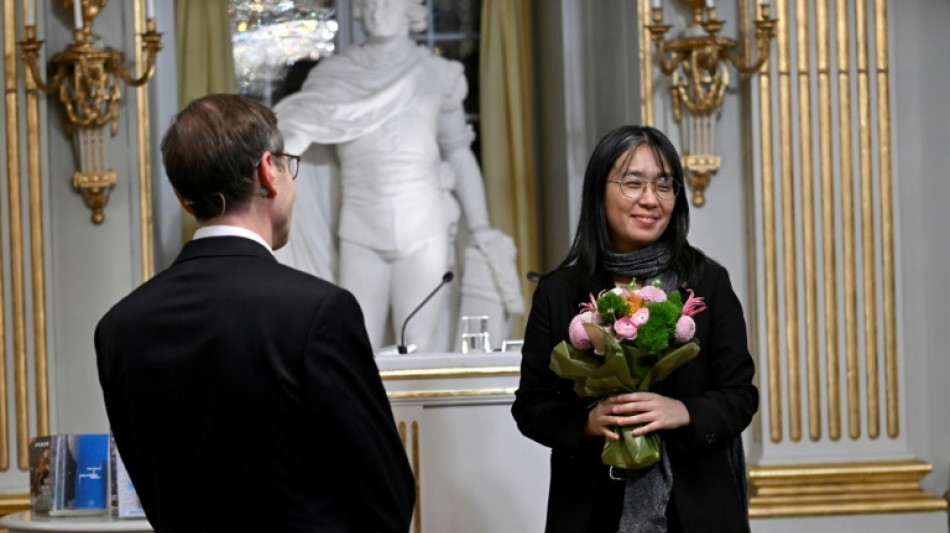
Nobel literature buzz tips Western author / Photo: Pontus LUNDAHL - TT NEWS AGENCY/AFP/File

 Infantino proposes consulting federations to reform FIFA
 South Africa arrests three more suspects, after nine women murdered
 Paramount settles with US states to clear Warner Bros. mega-merger

 Climate crisis a job for world leaders, not just activists: UK FM
 COP31 host says AI's climate footprint to be a summit priority
 EU proposes energy rating for data centres

 TradersYard Shifts Focus to Futures Trading

 Indonesia doing 'everything' but struggling to curb fires
 FQ-42 Vengeance Finds New Home at Creech Air Force Base
 Multi-Asset Trading Venue Monochrome Exchange Announces IEO of Its Native Token, $MCR
 Data centre command hub keeps AI up and running
 Leo XIV, first US pope transcends his restrained style

 France's debt climbs to highest since 1978: ministry
 Thousands protest inaction over climate crisis in Switzerland
 UK actor Naomi Watts honoured at Spain film festival
 Trump signs bill authorizing sweeping Russia sanctions
 Anthropic picks Accenture for in-house AI safety evaluation
 Hushing and hedging: US companies retreat on climate

 Crisis-wracked Volkswagen warns of 10-bn-euro hit to profits

 Shakira to cap off world tour with Madrid 12-gig run

 Isolated Syrian-Druze city shortages

 UNESCO can be 'moderator' in AI debate: chief to AFP

 Russia seizes assets of Nestle, French firms

 Anthropic says AI systems moving towards building themselves

 Asian stocks boosted by falling oil, yen weakens after BoJ rate hike

The Nobel literature prize could go to a Western author this Thursday, experts predict, though bookies have several authors from Asia as top picks even after South Korea's Han Kang last year became the first Asian woman to win.
Awarding the prize to another woman this year would make history: it has never gone to a woman two years in a row, and women are vastly under-represented among its laureates -- just 18 out of 121 since it was first awarded in 1901.
But literary critics in Stockholm told AFP they therefore expect a Western man to get the nod this year, citing Australia's Gerald Murnane, Romania's Mircea Cartarescu, Hungary's Laszlo Krasznahorkai and Peter Nadas as possibilities, as well as Swiss postmodernist Christian Kracht.
Murnane and Krasznahorkai meanwhile have the lowest odds on betting sites, along with India's Amitav Ghosh, who rose into the reckoning just two days before the announcement.
Another contender among bookmakers is China's Can Xue, who is known for her experimental style and has been likened to Franz Kafka.
The 18-member Swedish Academy that awards the prize insists it does not take gender, nationality or language into consideration.
But "even if they say that they don't think in terms of representation, you can still look at the list (of past laureates) and see that it's kind of 'OK, this year was a European, now we can look a little further afield. And now we go back to Europe. Last year was a woman, let's choose a man this year'," Sveriges Radio culture critic Lina Kalmteg told AFP.
After a #MeToo scandal that rocked the Academy in 2018, every other laureate has been a woman, suggesting an effort to right past wrongs and improve the gender imbalance.
- 'Bizarre masterpiece' -
Bjorn Wiman, culture editor at Swedish newspaper of reference Dagens Nyheter, told AFP he thought this year's winner would be a man "from the Anglo-Saxon, German or French-language world".
Christian Kracht, a 58-year-old German-language postmodernist author who writes about pop culture and consumerism, is a favourite in literary circles, he said.
At this year's Gothenburg Book Fair -- held annually a few weeks before the Nobel announcement -- "many members of the Swedish Academy were there, sitting in the front row during his event", Wiman said.
"And that is usually a sure sign," he said, adding that the same thing happened when Austrian playwright Elfriede Jelinek won the prize in 2004.
Another writer getting a lot of attention in the run-up this year is Australia's Murnane.
Born in 1939 in Melbourne, his work draws heavily on his own life experiences.
His novel "The Plains" (1982) delves into Australian landowners' culture, described by the New Yorker as a "bizarre masterpiece" that feels more like a dream than a book.
"The question is whether he'll answer the phone (when the Academy calls), I don't know if he even has one," joked Josefin de Gregorio, literary critic at Sweden's other main daily, Svenska Dagbladet.
"He's never left Australia. He lives in the countryside, he doesn't make himself very accessible," she said.
"I hope he wins, I want more people to discover his wonderful work," de Gregorio said.
Australian Aboriginal writer Alexis Wright has also been mentioned.
- 'Unthinkable' -
Other names that regularly make the rounds are Antiguan-American author Jamaica Kincaid, Canada's Anne Carson, Chile's Raul Zurita, and Argentina's Cesar Aira.
The last South American to win was Peru's Mario Vargas Llosa in 2010, and the region could be overdue, Kalmteg told AFP.
She also mentioned Mexican authors Cristina Rivera Garza and Fernanda Melchor.
With no public shortlist and the prize committee's deliberations sealed for 50 years, it is always difficult to predict which way the Academy is leaning.
It has a penchant for shining a spotlight on writers relatively unknown to a wider public, with Wiman noting that it was previously known for being "openly elitist, artistically".
"Authors like Han Kang would have been unthinkable five or six years ago," he said, noting that she was well-established internationally and only 53, while the Academy previously tended to honour older men.
The 2025 winner, who will take home a $1.2 million cheque, will be announced on Thursday at 1:00 pm (1100 GMT).
U.Ndiaye--CPN
