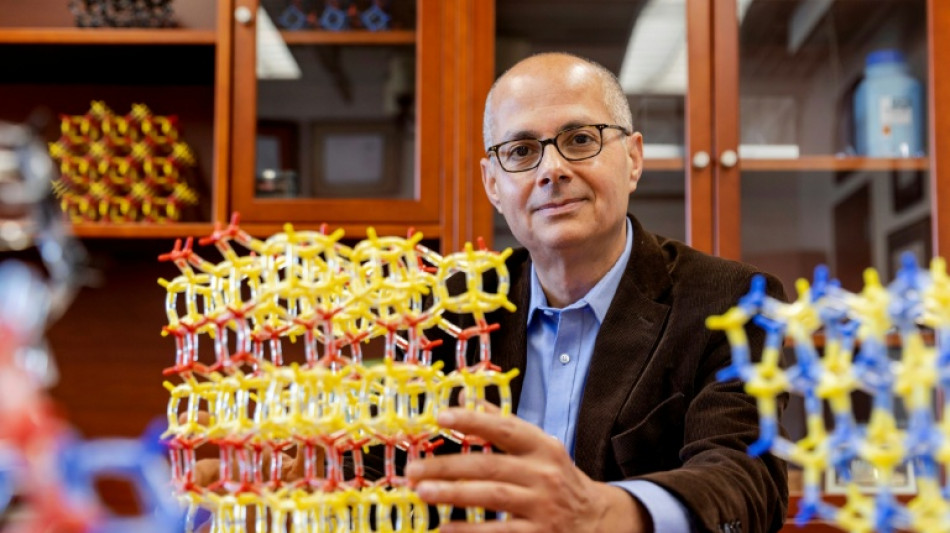
From refugee to Nobel: Yaghi hails science's 'equalizing force' / Photo: Brittany Hosea-Small - University of California, Berkeley/AFP

 Infantino proposes consulting federations to reform FIFA
 South Africa arrests three more suspects, after nine women murdered
 Paramount settles with US states to clear Warner Bros. mega-merger

 Climate crisis a job for world leaders, not just activists: UK FM
 COP31 host says AI's climate footprint to be a summit priority
 EU proposes energy rating for data centres

 TradersYard Shifts Focus to Futures Trading

 Indonesia doing 'everything' but struggling to curb fires
 FQ-42 Vengeance Finds New Home at Creech Air Force Base
 Multi-Asset Trading Venue Monochrome Exchange Announces IEO of Its Native Token, $MCR

 Data centre command hub keeps AI up and running
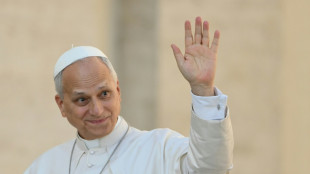 Leo XIV, first US pope transcends his restrained style

 France's debt climbs to highest since 1978: ministry

 Thousands protest inaction over climate crisis in Switzerland

 UK actor Naomi Watts honoured at Spain film festival

 Trump signs bill authorizing sweeping Russia sanctions

 Anthropic picks Accenture for in-house AI safety evaluation

 Hushing and hedging: US companies retreat on climate

 Crisis-wracked Volkswagen warns of 10-bn-euro hit to profits

 Shakira to cap off world tour with Madrid 12-gig run

 Isolated Syrian-Druze city shortages

 UNESCO can be 'moderator' in AI debate: chief to AFP

 Russia seizes assets of Nestle, French firms

 Anthropic says AI systems moving towards building themselves

 Asian stocks boosted by falling oil, yen weakens after BoJ rate hike

Nobel chemistry laureate Omar Yaghi was born to Palestinian refugees in Jordan, a quiet, studious child in a "large, rowdy family" that shared a single room with cattle they raised.
Which made Wednesday's news that the chemist at the University of California, Berkeley was among 2025's class of Nobel winners all the more emotional, Yaghi told journalists as he heralded the US public school system he said he is a product of.
He also emphasized that publicly financed education and research have been key to his career, at a moment when US President Donald Trump is upending the long-standing funding structures that undergird the work of universities.
"This recognition is really a testament of the power of the public school system in the US that takes people like me with a major disadvantaged background, a refugee background, and allows you to work, and work hard, and distinguish yourself," Yaghi said.
He described how his parents spent "every minute of their time dedicated to their kids and to their kids' education, because they saw that as a way to lift themselves and the kids out of challenging situations."
Their home had no electricity or running water. His father had finished school through sixth grade and his mother could neither read nor write.
"We didn't have a lot of the conveniences that many others do, but we had a lot of love and a lot of care," the scientist said.
Yaghi won the 2025 prize together with Susumu Kitagawa of Japan and UK-born Richard Robson for their groundbreaking discoveries on metal–organic frameworks (MOFs), whose uses include capturing carbon dioxide and harvesting water from desert air.
Born in 1965, he spent his childhood in Amman, Jordan, before leaving for the United States at the age of 15, on the advice of his stern father who saw for his son an opportunity to thrive.
At that point young Yaghi had already grown enamored with molecular structures after being drawn to "unintelligible but captivating" images in a book.
"I fell in love with them, even before I knew they were molecules," Yaghi said.
- 'Equalizing force' of science -
He began at a community college in upstate New York before transferring and finishing a degree at the State University of New York at Albany, supporting himself by bagging groceries and mopping floors.
Yaghi completed his PhD at the University of Illinois at Urbana-Champaign in 1990 and went on to work at a number of US universities before landing at UC Berkeley in 2012.
He emphasized Wednesday that groundbreaking research was made possible with grants that stemmed from federal sources.
"They were absolutely key in enabling me to go off in my own direction" and experiment, Yaghi said. "Science costs money, and it's an investment into our future."
He louded the "amazing" higher education, research and mentorship system in the United States that public funding is vital to: "Science is a jewel in the crown of our country."
"We cannot allow that to slip."
Yaghi was en route to Brussels via Frankfurt for a chemistry conference when the Nobel organizers got in touch with him with news of his prestigious honor, which he said "surprised and delighted" him.
"You cannot prepare for a moment like that," he said.
Yaghi's accomplishments include leading a research group that extracted water from desert air in Arizona, work his students have told him has garnered more than 250,000 citations.
The child of refugees told the Nobel Foundation Wednesday that "science is the great equalizing force in the world."
"Smart people, talented people, skilled people exist everywhere," Yaghi said.
"That's why we really should focus on unleashing their potential through providing them with opportunity."
M.Mendoza--CPN
