Trio wins physics Nobel for quantum mechanical tunnelling / Photo: Jonathan Nackstrand - AFP

 Green policies just good politics, says UK minister
 El Nino weather pattern enters record territory: scientist
 US networks halt Trump coverage in revolt over White House ban
 NOWPayments Releases Cross-Chain Payout Data Revealing Key Performance Benchmarks Across TRON, BNB Chain, and Solana
 COP31 host says AI climate footprint to be a summit priority
 Global stocks rally on lower oil prices, US-China hopes
 Spanish PM says unregulated AI could be 'devastating'

 From Korean Chipmakers to Leveraged Semiconductor ETFs: STARTRADER Launches 49 New 24/7 Stock and ETF CFDs
 Asia stocks rise on AI, US-China trade talks optimism

 France's Macron, Canada's Carney announce closer ties
 AI 'warning shots' focus Beijing on national security risks
 Philippine tribe in limbo over US-led tech hub
 Saudi-led coalition says Houthis fired ballistic missile at Riyadh
 Cuba works to restore power after another blackout
 Brigitte Bardot widower slams sale of star's belongings

 Indonesia accepts Malaysia's help to tackle wildfires

 Nvidia, OpenAI CEOs to attend Xi dinner at White House

 Cuba hit with seventh major blackout of the year

 Nigeria miners struggled to breathe in cell before 37 died: survivors

 Warren Buffett steps down as Berkshire Hathaway chairman

 Isolated Syrian-Druze city blames Damascus for shortages

 Kerry James Marshall: American 'blackness' painter celebrated in Europe

 Infantino 'must go', says German FA vice-president

 Japan's busiest rail station tests robot bins

 Backpackers fret over Australian visa crackdown

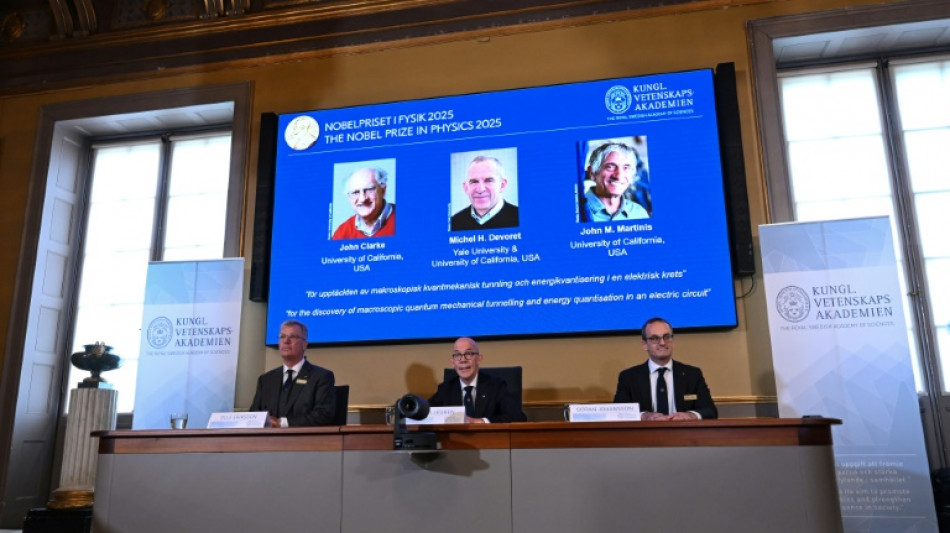
Briton John Clarke, Frenchman Michel Devoret and American John Martinis won the Nobel Prize in Physics on Tuesday for work on quantum physics in action, the Nobel jury said.
The trio was honoured "for the discovery of macroscopic quantum mechanical tunnelling and energy quantisation in an electric circuit," the jury said.
Quantum mechanics describes how differently things work on incredibly small scales.
For example, when a normal ball hits a wall, it bounces back. But on the quantum scale, a particle will actually pass straight through a comparable wall -- a phenomenon called "tunnelling".
Tuesday's prize was awarded for experiments in the 1980s which showed that quantum tunnelling can also be observed on a macroscopic scale – involving multiple particles – by using superconductors.
In a series of experiments, the researchers demonstrated that "the bizarre properties of the quantum world can be made concrete in a system big enough to be held in the hand," the Royal Swedish Academy of Sciences said in a statement.
The jury noted that the discoveries had "provided opportunities for developing the next generation of quantum technology, including quantum cryptography, quantum computers, and quantum sensors."
"It is wonderful to be able to celebrate the way that century-old quantum mechanics continually offers new surprises. It is also enormously useful, as quantum mechanics is the foundation of all digital technology," Olle Eriksson, chair of the Nobel Committee for Physics, said in a statement.
- 'Never occurred to me' -
Clarke, 83, is a professor at the University of California, Berkeley, and Devoret, 72, is a professor at University of California, Santa Barbara and is listed as a professor emeritus at Yale University.
Martinis, born 1958, is also a professor at the University of California, Santa Barbara.
"To put it mildly, it was the surprise of my life," Clarke told reporters via telephone during the prize announcement, about learning of his award.
"It never occurred to me in any way that this might be the basis of a Nobel Prize," Clarke added.
Clarke explained that the scientists were focused on the physics of their experiments and that they didn't realise the practical applications that could follow.
"It certainly had not occurred to us in any way that this discovery would have such a significant impact," Clarke said.
The physics prize is the second Nobel of the season, after the medicine prize was awarded on Monday to a US-Japanese trio for research into the human immune system.
Mary Brunkow and Fred Ramsdell, of the United States, and Japan's Shimon Sakaguchi were recognised by the Nobel jury for identifying immunological "security guards".
Last year, the Nobel Prize in Physics went to British-Canadian Geoffrey Hinton and American John Hopfield for their pioneering work on the foundations of artificial intelligence -- with both of them warning that their discoveries carried profound risks to society and humanity.
The physics prize will be followed by the chemistry prize on Wednesday.
The literature prize will be announced on Thursday, and the highly watched Nobel Peace Prize on Friday.
The economics prize wraps up the 2024 Nobel season on October 14.
The Nobel consists of a diploma, a gold medal and a $1.2 million cheque, to be shared if there is more than one winner in a discipline.
The laureates will receive their prizes from Sweden's King Carl XVI Gustaf at a formal ceremony in Stockholm on December 10.
That date is the anniversary of the death in 1896 of scientist Alfred Nobel, who created the prizes in his will.
J.Bondarev--CPN