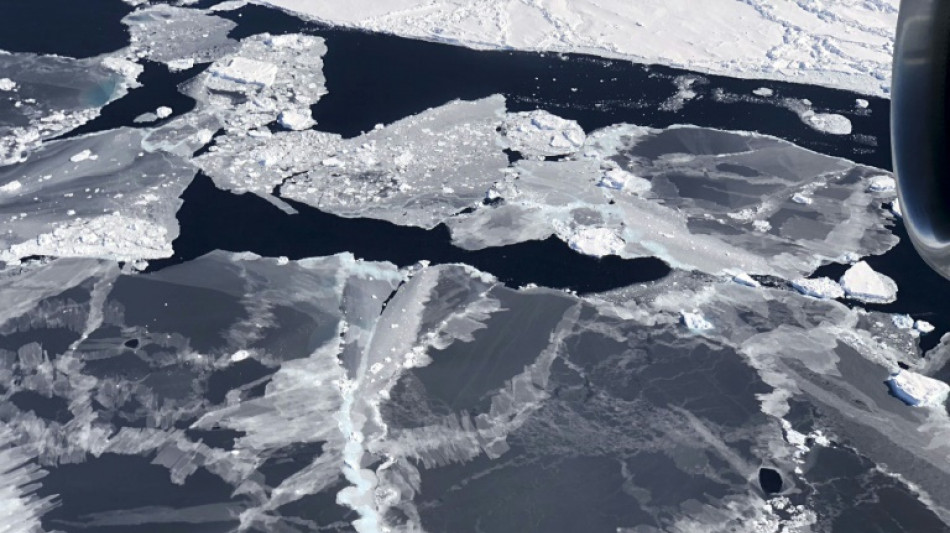
Emperor penguin populations declining faster than expected / Photo: Kate RAMSAYER - NASA/AFP/File

 Iran proposes Hormuz plan, Trump reportedly refuses

 El Nino rewrites the menu in the world's top restaurants

 Jay-Z rape accuser says she made 'false accusations'

 Trump's photo of Xi greeting carries signs of AI

 First US trial against TikTok to open Monday

 French literary prize removes novel from longlist after AI claims

 Trump accuser E. Jean Carroll finally has her damages

 Heavy fighting, internet disruption as Ethiopia conflict rages

 Asian markets mixed after oil gains

 UN approves resolution on dealing with rising sea levels

 Global stocks mostly fall as oil prices and bond yields rise

 Starbucks to close 250 more cafes in North America

 Stocks fall as oil prices rise and bonds back under pressure

 Top ECB official to resign to take up IMF role

 Eviction of pensioner puts Spain housing crisis in spotlight

 Average EU diesel price hits record 2.23 euros a litre: AFP analysis

 Whitetip Investments Marks 10 Years of Regulation, Transparency & Responsible Trading

 Stocks fall, oil prices rise as global bonds under pressure

 Hungary detects invasive spotted lanternfly for first time in EU

 Forex Expo Dubai 2026 Breaks Guinness World Record Again With 23,816 Attendees

 Asian markets fall on US-China jitters as leaders meet

 As Moscow steps up attacks, Kyiv residents brace for harsh winter

 Markets mixed as China's Xi arrives for US talks

 Archaeological 'breakthrough' could confirm origins of Paris

 Australian PM says OpenAI hacked government health website

Emperor penguin populations in Antarctica have shrunk by almost a quarter as global warming transforms their icy habitat, according to new research on Tuesday that warned the losses were far worse than previously imagined.
Scientists monitoring the world's largest penguin species used satellites to assess sixteen colonies in the Antarctic Peninsula, Weddell Sea and Bellingshausen Sea, representing nearly a third of the global emperor penguin population.
What they found was "probably about 50-percent worse" than even the most pessimistic estimate of current populations using computer modelling, said Peter Fretwell, who tracks wildlife from space at the British Antarctic Survey (BAS).
Researchers know that climate change is driving the losses but the speed of the declines is a particular cause for alarm.
The study, published in the journal Nature Communications: Earth & Environment, found that numbers declined 22 percent in the 15 years to 2024 for the colonies monitored.
This compares with an earlier estimate of a 9.5-percent reduction across Antarctica as a whole between 2009 and 2018.
Warming is thinning and destabilising the ice under the penguins' feet in their breeding grounds.
In recent years some colonies have lost all their chicks because the ice has given way beneath them, plunging hatchlings into the sea before they were old enough to cope with the freezing ocean.
Fretwell said the new research suggests penguin numbers have been declining since the monitoring began in 2009.
That is even before global warming was having a major impact on the sea ice, which forms over open water adjacent to land in the region.
But he said the culprit is still likely to be climate change, with warming driving other challenges for the penguins, such as higher rainfall or increasing encroachment from predators.
"Emperor penguins are probably the most clear-cut example of where climate change is really showing its effect," said Fretwell.
"There's no fishing. There's no habitat destruction. There's no pollution which is causing their populations to decline.
"It's just the temperatures in the ice on which they breed and live, and that's really climate change."
- 'Worrying result" -
Emperor penguins, aka Aptenodytes forsteri, number about a quarter of a million breeding pairs, all in Antarctica, according to a 2020 study.
A baby emperor penguin emerges from an egg kept warm in winter by a male, while the female in a breeding pair embarks on a two-month fishing expedition.
When she returns to the colony, she feeds the hatchling by regurgitating.
To survive on their own, chicks must develop waterproof feathers, a process that typically starts in mid-December.
Fretwell said there is hope that the penguins may go further south in the future but added that it is not clear "how long they're going to last out there".
Computer models have projected that the species will be near extinction by the end of the century if humans do not slash their planet-heating emissions.
The latest study suggests the picture could be even worse.
"We may have to rethink those models now with this new data," said Fretwell.
"We really do need to look at the rest of the population to see if this worrying result transfers around the continent," he added.
But he stressed there was still time to reduce the threat to the penguins.
"We've got this really depressing picture of climate change and falling populations even faster than we thought but it's not too late," he said.
We're probably going to lose a lot of emperor penguins along the way but if people do change, and if we do reduce or turn around our climate emissions, then then we will save the emperor penguin."
P.Schmidt--CPN