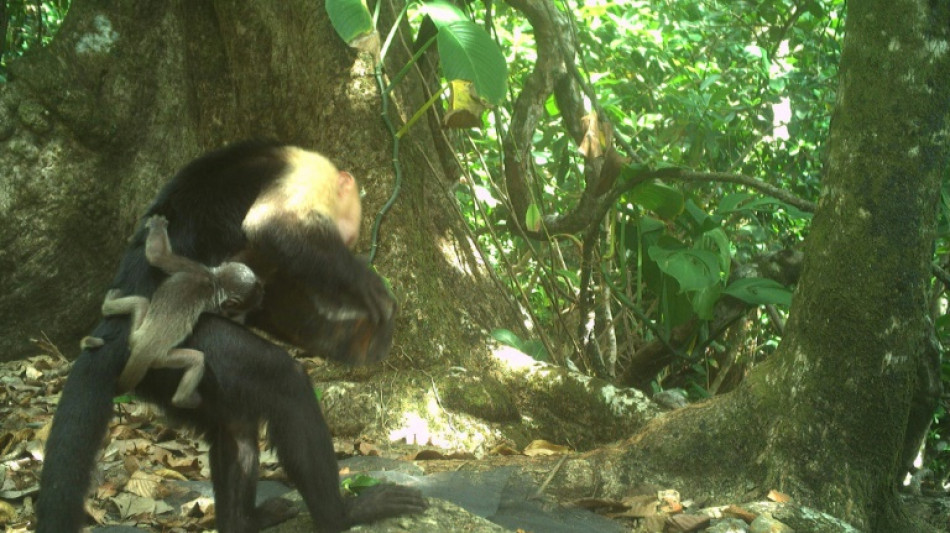
Monkeys kidnap babies of another species in weird 'fad' / Photo: Handout, Brendan Barrett - Max Planck Institute of Animal Behavior/AFP

 S.African women runners arm themselves after string of killings

 Indonesia fires threatens critically-endangered orangutan: IUCN

 Iran proposes Hormuz plan, Trump reportedly refuses

 El Nino rewrites the menu in the world's top restaurants

 Jay-Z rape accuser says she made 'false accusations'

 Trump's photo of Xi greeting carries signs of AI

 First US trial against TikTok to open Monday

 French literary prize removes novel from longlist after AI claims

 Trump accuser E. Jean Carroll finally has her damages

 Heavy fighting, internet disruption as Ethiopia conflict rages

 Asian markets mixed after oil gains

 UN approves resolution on dealing with rising sea levels

 Global stocks mostly fall as oil prices and bond yields rise

 Starbucks to close 250 more cafes in North America

 Stocks fall as oil prices rise and bonds back under pressure

 Top ECB official to resign to take up IMF role

 Eviction of pensioner puts Spain housing crisis in spotlight

 Average EU diesel price hits record 2.23 euros a litre: AFP analysis

 Whitetip Investments Marks 10 Years of Regulation, Transparency & Responsible Trading

 Stocks fall, oil prices rise as global bonds under pressure

 Hungary detects invasive spotted lanternfly for first time in EU

 Forex Expo Dubai 2026 Breaks Guinness World Record Again With 23,816 Attendees

 Asian markets fall on US-China jitters as leaders meet

 As Moscow steps up attacks, Kyiv residents brace for harsh winter

 Markets mixed as China's Xi arrives for US talks

A new trend is catching on among bored young male capuchins: kidnapping baby howler monkeys, in what scientists say is the first time animals have been recorded stealing another species' infants for no apparent reason.
PhD student Zoe Goldsborough first noticed something wrong in 2022 while sifting through footage captured by motion-triggered cameras on Jicaron, an island off the coast of Panama.
"I was very shocked" to see a white-faced capuchin monkey with a baby howler monkey on its back, Goldsborough, a researcher at Germany's Max Planck Institute of Animal Behaviour, told AFP.
The scientists nicknamed the capuchin Joker because the small scar at the side of its mouth reminded them of the "Batman" villain.
After reviewing more footage, they spotted Joker carrying four different howler monkey babies.
At first, they thought this was the "heartwarming story of a weird capuchin adopting these infants", said Goldsborough, the lead author of a new study in the journal Current Biology.
Then the scientists started finding other cases not involving Joker. They eventually observed five capuchins carrying 11 different howler infants over a 15-month period.
Then team then discovered footage of mournful howler monkey parents calling for their lost babies, showing that the infants had actually been abducted.
- A deadly trend -
The researchers were puzzled because the capuchins did not eat or prey on the babies, nor did they seem to enjoy playing with them.
Goldsborough said they eventually realised these abductions were a social tradition or "fad" among the island's young male capuchins.
It is the first time one species has been documented repeatedly abducting the infants of another due to the spread of such a tradition, study co-author Brendan Barrett told AFP.
The trend came with a high price: Four howler babies were observed to have died, but the researchers believe none survived.
Exactly how the capuchins manage to kidnap the babies remains a mystery.
The abduction likely takes place in the trees, and the cameras cover only the ground at the island's Coiba National Park.
"They're very successful at it, because they seem to even be able to get a one- or two-day-old infant off its mother," Goldsborough said.
The capuchins also do not suffer injuries, despite adult howler monkeys being three times their size.
Cultural fads spreading among animals is rare but not unheard of.
Barrett has previously studied capuchins in Costa Rica that suddenly started grooming porcupines, before growing bored of the trend.
And back in the 1980s, killer whales took to donning dead salmon on their heads off the northwestern US coast.
This trend returned decades later when orcas were again spotted wearing these "salmon hats" last year.
- 'Agents of chaos' -
The researchers started recording the capuchins in 2017 because they skilfully use stone tools to crack nuts and shellfish.
The capuchins have no predators and plenty of food on the island, leaving them a lot of free time to mess around.
"They're little exploratory agents of chaos," Barrett said.
While this extra time to experiment could result in socially learned traditions such as using tools, it could also lead to "seemingly arbitrary things" like stealing the howler infants, he said.
The study covered only abductions recorded until July 2023, but Goldsborough said there had been at least one more baby taken since, though they have not been through all the footage.
There might have been a drop in kidnappings simply because the capuchins have fewer babies to steal -- the island's howler monkeys are classified as endangered.
The researchers also want to study whether the normally docile howler monkeys will start becoming more fearful -- or aggressive -- towards the previously harmless capuchins.
P.Petrenko--CPN